


Carotid Intima-Media Thickness in Indian Patients With Non-alcoholic Fatty Liver Disease: A Systematic Review and a Meta-Analysis
- PMID: 39360047
- PMCID: PMC11445799
- DOI: 10.7759/cureus.68439
Carotid Intima-Media Thickness in Indian Patients With Non-alcoholic Fatty Liver Disease: A Systematic Review and a Meta-Analysis
Abstract
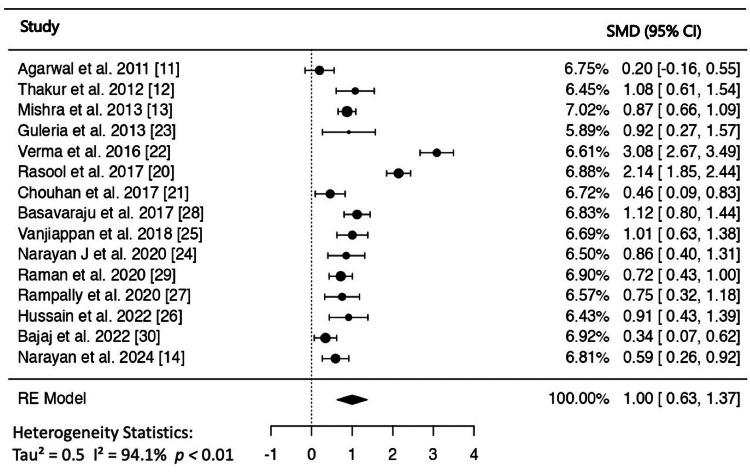
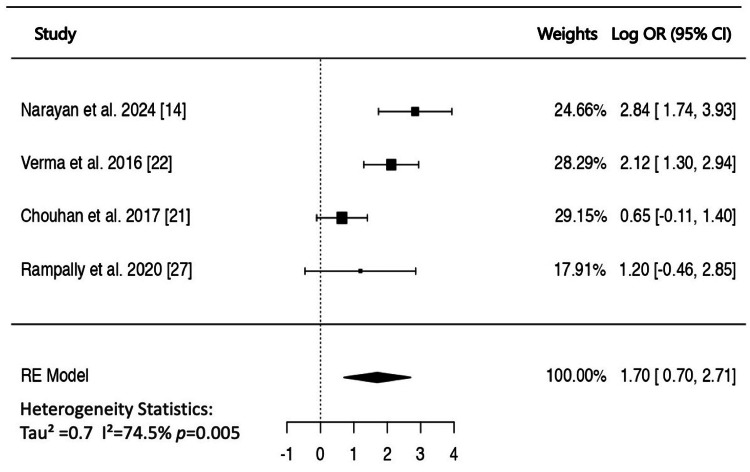
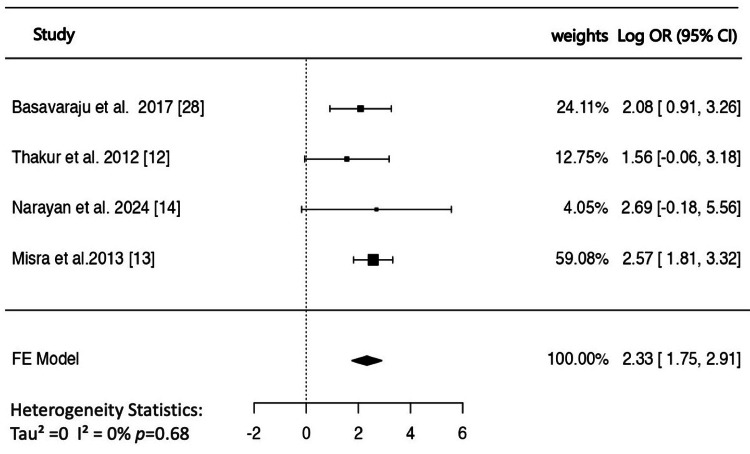
There is a significant association of non-alcoholic fatty liver disease (NAFLD) with cardiovascular disease (CVD). Most CVDs begin with atherosclerosis in the arteries, which can be reliably measured as the carotid intima-media thickness (CIMT) by ultrasound. Given that ethnic and regional differences have an impact on NAFLD, we aimed to evaluate the association of NAFLD patients from India with subclinical atherosclerosis, measured as CIMT. A thorough literature search was performed on four electronic databases using combinations of several keywords. The relevant data were pooled in a random or fixed-effect model, based on heterogeneity, to calculate the pooled standardised mean difference (SMD), or odds ratio (OR) with 95% confidence interval (CI). The final analysis included a total of 15 studies with 1196 NAFLD and 1482 control subjects. NAFLD patients had a 21.3% higher mean CIMT than the controls. The pooled SMD was 1.001 (95% CI: 0.627-1.375, p < 0.001). Three studies that balanced cardiometabolic risk factors found a similar association (p = 0.037). Furthermore, NAFLD was significantly associated with the presence of high (>0.8 mm) CIMT (pooled OR = 5.4, 95% CI: 2.0-14 .9) and carotid plaques (pooled OR = 10.24, 95% CI: 5.74-18.26). The mean CIMT was also higher in diabetic NAFLD than in the diabetic control (pooled SMD = 1.07, 95% CI = 0.818-1.324, p < 0.001). There is a significant positive association between the marker of subclinical atherosclerosis and NAFLD in India. This might give more light on screening and follow-up plans for such patients.
Keywords: atherosclerotic cardiovascular disease; carotid atherosclerosis; carotid intima-media thickness (cimt); from india; non-alcoholic fatty liver.
Copyright © 2024, Kumar et al.
Conflict of interest statement
Conflicts of interest: In compliance with the ICMJE uniform disclosure form, all authors declare the following: Payment/services info: All authors have declared that no financial support was received from any organization for the submitted work. Financial relationships: All authors have declared that they have no financial relationships at present or within the previous three years with any organizations that might have an interest in the submitted work. Other relationships: All authors have declared that there are no other relationships or activities that could appear to have influenced the submitted work.
Figures
References
-
- Global prevalence of nonalcoholic fatty liver disease: An updated meta-analysis on 78 million population over 38 countries. Amini-Salehi E, Letafatkar N, Norouzi N, et al. Arch Med Res. 2024;55:103043. - PubMed
-
- Global burden of adult non-alcoholic fatty liver disease (NAFLD) and non-alcoholic steatohepatitis (NASH) has been steadily increasing over the past decades and is expected to persist in the future. Dong X, Li JM, Lu XL, Lin XY, Hong MZ, Weng S, Pan JS. Transl Gastroenterol Hepatol. 2024;9:33. - PMC - PubMed
-
- Hard clinical outcomes in patients with NAFLD. Kumar R. Hepatol Int. 2013;7 Suppl 2:790–799. - PubMed
Publication types
LinkOut - more resources
Full Text Sources