


Harnessing the potency of scorpion venom-derived proteins: applications in cancer therapy
- PMID: 39361208
- PMCID: PMC11450130
- DOI: 10.1186/s40643-024-00805-0
Harnessing the potency of scorpion venom-derived proteins: applications in cancer therapy
Abstract
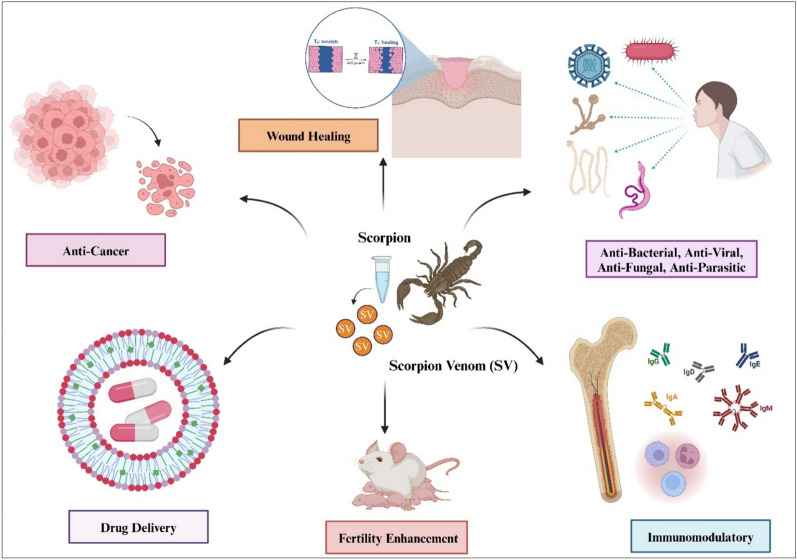
Despite breakthroughs in the development of cancer diagnosis and therapy, most current therapeutic approaches lack precise specificity and sensitivity, resulting in damage to healthy cells. Selective delivery of anti-cancer agents is thus an important goal of cancer therapy. Scorpion venom (SV) and/or body parts have been used since early civilizations for medicinal purposes, and in cultures, SV is still applied to the treatment of several diseases including cancer. SV contains numerous active micro and macromolecules with diverse pharmacological effects. These include potent anti-microbial, anti-viral, anti-inflammatory, and anti-cancer properties. This review focuses on the recent advances of SV-derived peptides as promising anti-cancer agents and their diagnostic and therapeutic potential applications in cancers such as glioma, breast cancer, prostate cancer, and colon cancer. Well-characterized SV-derived peptides are thus needed to serve as potent and selective adjuvant therapy for cancer, to significantly enhance the patients' survival and wellbeing.
Keywords: Anticancer agents; Cancer therapy; Drug development; Drug discovery; Peptide therapeutics; SV-derived peptides.
© 2024. The Author(s).
Conflict of interest statement
The authors have no financial or non-financial interest to disclose.
Figures
References
-
- Al-Asmari AK, Riyasdeen A, Abbasmanthiri R, Arshaduddin M, Al-Harthi FA (2016b) Scorpion (Androctonus bicolor) venom exhibits cytotoxicity and induces cell cycle arrest and apoptosis in breast and colorectal cancer cell lines. Indian J Pharmacol 48(5):537–543. 10.4103/0253-7613.190742 - DOI - PMC - PubMed
Publication types
LinkOut - more resources
Full Text Sources
