Review
. 2024 Nov 28;64(5):2400803.
doi: 10.1183/13993003.00803-2024. Print 2024 Nov.

Fungal lung disease

Affiliations
Review

Fungal lung disease

Tavleen Kaur Jaggi et al. Eur Respir J. .

Abstract

Fungal lung disease encompasses a wide spectrum of organisms and associated clinical conditions, presenting a significant global health challenge. The type and severity of disease are determined by underlying host immunity and infecting fungal strain. The most common group of diseases are associated with the filamentous fungus Aspergillus species and include allergic bronchopulmonary aspergillosis, sensitisation, aspergilloma and chronic and invasive pulmonary aspergillosis. Fungal lung disease remains epidemiologically heterogenous and is influenced by geography, environment and host comorbidities. Diagnostic modalities continue to evolve and now include novel molecular assays and biomarkers; however, persisting challenges include achieving rapid and accurate diagnosis, particularly in resource-limited settings, and in differentiating fungal infection from other pulmonary conditions. Treatment strategies for fungal lung diseases rely mainly on antifungal agents but the emergence of drug-resistant strains poses a substantial global threat and adds complexity to existing therapeutic challenges. Emerging antifungal agents and increasing insight into the lung mycobiome may offer fresh and personalised approaches to diagnosis and treatment. Innovative methodologies are required to mitigate drug resistance and the adverse effects of treatment. This state-of-the-art review describes the current landscape of fungal lung disease, highlighting key clinical insights, current challenges and emerging approaches for its diagnosis and treatment.


Conflict of interest statement

Conflict of interest: S.H. Chotirmall has served on advisory boards for CSL Behring, Pneumagen Ltd and Boehringer Ingelheim, on data safety monitoring boards for Inovio Pharmaceuticals and Imam Abdulrahman Bin Faisal University, and has received personal fees from AstraZeneca and Chiesi Farmaceutici, all unrelated to this work. The remaining authors have no potential conflicts of interest to disclose.

Figures
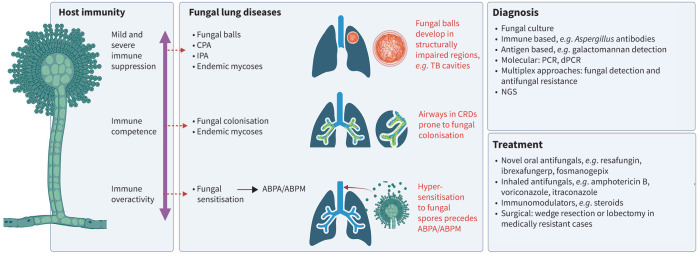
None
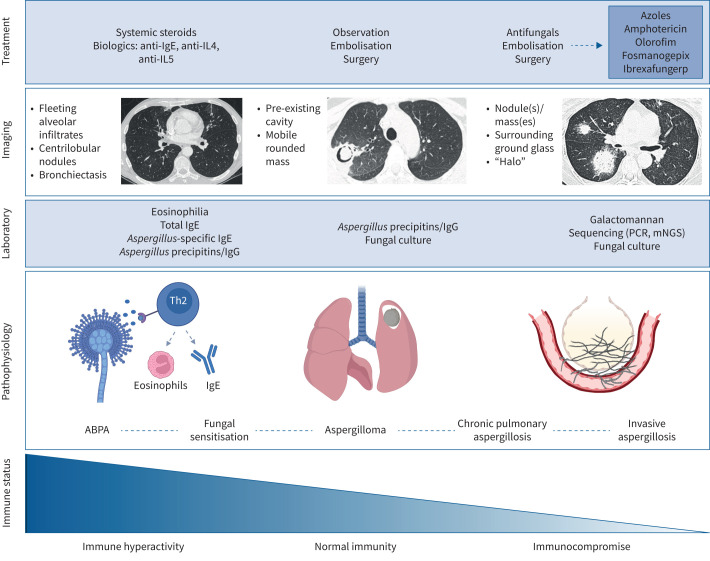
Relationship of fungal lung disease with host immunity, diagnosis and treatment options. CPA: chronic pulmonary aspergillosis; IPA: invasive pulmonary aspergillosis; ABPA: allergic bronchopulmonary aspergillosis; ABPM: allergic bronchopulmonary mycosis; TB: tuberculosis; CRD: chronic respiratory diseases; dPCR: digital PCR; NGS: next-generation sequencing. Figure created with Biorender.com.
FIGURE 1
FIGURE 1
Schematic overview of the clinical spectrum of Aspergillus-associated disease with accompanying relationship to host immune status, radiographic findings, diagnostics and treatment modalities. IL: interleukin; mNGS: metagenomic next-generation sequencing; ABPA: allergic bronchopulmonary aspergillosis; Th2: T-helper type 2. Figure created with Biorender.com.
FIGURE 2
FIGURE 2
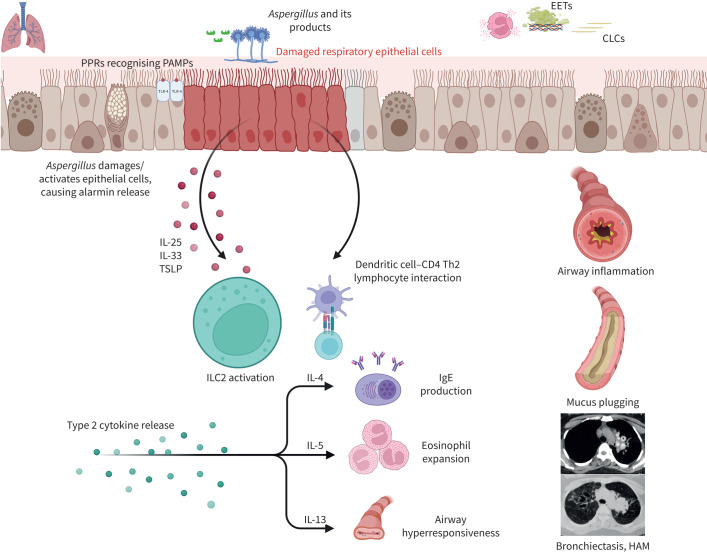
The key events in allergic bronchopulmonary aspergillosis (ABPA) pathogenesis include Aspergillus colonisation followed by skewed type-2 immune responses. Polymorphisms in airway epithelial receptors and innate and adaptive immune pathways prevent elimination of A. fumigatus and promote the development of an aberrant type-2 immune response. Pathogen-associated molecular patterns (PAMPs) from Aspergillus (glucan, galactomannan, galactosaminogalactan, proteases) are recognised by pattern recognition receptors (PRRs), including dectin-1 and toll-like receptors (TLRs), at the lung epithelial cell surface. Fungal proteases can damage the respiratory epithelium and result in release of alarmins (interleukin (IL)-33, IL-25 and thymic stromal lymphopoietin (TSLP)), which in turn stimulate the type 2 innate lymphoid cells (ILC2) and CD4+ type 2 lymphocytes. The dendritic cells also recognise fungal proteins and activate allergen-specific type 2 T-cells (Th2 cells). Eosinophils remain the primary mediators of inflammation in ABPA, with the interaction between eosinophils and A. fumigatus releasing galectin-10 and forming Charcot–Leyden crystals (CLCs). Subsequently, eosinophils undergo cell death forming histone-rich extracellular traps (EETs) and increase the viscosity of mucus plugs, which contribute to ABPA pathogenesis. The skewed type 2 responses lead to secretion of IL-4, IL-5 and IL-13. IL-4 mediates the class switching and production of IgE antibodies, which attach to mast cells and cause mast cell degranulation on allergen exposure. IL-5 is pivotal for eosinophil recruitment, maturation and survival and is central to eosinophilic inflammation. IL-13 from ILC2 and Th2 cells promotes mucus hypersecretion. Finally, immune activation leads to airway inflammation, mucus plugging and bronchiectasis. HAM: high-attenuation mucus. Figure created with Biorender.com.
FIGURE 3
FIGURE 3
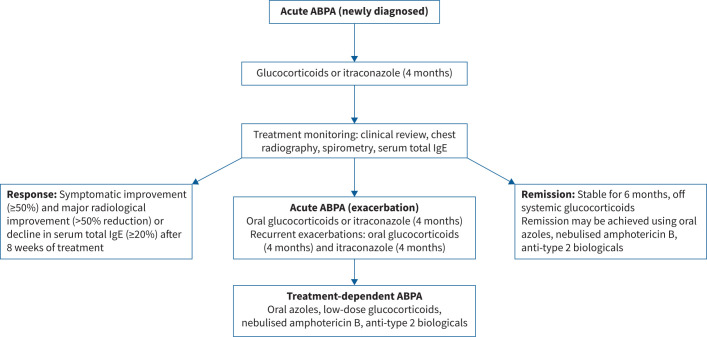
Treatment of various allergic bronchopulmonary aspergillosis (ABPA) categories as suggested by the International Society for Human and Animal Mycology-ABPA working group.
FIGURE 4
FIGURE 4
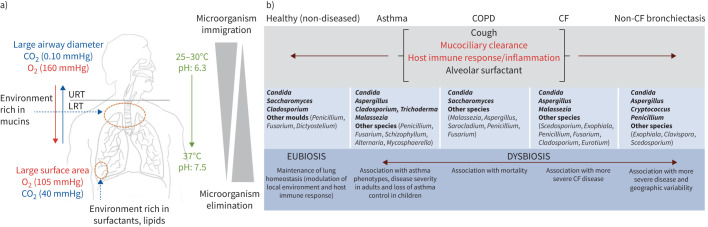
A summary of the homeostatic mechanisms to maintain the lung mycobiome in health and its composition and clinical correlates in chronic respiratory disease. a) Bidirectional flux from the oropharyngeal area, or upper respiratory tract (URT), to the lower respiratory tract (LRT) with biotic (bronchial epithelial cells, respiratory cilia, diameter and cell surface exchanges) and abiotic (temperature, pH, O2/CO2 pressures, airway mucus rich in mucins, a lipid-rich surfactant) factors maintaining a relatively low airway fungal biomass (the mycobiome). The mycobiome maintains a dynamic balance between fungal immigration, driven by inhalation, salivary micro-aspiration and mucosal dispersion, and elimination, driven by cough, mucociliary clearance, innate and adaptive host immune response and antimicrobial activity of alveolar surfactant. This constant dynamic of flux ensures the mycobiome is transient and mobile, with intimate links to the external environment. In health, the lung mycobiome is in a eubiotic state. b) By contrast, dysbiosis of the lung mycobiome occurs across several chronic respiratory diseases including asthma, COPD, cystic fibrosis (CF) and non-CF bronchiectasis. Mechanisms of microbial clearance are differentially impaired based on the pathophysiology of the underlying disease and indicated as normal (black text) to abnormal (red text). In diseased lungs, the mycobiome is more long-lasting and exhibits change, contributing to disease progression.

References

    1. Chotirmall SH, Bogaert D, Chalmers JD, et al. Therapeutic targeting of the respiratory microbiome. Am J Respir Crit Care Med 2022; 206: 535–544. doi: 10.1164/rccm.202112-2704PP - DOI - PMC - PubMed
    1. Mac Aogain M, Jaggi TK, Chotirmall SH. The airway microbiome: present and future applications. Arch Bronconeumol 2022; 58: 8–10. doi: 10.1016/j.arbres.2021.08.003 - DOI - PubMed
    1. Tiew PY, Mac Aogain M, Ter SK, et al. Respiratory mycoses in COPD and bronchiectasis. Mycopathologia 2021; 186: 623–638. doi: 10.1007/s11046-021-00539-z - DOI - PubMed
    1. Hong G, Miller HB, Allgood S, et al. Use of selective fungal culture media increases rates of detection of fungi in the respiratory tract of cystic fibrosis patients. J Clin Microbiol 2017; 55: 1122–1130. doi: 10.1128/JCM.02182-16 - DOI - PMC - PubMed
    1. Bafadhel M, McKenna S, Agbetile J, et al. Aspergillus fumigatus during stable state and exacerbations of COPD. Eur Respir J 2014; 43: 64–71. doi: 10.1183/09031936.00162912 - DOI - PubMed

MeSH terms

Substances