


Global 3D rocket launch and re-entry air pollutant and CO2 emissions at the onset of the megaconstellation era
- PMID: 39362884
- PMCID: PMC11450105
- DOI: 10.1038/s41597-024-03910-z
Global 3D rocket launch and re-entry air pollutant and CO2 emissions at the onset of the megaconstellation era
Abstract
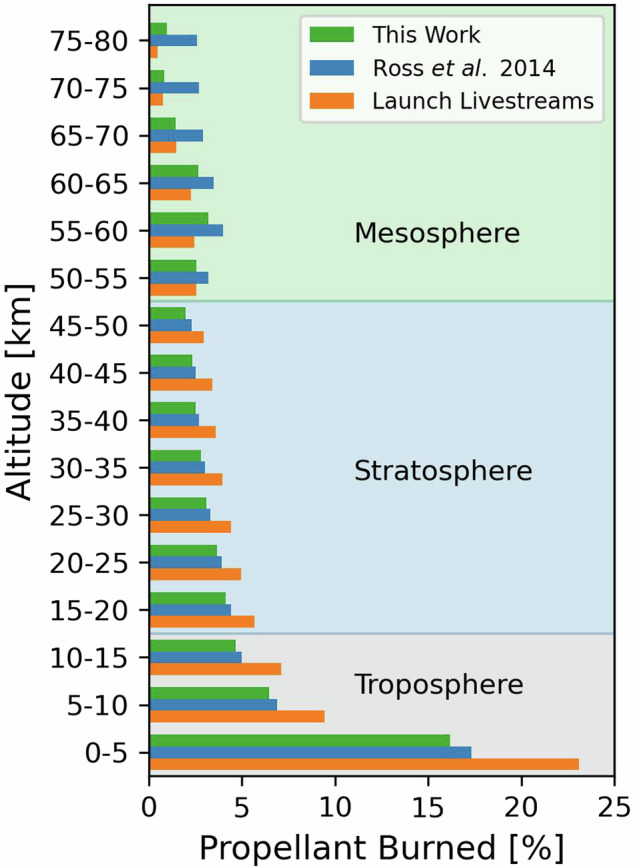
Satellite megaconstellation (SMC) missions are spurring rapid growth in rocket launches and anthropogenic re-entries. These events inject pollutants and carbon dioxide (CO2) in all atmospheric layers, affecting climate and stratospheric ozone. Quantification of these and other environmental impacts requires reliable inventories of emissions. We present a global, hourly, 3D, multi-year inventory of air pollutant emissions and CO2 from rocket launches and object re-entries spanning the inception and growth of SMCs (2020-2022). We use multiple reliable sources to compile information needed to build the inventory and conduct rigorous and innovative cross-checks and validations against launch livestreams and past studies. Our inventory accounts for rocket plume afterburning effects, applies object-specific ablation profiles to re-entering objects, and quantifies unablated mass of objects returning to Earth. We also identify all launches and objects associated with SMC missions, accounting for 37-41% of emissions of black carbon particles, carbon monoxide, and CO2 by 2022. The data are provided in formats for ease-of-use in atmospheric chemistry and climate models to inform regulation and space sustainability policies.
© 2024. The Author(s).
Conflict of interest statement
The authors declare no competing interests.
Figures


References
-
- McDowell, J. C. Satellite and Debris Population: Past Decade. Jonathan’s Space Reporthttps://planet4589.org/space/stats/acdec.html (2024).
-
- European Space Agency. DISCOSweb (Database and Information System Characterising Objects in Space). https://discosweb.esoc.esa.int/ (2024).
-
- Williams, A., Boley, A., Rotola, G. & Green, R. Sustainable skies and the Earth–space environment. Nat Sustain7, 228–231, 10.1038/s41893-024-01308-8 (2024).
-
- Gaston, K. J., Anderson, K., Shutler, J. D., Brewin, R. J. W. & Yan, X. Environmental impacts of increasing numbers of artificial space objects. Front Ecol Environ21, 289–296, 10.1002/fee.2624 (2023).
-
- European Space Agency. ESA Space Debris Mitigation Requirements. https://technology.esa.int/upload/media/DGHKMZ_6542582e18e33.pdf (2023).
Grants and funding
- 851854/EC | EU Framework Programme for Research and Innovation H2020 | H2020 Priority Excellent Science | H2020 European Research Council (H2020 Excellent Science - European Research Council)
- 851854/EC | EU Framework Programme for Research and Innovation H2020 | H2020 Priority Excellent Science | H2020 European Research Council (H2020 Excellent Science - European Research Council)
LinkOut - more resources
Full Text Sources
Miscellaneous
