. 2024 Oct 3;22(1):85.
doi: 10.1186/s12959-024-00657-w.

Lipoprotein apheresis: an established therapeutic modality for homozygous familial hypercholesterolemia patients refractory to PCSK9 inhibitors: a case report and literature review

Affiliations

Lipoprotein apheresis: an established therapeutic modality for homozygous familial hypercholesterolemia patients refractory to PCSK9 inhibitors: a case report and literature review

Mingjing Guan et al. Thromb J. .

Abstract

Homozygous familial hypercholesterolemia (HoFH), is a rare genetic disorder characterized by dual mutations in the low-density lipoprotein receptor (LDLR) gene, leading to dysfunctional or absent LDLRs, often accompanied by severe premature Atherosclerotic Cardiovascular Disease (ASCVD) and exhibiting refractoriness to aggressive pharmacological interventions. Double filtration plasmapheresis (DFPP), a form of lipoprotein apheresis (LA), has been effectively utilized as an adjunctive treatment modality to reduce serum LDL-C levels in refractory cases of HoFH. Here, we report a case of a 36-year-old female with HoFH who developed xanthomas on her limbs and waist at age 7. Despite maximum-tolerated doses of statins from age 32, combined with ezetimibe and evolocumab, her LDL-C levels remained critically elevated at 12-14 mmol/L. Her genetic testing confirmed a homozygous LDLR mutation. At 35 years old, she experienced exertional chest pain, and percutaneous coronary intervention revealed severe calcific left main stenosis, necessitating stent implantation. Subsequently, she initiated once every 1-2 months DFPP. Pre-DFPP, her LDL-C and total cholesterol (TC) levels were 13.82 ± 3.28 and 15.45 ± 0.78 mmol/L, respectively. Post-DFPP, her LDL-C and TC levels significantly decreased to 2.43 ± 0.33 mmol/L (81.76 ± 4.11% reduction) and 3.59 ± 0.41 mmol/L (76.76 ± 2.75% reduction), respectively. Lipoprotein (a) and triglycerides also decreased by 89.10 ± 1.39% and 42.29 ± 15.68%,respectively. Two years later, there was no progression of coronary artery disease, and her symptoms and xanthomas regressed significantly. Collectively, DFPP effectively reduces LDL-C levels in refractory cases of HoFH and contributes to delaying ASCVD progression, representing an efficacious adjunctive therapeutic modality.

Keywords: Double Filtration Plasmapheresis; Homozygous Familial Hypercholesterolemia; Lipoprotein Apheresis; Proprotein Convertase Subtilisin Kexin 9 Inhibitor.


Conflict of interest statement

The authors declare no competing interests.

Figures
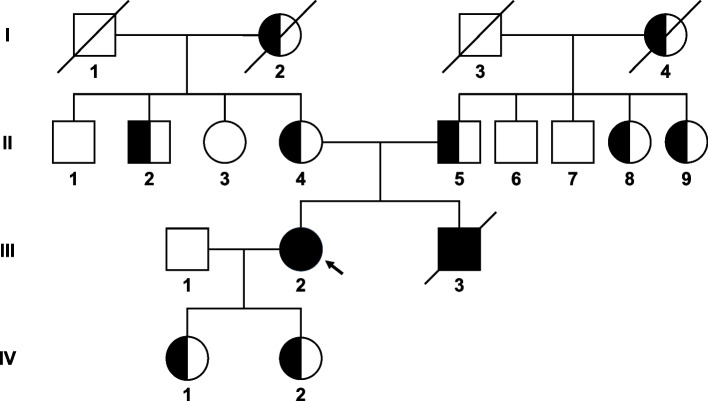
Fig. 1
Fig. 1
Pedigree of the present familial hypercholesterolemia family. The proband is indicated by an arrow. Squares indicate males; circles, females; slashes, deceased individuals; shaded (black) symbols, individuals with homozygous familial hypercholesterolemia; half-shaded (black) symbols, individuals with heterozygous familial hypercholesterolemia. I-2 and I-4 are full sisters
Fig. 2
Fig. 2
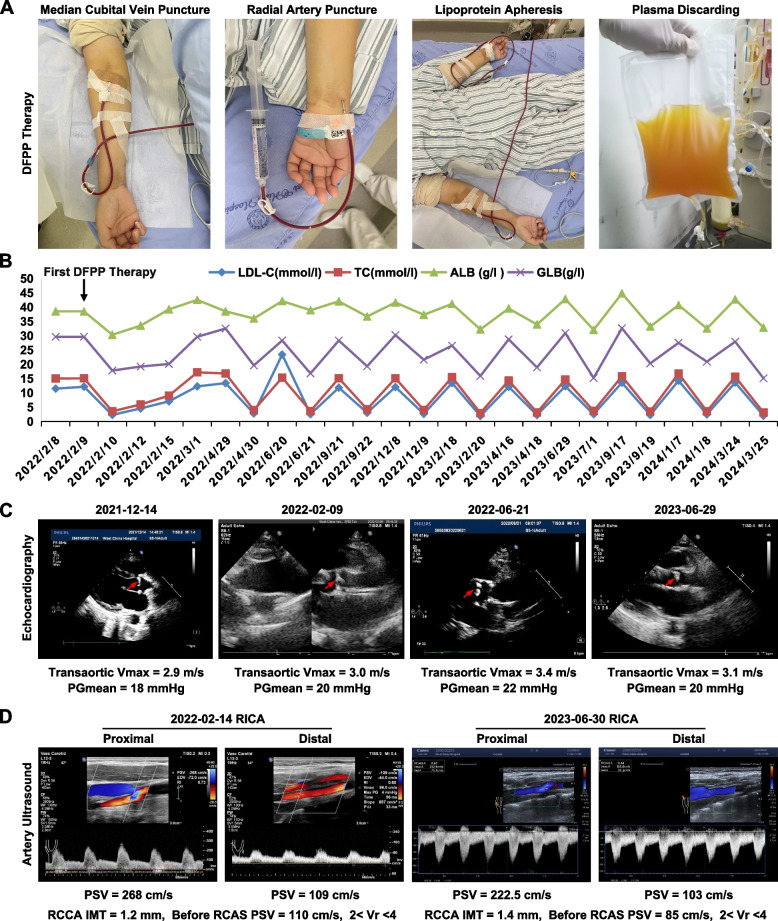
The clinical follow-up of the patient. A The direct puncture technique, procedure, and disposal of waste plasma during DFPP therapy. B Changes in low-density lipoprotein cholesterol(LDL-C, mmol/l), total cholesterol(TC, mmol/l), albumin(ALB, g/l), and globulin(GLB, g/l) levels pre and post DFPP therapy. C Echocardiography manifestations: The times of four examinations (2021–12-14 outpatient, 2022–02-09 first DFPP, and two follow-ups on 2022–06-21/2023–06-29) showed irregular thickening and calcification protruding into the lumen at the sinotubular junction of the aortic root, causing localized stenosis. Transaortic maximum velocity (Vmax) and mean paravalvular gradient (PGmean) were recorded for assessment, as transaortic Vmax was 2.9 m/s, PGmean was 18 mmHg (2021–12-14); transaortic Vmax was 3.0 m/s, PGmean was 20 mmHg (2022–02-09); transaortic Vmax was 3.4 m/s, PGmean was 22 mmHg(2022–06-21); transaortic Vmax was 3.1 m/s, PGmean was 20 mmHg(2023–06-29), respectively. D Carotid artery ultrasound manifestations: The times of the two examinations (the first DFPP on 2022–02-14, and a follow-up on 2023–06-30). The results showed moderate to severe stenosis at the origin of the right internal carotid artery (RICA). The peak systolic velocity (PSV) was recorded at the origin and distal end of the RICA, as well as the intima-media thickness (IMT) of the right common carotid artery (RCCA), and the PSV and Velocity Ratio (Vr) changes before the right common carotid artery stenosis (RCAS). The values were: RICA proximal was PSV 268 cm/s, RICA distal PSV was 109 cm/s, RCCA IMT was 1.2 mm, before RCAS PSV was 110 cm/s, 2 < Vr < 4 (2022–02-14) and RICA proximal PSV was 222.5 cm/s, RICA distal PSV was 103 cm/s, RCCA IMT was 1.4 mm, before RCAS PSV was 85 cm/s, 2 < Vr < 4 (2023–06-30)

References

    1. Khera AV, Won HH, Peloso GM, et al. Diagnostic yield and clinical utility of sequencing familial hypercholesterolemia genes in patients with severe hypercholesterolemia. J Am Coll Cardiol. 2016;67:2578–89. - DOI - PMC - PubMed
    1. Cuchel M, Bruckert E, Ginsberg HN, et al. Homozygous familial hypercholesterolaemia: new insights and guidance for clinicians to improve detection and clinical management. A position paper from the Consensus Panel on Familial Hypercholesterolaemia of the European Atherosclerosis Society. Eur Heart J. 2014;35:2146–57. - DOI - PMC - PubMed
    1. Sprecher DL, Schaefer EJ, Kent KM, et al. Cardiovascular features of homozygous familial hypercholesterolemia: analysis of 16 patients. Am J Cardiol. 1984;54:20–30. - DOI - PubMed
    1. Qamar A, et al. Interindividual variation in low-density lipoprotein cholesterol level reduction with evolocumab: An analysis of FOURIER trial data. JAMA Cardiol. 2019;4:59–63. - DOI - PMC - PubMed
    1. O’Donoghue ML, Giugliano RP, Wiviott SD, et al. Long-term evolocumab in patients with established atherosclerotic cardiovascular disease. Circulation. 2022;146:1109. - DOI - PubMed

LinkOut - more resources