


Strengthening nutrition policy and service delivery: Lessons learned from a six-country assessment of Alive and Thrive's technical assistance
- PMID: 39363438
- PMCID: PMC11956047
- DOI: 10.1111/mcn.13711
Strengthening nutrition policy and service delivery: Lessons learned from a six-country assessment of Alive and Thrive's technical assistance
Abstract
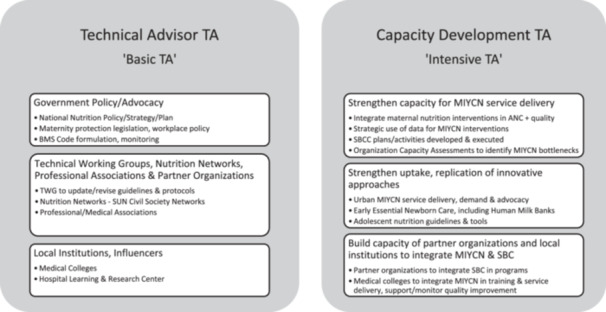
Alive & Thrive (A&T) provides strategic technical assistance (TA) to develop effective policies; improve maternal, infant, and young child nutrition (MIYCN) programme design and implementation and enhance system capacity to sustain quality MIYCN service delivery at scale. A qualitative assessment was conducted using document review and stakeholder interviews (n = 79) to describe a selection of A&T's TA in six countries and systematically assess the contextual and TA process-related factors that influenced the results achieved and document the lessons learned about MIYCN TA design and implementation. To facilitate the selection of different types of TA, we classified TA into two levels of stakeholder engagement and intensity. Under the Technical Advisor TA category, we assessed A&T's support to strengthen national policy formulation, monitoring, and implementation of the International Code of Marketing of Breast-milk Substitutes. For Capacity Development TA, we assessed A&T support to scale-up maternal nutrition services and to increase strategic use of data. Factors important for TA provision included identifying and engaging with the right people, using evidence to support advocacy and decision-making, using multiple ways to strengthen capacity, developing packages of tools to support programme scale-up, and reinforcing feedback mechanisms to improve service provision and data quality. Challenges included shifts in the political context, poorly functioning health systems, and limited resources to replicate or sustain the progress made. Continued investment in evidence-based and practical TA that strengthens the institutionalization of nutrition across all stakeholders-including government, medical associations, civil society and development partners-is essential. Future TA must support governments to strengthen system capacity for nutrition, including financial and human resource gaps that hamper full scale-up.
Keywords: capacity building; decision‐making; health services; maternal nutrition; nutrition policy; strategic use of data; technical assistance.
© 2024 The Author(s). Maternal & Child Nutrition published by John Wiley & Sons Ltd.
Conflict of interest statement
The authors declare no conflict of interest. Drs. Escobar‐DeMarco and Bose were members of the A&T assessment team but were not involved in implementation of any of the TA studied for this manuscript.
Figures
References
-
- Baker, P. , Hawkes, C. , Wingrove, K. , Demaio, A. R. , Parkhurst, J. , Thow, A. M. , & Walls, H. (2018). What drives political commitment for nutrition? A review and framework synthesis to inform the United Nations Decade of Action on Nutrition. BMJ Global Health, 3(1), e000485. 10.1136/bmjgh-2017-000485 - DOI - PMC - PubMed
-
- Bhutta, Z. A. , Akseer, N. , Keats, E. C. , Vaivada, T. , Baker, S. , Horton, S. E. , Katz, J. , Menon, P. , Piwoz, E. , Shekar, M. , Victora, C. , & Black, R. (2020). How countries can reduce child stunting at scale: Lessons from exemplar countries. The American Journal of Clinical Nutrition, 112(Suppl_2), 894S–904S. 10.1093/ajcn/nqaa153 - DOI - PMC - PubMed
MeSH terms
Grants and funding
LinkOut - more resources
Full Text Sources
Medical
