


Hospitalizations and emergency attendance averted by influenza vaccination in Victoria, Australia, 2017 - 2019
- PMID: 39363589
- PMCID: PMC11450505
- DOI: 10.1017/S0950268824001122
Hospitalizations and emergency attendance averted by influenza vaccination in Victoria, Australia, 2017 - 2019
Abstract
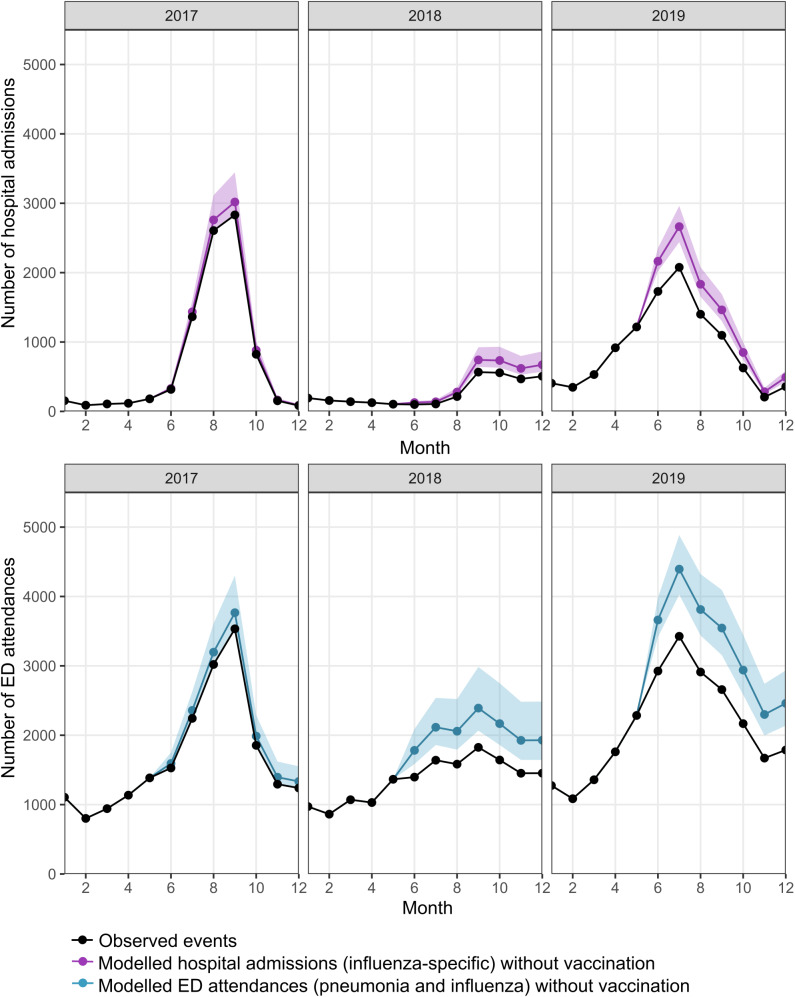
Seasonal influenza epidemics result in high levels of healthcare utilization. Vaccination is an effective strategy to reduce the influenza-related burden of disease. However, reporting vaccine effectiveness does not convey the population impacts of influenza vaccination. We aimed to calculate the burden of influenza-related hospitalizations and emergency department (ED) attendance averted by influenza vaccination in Victoria, Australia, from 2017 to 2019, and associated economic savings. We applied a compartmental model to hospitalizations and ED attendances with influenza-specific, and pneumonia and influenza (P&I) with the International Classification of Diseases, 10th Revision, Australian Modification (ICD-10-AM) diagnostic codes of J09-J11 and J09-J18, respectively. We estimated an annual average of 7657 (120 per 100000 population) hospitalizations and 20560 (322 per 100000 population) ED attendances over the study period, associated with A$85 million hospital expenditure. We estimated that influenza vaccination averted an annual average of 1182 [range: 556 - 2277] hospitalizations and 3286 [range: 1554 - 6257] ED attendances and reduced the demand for healthcare services at the influenza season peak. This equated to approximately A13 [range: A6 - A25] million of savings over the study period. Calculating the burden averted is feasible in Australia and auseful approach to demonstrate the health and economic benefits of influenza vaccination.
Keywords: epidemiology; influenza; prevention; vaccination (immunization); vaccine policy development.
Conflict of interest statement
C.G.A.P., A.K., S.N., M.R.R., and J.S. – nothing to declare. S.G.S. has received honoraria from CSL Seqirus, Moderna, Pfizer, and Evo Health. The WHO Collaborating Centre for Reference and Research on Influenza has a collaborative research and development agreement (CRADA) with CSL Seqirus for isolation of candidate vaccine viruses in cells and an agreement with IFPMA for isolation of candidate vaccine viruses in eggs.
Figures
References
-
- Machado A, Mazagatos C, Dijkstra F, Kislaya I, Gherasim A, McDonald SA, Kissling E, Valenciano M, Meijer A, Hooiveld M, Nunes B, Larrauri A. (2019) Impact of influenza vaccination programmes among the elderly population on primary care, Portugal, Spain and the Netherlands: 2015/16 to 2017/18 influenza seasons. Euro Surveillance 24(45), 1900268. 10.2807/1560-7917.Es.2019.24.45.1900268. - DOI - PMC - PubMed
