


Healthcare can't stop evolving: innovation as the catalyst for unleashing the managerial potential of value-based healthcare by stimulating intangible assets and enhancing organizational resilience
- PMID: 39364090
- PMCID: PMC11447451
- DOI: 10.3389/fpsyg.2024.1438029
Healthcare can't stop evolving: innovation as the catalyst for unleashing the managerial potential of value-based healthcare by stimulating intangible assets and enhancing organizational resilience
Abstract
Background: With increasing healthcare service utilization and the introduction of costly therapies, healthcare organizations are pressured to deliver cost-effective services within constrained budgets. Rising costs and the need for efficient healthcare delivery are major concerns for governments, insurers, and health plans.
Objectives: It aims to understand the impact of these intangible assets on creating value and organizational resilience in healthcare, informing better practices and strategies for VBHC implementation.
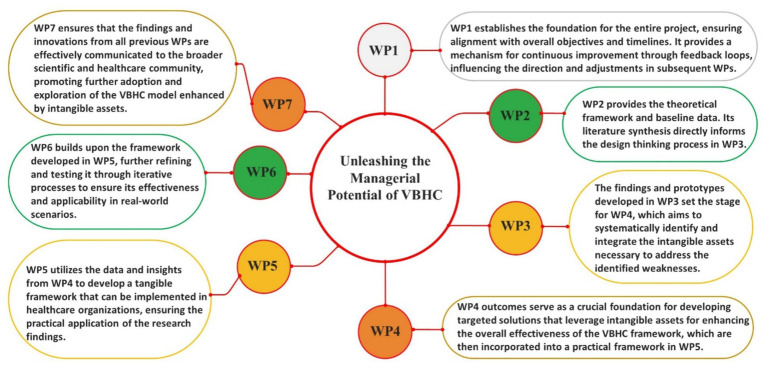
Methods: An applied research approach using the Work Breakdown Structure (WBS) methodology was adopted. The research was divided into seven interconnected Work Packages (WPs), each designed to investigate different aspects of the integration between VBHC and intangible assets, with a focus on enhancing organizational resilience through innovative health processes. Key methodologies included literature reviews and qualitative analyses, employing Open Innovation and Design Thinking.
Results: The study revealed a dynamic interplay between VBHC, organizational resilience, and intangible assets. It showed that managerial effectiveness is influenced by direct patient outcomes and elements like intellectual capital and organizational reputation. Data integration from various Work Packages provided new insights into how intangible assets underpin VBHC strategies, proposing novel management approaches. Findings highlight the essential role of intangible assets in enhancing service delivery and fostering sustainable healthcare practices.
Discussion: The study highlights a significant oversight in the integration of intangible assets within healthcare organizations, despite their crucial role in optimizing VBHC. It supports literature emphasizing the importance of intellectual capital and organizational culture in enhancing healthcare management efficiency and resilience. A paradigm shift in VBHC to include these assets is needed for building a more adaptable and sustainable healthcare system. This integration can lead to better clinical outcomes, patient satisfaction, and overall healthcare efficiency, aligning more closely with VBHC goals.
Conclusion: Recognizing and effectively managing intangible assets are paramount for the successful implementation of VBHC and enhanced organizational resilience. Strategic integration of these assets into healthcare management practices can significantly improve patient outcomes and create a more sustainable, patient-centered, and resilient healthcare system. Future studies should develop methodologies for robust measurement and integration of these assets to fully realize the potential of VBHC.
Keywords: applied research; healthcare innovation and quality; healthcare management; organizational resilience: intangible assets in healthcare; patient outcomes measurement; value-based health care; work break structure.
Copyright © 2024 Gaspary, Gerhardt, de Freitas Michelin, Lopes, Rosa and Siluk.
Conflict of interest statement
The authors declare that the research was conducted in the absence of any commercial or financial relationships that could be construed as a potential conflict of interest.
Figures
References
-
- Arnott R., Harvey C. R., Kalesnik V., Linnainmaa J. T. (2021). Reports of value’s death may be greatly exaggerated. Financ. Anal. J. 77, 44–67. doi: 10.1080/0015198X.2020.1842704 - DOI
-
- Baglioni E., Campling L., Hanlon G. (2021). Beyond rentiership: standardisation, intangibles and value capture in global production. Environ. Plan A Econ. Space 55, 1528–1547. doi: 10.1177/0308518X21997835 - DOI
-
- Baldi G., Bodmer A. (2017). Intangible investments and international business cycles. I Econ Econ Policy. 14, 211–219. doi: 10.1007/s10368-016-0339-1 - DOI
-
- Bana e Costa C. A. B., Ensslin L., Cornêa É. C., Vansnick J. C. (1999). Decision support systems in action: integrated application in a multicriteria decision aid process. Eur. J. Oper. Res. 113, 315–335. doi: 10.1016/S0377-2217(98)00219-7 - DOI
Publication types
LinkOut - more resources
Full Text Sources
