


Effects of food containing Lactococcus lactis strain T21 on the improvement of skin condition: a randomized, double-blind, placebo-controlled, parallel-group study
- PMID: 39364129
- PMCID: PMC11444856
- DOI: 10.12938/bmfh.2023-086
Effects of food containing Lactococcus lactis strain T21 on the improvement of skin condition: a randomized, double-blind, placebo-controlled, parallel-group study
Abstract
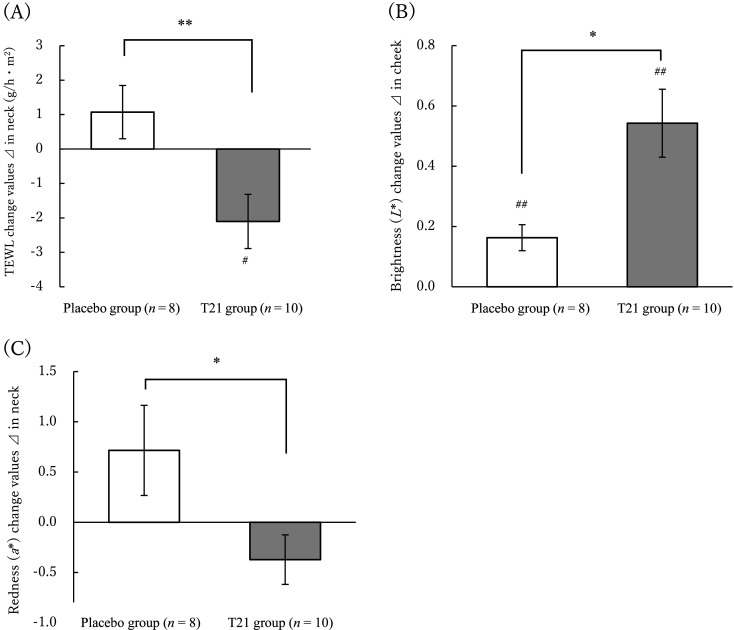
This research aimed to examine the effect of daily intake of food containing Lactococcus lactis strain T21 (T21) on skin conditions and inflammation-related markers in healthy adults who experience itching because of dry skin and have an atopic predisposition. A randomized, double-blind, placebo-controlled parallel-group study was conducted on 44 subjects aged 20 to 64 years. Subjects were randomly assigned to receive a T21-containing food or placebo daily for 8 weeks. The hydration of stratum corneum, trans-epidermal water loss, skin brightness (L*), skin redness (a*), and quality of life (QOL) scores were evaluated. Moreover, SCCA2, Th1/Th2, peripheral blood eosinophil count, TGF-β1, TARC, total IgE, and LDH were measured as inflammation-related markers. The results showed that, compared with the placebo, food containing T21 reduced trans-epidermal water loss in the neck and increased neck skin brightness (L*) after 8 weeks of consumption. Furthermore, a stratified analysis in subjects with a history of atopy showed improvements in neck skin redness (a*) and skin-related QOL. No significant improvement in inflammation-related markers was observed. Intake of food containing T21 for 8 weeks in healthy adult with atopic predisposition was suggested to improve skin barrier function in the neck and brightness in the neck skin. Furthermore, the results also suggested that it had the effect of improving rough skin and reducing discomfort due to dryness in healthy adults with a history of atopy.
Keywords: Lactococcus lactis strain T21; inflammation-related marker; lactic acid bacteria; quality of life; skin condition; trans-epidermal water loss.
©2024 BMFH Press.
Conflict of interest statement
Nissin Food Holdings Co., Ltd. provided the research funds and test foods (T21 and placebo) for this study, which was properly conducted by a third-party organization, EP Mediate Co., Ltd. Sumio Kondo at Fukushima Health Care Center was the principal investigator of this study; he has no conflicts of interest to disclose despite having performed commissioned work. There were no other conflicts of interest to be noted.
Figures


References
-
- Tanemono S, Sujino T, Kanai T. 2017. Relationship between intestinal flora and immunity. Jpn J Clin Immunol 40: 408–415.
-
- Izawa Y, Noma T, Yamamoto M, Kimura K, Ito H, Taketomo N, Numano K, Kawashima M. 2008. Verification of the effect of yogurt using LB81 lactobacillus on skin function improvement. Chonai Saikingaku Zasshi 22: 1–5.
-
- Yoshikawa K, Aota K, Takada Y, Nakamura T, Hoshino T, Yamashita S, Takara T. 2018. Effect of Lactobacillus brevis SBC8803 (SBL88TM lactobacillus) intake on improving sleep quality—a randomized, placebo-controlled, double-blind, parallel-group study. Jpn Pharmacol Ther 46: 1723–1738.
-
- Nakagawa K, Koda T, Hamada K, Sugaya T, Saito T. 2020. Application of Lactobacillus B240 as a conditioning food for mucosal immune support and anti-infective effect. J Nutr Sci Vitaminol (Tokyo) 73: 55–60.
-
- Suzuki H. 2015. Effects of consumption of a beverage containing Lactococcus lactis subsp. lactis JCM5805 on antiviral immune response and maintenance of physical condition—a placebo-controlled, randomized, double-blind, parallel-group comparison study—. Jpn Pharmacol Ther 43: 1465–1472.
