


Safety and efficacy of PCSK9 inhibitors and effect on coronary plaque phenotype in statin-treated patients following acute coronary syndrome: a systematic review and meta-analysis
- PMID: 39365518
- PMCID: PMC11452574
- DOI: 10.1186/s43044-024-00567-2
Safety and efficacy of PCSK9 inhibitors and effect on coronary plaque phenotype in statin-treated patients following acute coronary syndrome: a systematic review and meta-analysis
Abstract
Background: Acute coronary syndrome continues to be a significant cardiovascular issue. Statins are commonly acknowledged as medications that reduce LDL-C levels and stabilize plaques. Nevertheless, their efficacy is limited. Presently, PCSK9 inhibitors are suggested to be advantageous in patients who are already receiving statin treatment. The study seeks to assess the safety and effectiveness of PCSK9 inhibitors in individuals who have been treated with statins after experiencing acute coronary syndrome (ACS), as well as investigate the impact on the characteristics of coronary plaque.
Methods: Articles were identified from PubMed, Cochrane Central Register of Controlled Trials, and ProQuest. Our analysis comprised trials and observational studies that compared the plaque phenotype, lipid profile, and safety outcomes between PCSK9 inhibitors and a control group in patients with acute coronary syndrome who were already being treated with statins. The random-effect model was used to measure the pooled effect, which was presented in terms of mean difference, standardized mean difference, and risk ratio.
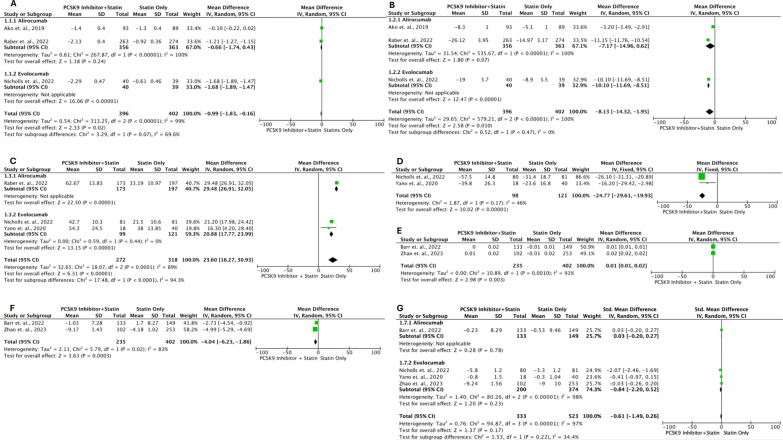
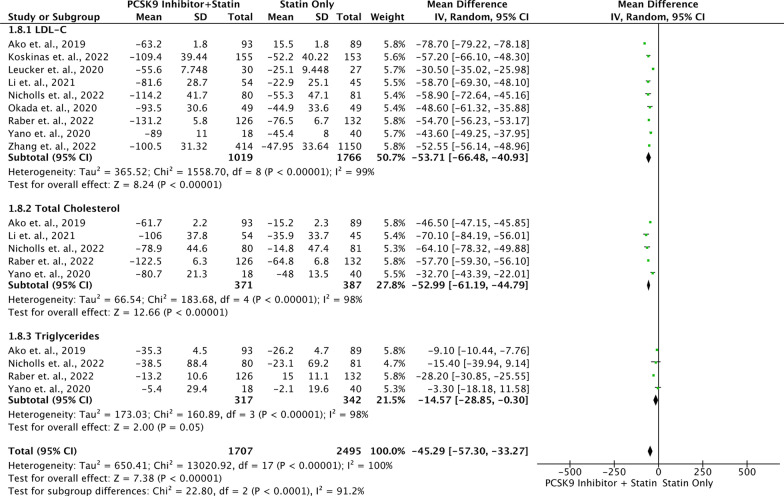
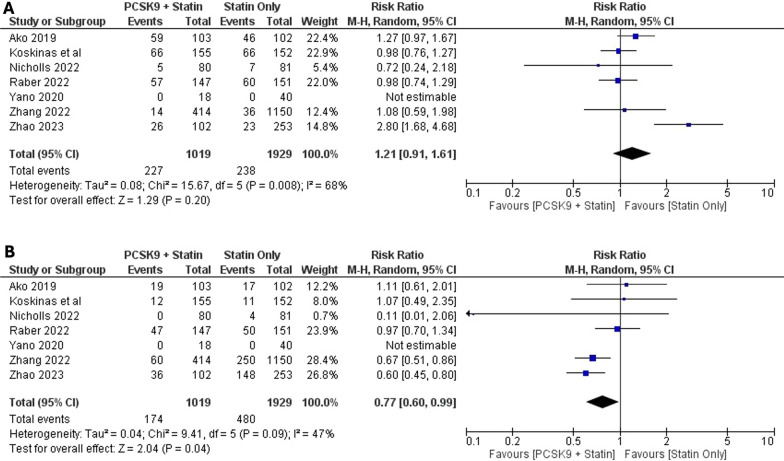
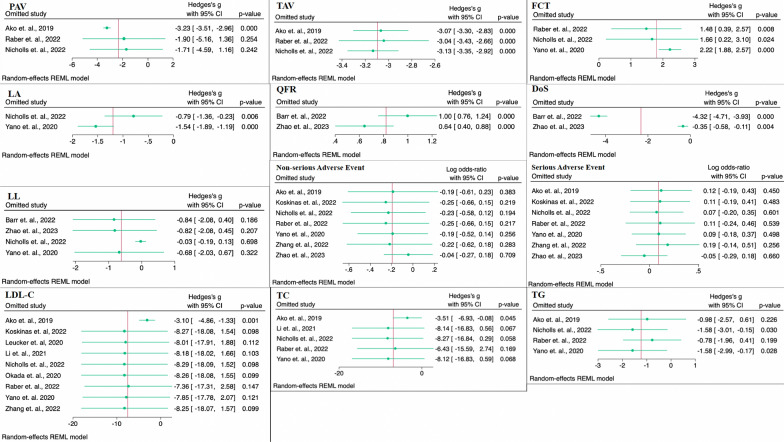
Results: Acquired 12 studies that fulfilled our criteria. The addition of PCSK9 inhibitors ameliorates the plaque phenotype significantly in terms of percent atheroma volume (P = 0.02), total atheroma volume (P < 0.010), fibrous cap thickness (P < 0.00001), lipid arc (P < 0.00001), quantitative flow ratio (P = 0.003), and diameter of stenosis (P = 0.0003) but not in lipid/lesion length (P = 0.17). The administration of PCSK9 inhibitors led to a considerable improvement in all lipid profiles (P < 0.00001). Regarding safety analysis, there is no substantial disparity in the likelihood of non-serious side events (RR 1.21; P = 0.2), however, a significant reduction in the risk of serious adverse effects (RR 0.77; P = 0.04) in the PCSK9 inhibitor group.
Conclusions: The addition of PCSK9 inhibitors compared to statin-only treatment led to a majority of patients experiencing significant benefits in terms of safety and efficacy following ACS.
Keywords: Acute coronary syndrome; Atherosclerosis; LDL-C; Proprotein convertase subtilisin/kexin type 9; Statin.
© 2024. The Author(s).
Conflict of interest statement
All authors and contributors (DIH, FRQ, MY, NA, IP, AMA) to the study declare no conflict of interest.
Figures
References
-
- Indonesian Heart Association. Management Guideline of Acute Coronary Syndrome “Pedoman Tata Laksana Sindrom Koroner Akut.” Fourth Edition. Jakarta: Jurnal Kardiologi Indonesia; 2018. 1–76 p
-
- Virani SS, Alonso A, Aparicio HJ, Benjamin EJ, Bittencourt MS, Callaway CW, et al (2021) Heart Disease and Stroke Statistics - Update: A Report From the American Heart Association. Circulation. Lippincott Williams and Wilkins; 143. E254–743. - PubMed
-
- Maggioni AA, Maseri A, Fresco C, Franzosi MG, Mauri F, Santoro E et al (1993) Age-related increase in mortality among patients with first myocardial infarctions treated with thrombolysis. N Engl J Med 329(20):1442–1448 - PubMed
-
- Koskinas KC, Siontis GCM, Piccolo R, Mavridis D, Räber L, Mach F et al (2018) Effect of statins and non-statin LDL-lowering medications on cardiovascular outcomes in secondary prevention: a meta-analysis of randomized trials. Eur Heart J 39(14):1172–1180 - PubMed
Publication types
LinkOut - more resources
Full Text Sources
Miscellaneous