Meta-Analysis
. 2024 Oct 4;15(1):8629.
doi: 10.1038/s41467-024-52129-4.

Multi-ancestry GWAS meta-analyses of lung cancer reveal susceptibility loci and elucidate smoking-independent genetic risk

Affiliations
Meta-Analysis

Multi-ancestry GWAS meta-analyses of lung cancer reveal susceptibility loci and elucidate smoking-independent genetic risk

Bryan R Gorman et al. Nat Commun. .

Abstract

Lung cancer remains the leading cause of cancer mortality, despite declining smoking rates. Previous lung cancer GWAS have identified numerous loci, but separating the genetic risks of lung cancer and smoking behavioral susceptibility remains challenging. Here, we perform multi-ancestry GWAS meta-analyses of lung cancer using the Million Veteran Program cohort (approximately 95% male cases) and a previous study of European-ancestry individuals, jointly comprising 42,102 cases and 181,270 controls, followed by replication in an independent cohort of 19,404 cases and 17,378 controls. We then carry out conditional meta-analyses on cigarettes per day and identify two novel, replicated loci, including the 19p13.11 pleiotropic cancer locus in squamous cell lung carcinoma. Overall, we report twelve novel risk loci for overall lung cancer, lung adenocarcinoma, and squamous cell lung carcinoma, nine of which are externally replicated. Finally, we perform PheWAS on polygenic risk scores for lung cancer, with and without conditioning on smoking. The unconditioned lung cancer polygenic risk score is associated with smoking status in controls, illustrating a reduced predictive utility in non-smokers. Additionally, our polygenic risk score demonstrates smoking-independent pleiotropy of lung cancer risk across neoplasms and metabolic traits.


Conflict of interest statement

S.-G.J. is an employee and shareholder of BridgeBio Pharma, unrelated to the present work. The other authors declare no competing interests.

Figures
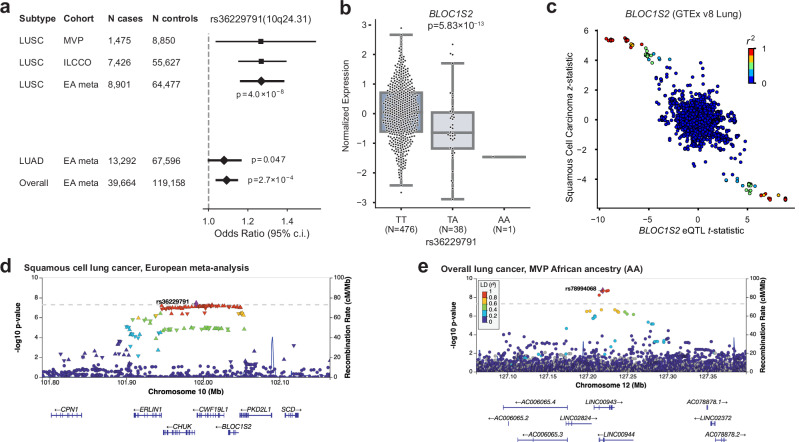
Fig. 1
Fig. 1. Highlighted novel GWAS loci.
ad GWAS of squamous cell lung carcinoma (LUSC) in European ancestry (EA) meta-analysis identifies a novel locus at 10q24.31. a Odds ratios and 95% confidence intervals for rs36229791 in LUSC compared to lung adenocarcinoma (LUAD) and overall lung cancer. Inset p-values were obtained from a fixed-effect inverse variance-weighted meta-analysis. b BLOC1S2 expression varies by genotype at rs36229791 in GTEx v8 Lung tissue samples. t-test was utilized and a two-sided p-value is shown. The center box plot line represents the median (50th percentile). The box edges are the 25th and 75th percentiles (interquartile range; IQR). Whiskers extend to the smallest and largest values within 1.5 times the IQR. Source data are provided as a Source Data file. c BLOC1S2 eQTL t-statistic vs LUSC z-statistic. d Regional association plot showing SNP significance and genes around lead SNP rs36229791. Association p-values were obtained from a fixed-effect inverse variance-weighted meta-analysis. The dashed line marks the threshold for genome-wide significance (P = 5 × 10–8). Source data are provided as a Source Data file. e The African ancestry GWAS highlights a putatively novel locus on chr12 at LINC00944. The risk allele has effectively 0% frequency in EA. Association p-values were obtained from a two-sided test of the z-statistic, calculated using logistic regression. The dashed line marks the threshold for genome-wide significance (P = 5 × 10–8).
Fig. 2
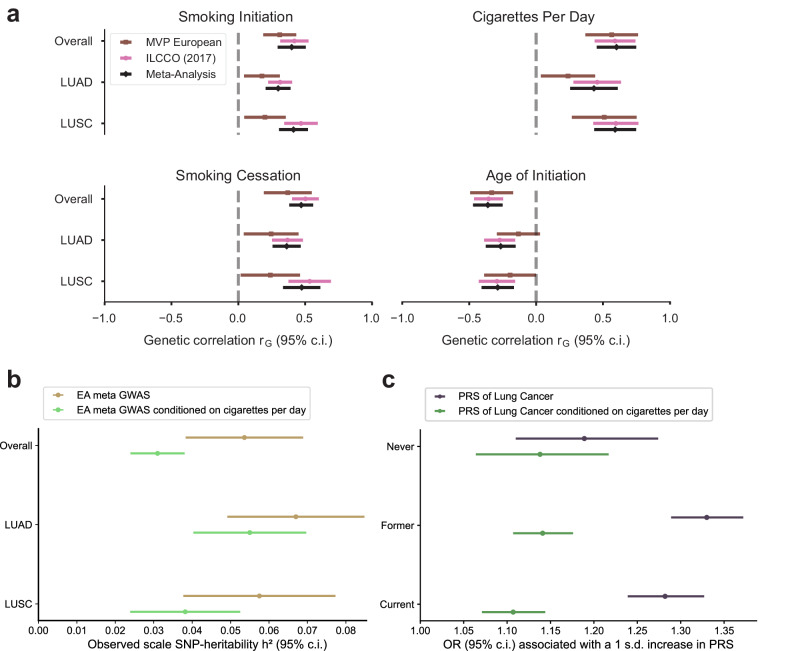
Fig. 2. Association of lung cancer GWAS with smoking behaviors.
a Genetic correlations between the lung cancer GWAS and smoking behaviors, including smoking initiation, cigarettes per day, smoking cessation, and age of initiation. Error bands represent the 95% confidence interval of the genetic correlation point estimates. b SNP heritability for the meta-analysis and conditional meta-analysis. The heritability decreases in the conditional analysis for overall lung cancer as well as both subtypes, suggesting that some portion of the heritability of lung cancer is due to smoking behavior. Error bands represent the 95% confidence interval of the SNP-heritability point estimates. c Polygenic risk scores (PRS) based on standard lung cancer GWAS (blue) perform worse in never-smokers than former or current smokers, while conditioning on smoking behavior (orange) results in similar performance. Error bands represent the 95% confidence interval of the odds ratio (OR) associated with a one standard deviation increase in PRS.
Fig. 3
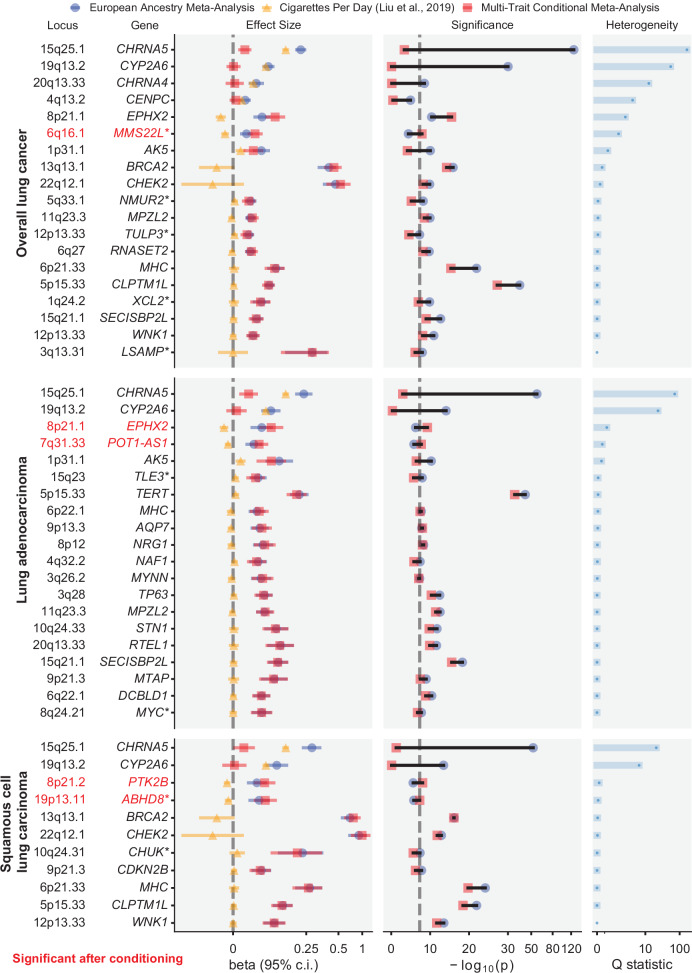
Fig. 3. Forest plot of genome-wide significant associations.
Within each cancer subtype, changes in effect size and significance are shown before and after conditioning on cigarettes per day in the European meta-analysis cohort. Novel loci are indicated by an asterisk after the gene name (*). Loci that became significant after conditioning (P < 5 × 10−8) are in red. Ncases = 39,664; Ncontrols = 119,158. Association p-values were obtained from fixed-effect inverse variance-weighted meta-analysis of MVP European and ILCCO cohorts. The dashed line in −log10(p) marks the threshold for genome-wide significance (P = 5 × 10–8).
Fig. 4
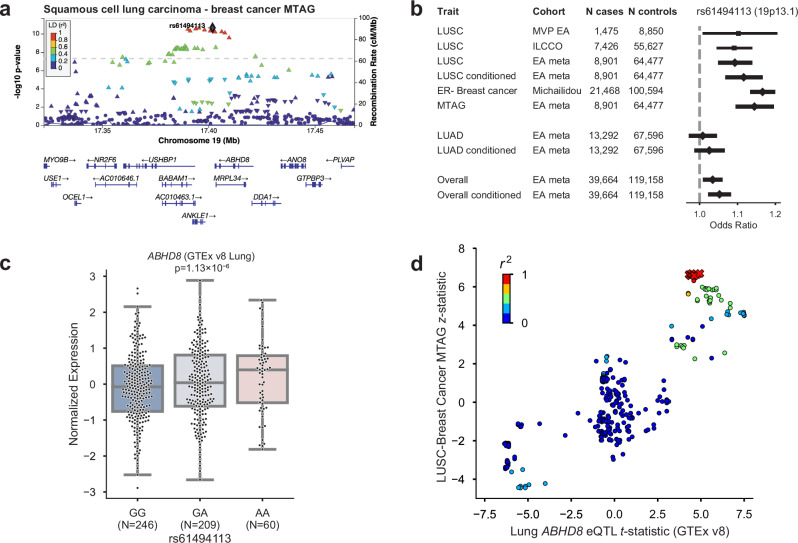
Fig. 4. Significant locus after conditioning on smoking behavior, 19p13.11, has pleiotropic associations with ER-negative breast cancer.
a Regional association plot of the 19p13.11 multi-trait analysis of GWAS (MTAG) locus. P-values are derived from the two-tailed MTAG test. The dashed line marks the threshold for genome-wide significance (P = 5 × 10–8). b Odds ratios and 95% confidence intervals for lead SNP rs61494113 in squamous cell lung carcinoma (LUSC), before and after conditioning on cigarettes per day, compared to lung adenocarcinoma, overall lung cancer, and MTAG analysis with estrogen receptor-negative (ER−) breast cancer. c ABHD8 expression varies by genotype at rs61494113 in GTEx v8 Lung tissue samples. t-test was utilized and a two-sided p-value is shown. The center box plot line represents the median (50th percentile). The box edges are the 25th and 75th percentiles (interquartile range; IQR). Whiskers extend to the smallest and largest values within 1.5 times the IQR. Source data are provided as a Source Data file. d ABHD8 eQTL t-statistic vs LUSC z-statistic; red X’s indicate the 95% credible set. Source data are provided as a Source Data file.
Fig. 5
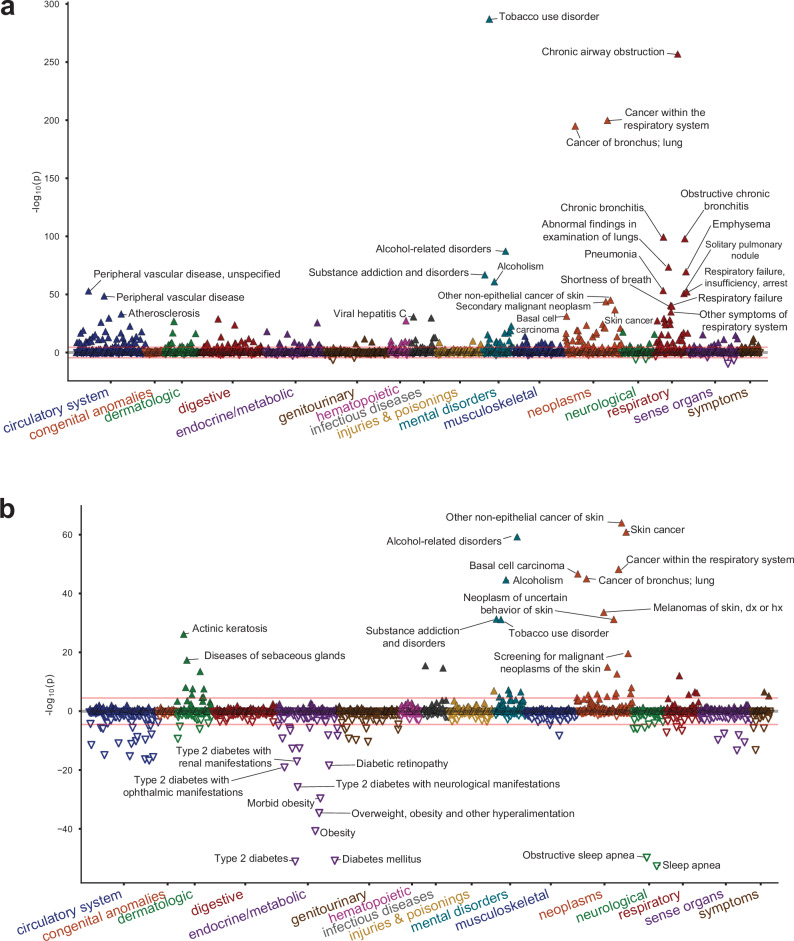
Fig. 5. Phenome-wide association study (PheWAS) of polygenic risk scores (PRS) of lung cancer and lung cancer conditioned on cigarettes per day.
a PheWAS of PRS on lung cancer is mostly confounded with smoking associations. b PheWAS of the conditional meta-analysis PRS shows associations with skin cancer and metabolic traits. Association p-values were obtained from a two-sided test of the z-statistic, calculated using logistic regression. The red line in each plot indicates Bonferroni-corrected significance (P = 2.8 × 10–5).

References

    1. Schabath, M. B. & Cote, M. L. Cancer progress and priorities: lung cancer. Cancer Epidemiol. Biomark. Prev.28, 1563–1579 (2019). - DOI - PMC - PubMed
    1. Leiter, A., Veluswamy, R. R. & Wisnivesky, J. P. The global burden of lung cancer: current status and future trends. Nat. Rev. Clin. Oncol.20, 624–639 (2023). - DOI - PubMed
    1. Sung, H. et al. Global Cancer Statistics 2020: GLOBOCAN estimates of incidence and mortality worldwide for 36 cancers in 185 countries. CA Cancer J. Clin.71, 209–249 (2021). - DOI - PubMed
    1. Siegel, R. L., Miller, K. D., Fuchs, H. E. & Jemal, A. Cancer statistics, 2022. CA Cancer J. Clin.72, 7–33 (2022). - DOI - PubMed
    1. Bossé, Y. & Amos, C. I. A decade of GWAS results in lung cancer. Cancer Epidemiol. Biomark. Prev.27, 363–379 (2018). - DOI - PMC - PubMed

Publication types

LinkOut - more resources