Efficacy and Tollerability of INI-Based 2-Drug Regimen in Virosuppressed Persons Living with HIV: A Systematic Review and Meta-Analysis
- PMID: 39370125
- PMCID: PMC11458504
- DOI: 10.3947/ic.2024.0066
Efficacy and Tollerability of INI-Based 2-Drug Regimen in Virosuppressed Persons Living with HIV: A Systematic Review and Meta-Analysis
Abstract
Background: The aim of this meta-analysis was to synthesize the available evidence from the literature on the efficacy and safety of integrase inhibitor-based two drug regimens compared to triple drug regimens in virosuppressed people living with HIV (PLWH) in a long-term follow-up (at 96 weeks).
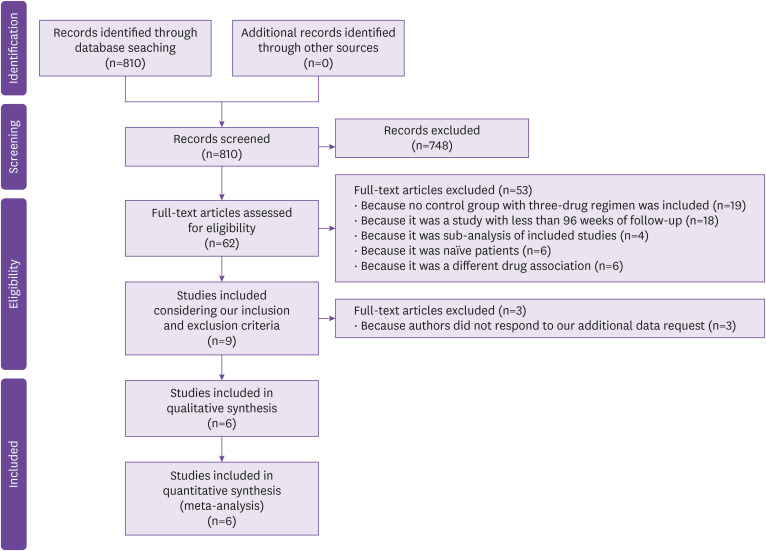
Materials and methods: A systematic review and meta-analysis were conducted to evaluate the efficacy, safety, and adverse drug reactions leading to discontinuation of two drug regimens compared to triple drug regimens in virosuppressed PLWH patients at 96 weeks of follow-up. We searched MEDLINE, Google Scholar, and the Cochrane Library up to March 15, 2024, and studies were selected for eligibility based on predefined criteria. Data were extracted independently by two reviewers, and risk ratios (RRs) were calculated as the measure of association between therapy and incidence of events.
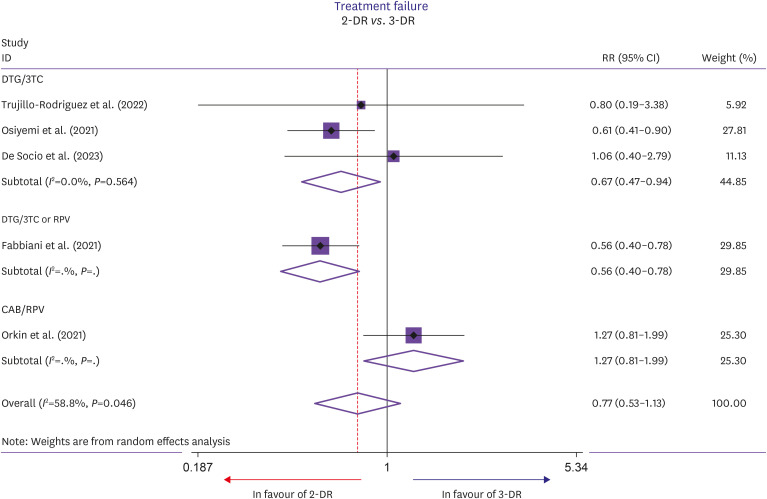
Results: Six studies were included in the analysis, both clinical trials and observational studies. The two drug regimens included cabotegravir/rilpivirine, dolutegravir/lamivudine, and dolutegravir/rilpivirine. No significant differences were observed in treatment failure (RR, 0.77; 95% confidence interval [CI], 0.53-1.13; P=0.182), virological failure (RR, 0.79; 95% CI, 0.48-1.29; P=0.341), adverse drug reactions leading to discontinuation (RR, 1.74; 95% CI, 0.73-4.17; P=0.215), or appearance of mutation (RR, 2.48; 95% CI, 0.33-18.68; P=0.379) between two drug regimen and triple drug regimen groups at 96 weeks of follow up.
Conclusion: The meta-analysis provide an overview of the available evidence and supports the use of two drug regimens as an option for simplifying treatment and improving clinical outcomes in virosuppressed PLWH.
Keywords: Efficacy; HIV; Meta-analysis; Two drug regimens; Virosuppressed.
© 2024 by The Korean Society of Infectious Diseases, Korean Society for Antimicrobial Therapy, The Korean Society for AIDS, and Korean Society of Pediatric Infectious Diseases.
Conflict of interest statement
No conflict of interest.
Figures
References
-
- Moreno S, Perno CF, Mallon PW, Behrens G, Corbeau P, Routy JP, Darcis G. Two-drug vs. three-drug combinations for HIV-1: Do we have enough data to make the switch? HIV Med. 2019;20(Suppl 4):2–12. - PubMed
-
- Hidalgo-Tenorio C, Pasquau J, Vinuesa D, Ferra S, Terrón A, SanJoaquín I, Payeras A, Martínez OJ, López-Ruz MÁ, Omar M, de la Torre-Lima J, López-Lirola A, Palomares J, Blanco JR, Montero M, García-Vallecillos C. DOLAVI real-life study of dolutegravir plus lamivudine in naive HIV-1 patients (48 weeks) Viruses. 2022;14:524. - PMC - PubMed
-
- Pisaturo M, Onorato L, Russo A, Martini S, Chiodini P, Signoriello S, Maggi P, Coppola N. Risk of failure in dual therapy versus triple therapy in naïve HIV patients: a systematic review and meta-analysis. Clin Microbiol Infect. 2021;27:28–35. - PubMed
-
- Achhra AC, Mwasakifwa G, Amin J, Boyd MA. Efficacy and safety of contemporary dual-drug antiretroviral regimens as first-line treatment or as a simplification strategy: a systematic review and meta-analysis. Lancet HIV. 2016;3:e351–e360. - PubMed