


Development of a Simple Patient-reported Outcome Measurement for Terminally Ill Cancer Patients Receiving Home-based Palliative Care
- PMID: 39371503
- PMCID: PMC11450855
- DOI: 10.25259/IJPC_100_2024
Development of a Simple Patient-reported Outcome Measurement for Terminally Ill Cancer Patients Receiving Home-based Palliative Care
Abstract
Objective: To develop a patient-reported outcome measurement for terminally ill cancer patients (PROMs-TCP) receiving home-based palliative care, which is valid, reliable and easy to use by patients or caregivers to indicate urgent needs for assistance from the care team.
Materials and methods: Three-step approach consisting of literature review, focus groups and questionnaire testing. 169 terminally ill cancer patients who received palliative care at Cancer hospital, tertiary-care hospital and university school of medicine in Thailand. The PROMs-TCP comprised five key questions with a total score of 10 and one supplemental question. PROMs-TCP was tested for content validity, internal consistency and inter-rater reliability, criterion validity, discriminant validity and sensitivity to change. The palliative care outcome scale (POS) was used as an indicator.
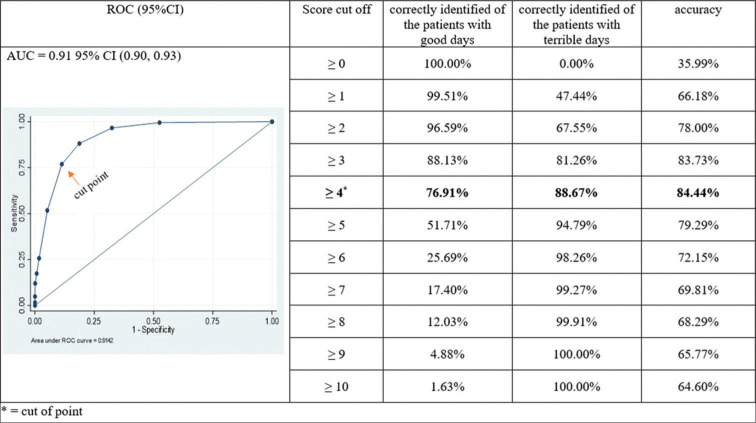
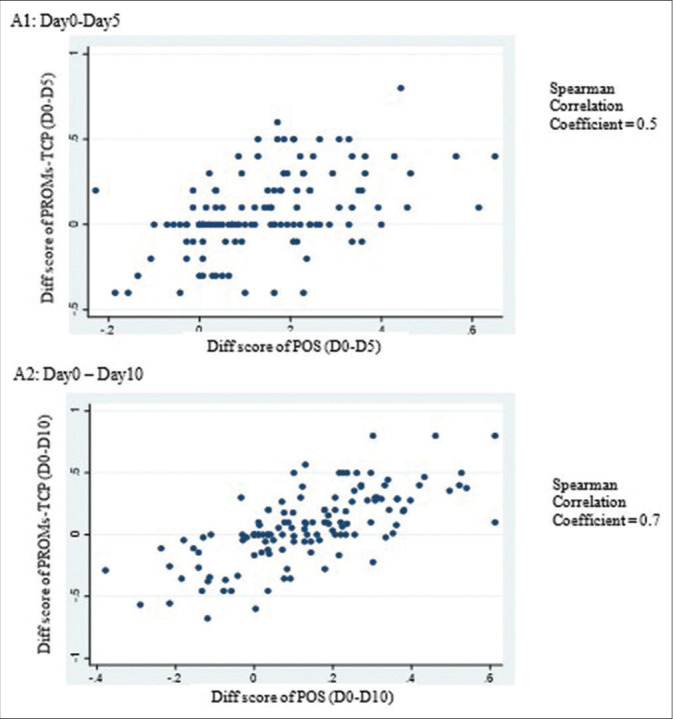
Results: PROMs-TCP consists of five questions. The item-level content validity index (CVI) ranged from 0.8 to 1, and the scale-level CVI was 0.97. PROMs-TCP correlated well with POS scores, with correlations ranging from -0.7 to -0.8. Internal consistency was good (Cronbach's α = 0.85), while inter-rater agreements between patients and caregivers and between patients and nurses were moderate to good (Cohen's weighted k = 0.69-0.87). The tool could reasonably discriminate terrible days from good days for the patients. It was also responsive to change scores, with effect size scores of 0.36.
Conclusion: PROMs-TCP could be used for daily health status assessment of home-based patients with terminally ill cancer, supporting the provision of palliative care in primary care settings.
Keywords: Home-based palliative care; Outcome assessment; Primary care; Thailand.
© 2024 Published by Scientific Scholar on behalf of Indian Journal of Palliative Care.
Conflict of interest statement
There are no conflicts of interest.
Figures
References
-
- WHO Palliative Care: Key Fact. Available from: https://www.who.int/news-room/fact-sheets/detail/palliative-care [Last accessed on 2020 May 10]
-
- Bureau of Inspector General Ministry of Public Health Government Inspectorate Ministry of Health Ministry of Public Health Inspection Plan Fiscal Year 2017. Available from: https://203.157.185.18/download/inspection/1-2560/c%20%e0%b8%84%e0%b8%93... [Last accessed on 2018 May 10]
-
- Riolfi M, Mogliani E, Salvetti I, Poles G, Trivellato E, Manno P. Effectiveness and Challenges in Cancer Palliative Home-care Services: A Retrospective Cohort Study. Recenti Prog Med. 2021;112:647–52. - PubMed
-
- Riolfi M, Buja A, Zanardo C, Marangon CF, Manno P, Baldo V. Effectiveness of Palliative Home-care Services in Reducing Hospital Admissions and Determinants of Hospitalization for Terminally Ill Patients Followed Up by a Palliative Home-care Team: A Retrospective Cohort Study. Palliat Med. 2014;28:403–11. doi: 10.1177/0269216313517283. - DOI - PubMed
LinkOut - more resources
Full Text Sources