Review
. 2024 Sep 20:15:1474285.
doi: 10.3389/fphar.2024.1474285. eCollection 2024.

Inflammation in a ferroptotic environment

Affiliations
Review

Inflammation in a ferroptotic environment

Anja Wickert et al. Front Pharmacol. .

Abstract

Ferroptosis is an iron-dependent form of cell death, which finally culminates in lipid peroxidation and membrane damage. During the past decade, the interest in ferroptosis increased substantially and various regulatory components were discovered. The role of ferroptosis during inflammation and its impact on different immune cell populations is still under debate. Activation of inflammatory pathways such as nuclear factor kappa-light-chain-enhancer of activated B cells (NF-κB) and hypoxia inducible factors (HIFs) are known to alter the ability of cells to undergo ferroptosis and are closely connected to iron metabolism. During inflammation, iron regulatory systems fundamentally change and cells such as macrophages and neutrophils adapt their metabolism towards iron sequestering phenotypes. In this review, we discuss how ferroptosis alters inflammatory pathways and how iron metabolism under inflammatory conditions affects immune cell ferroptosis.

Keywords: HIF; LCN2; NF-kB; iron; lipid peroxidation.


Conflict of interest statement

The authors declare that the research was conducted in the absence of any commercial or financial relationships that could be construed as a potential conflict of interest.

Figures
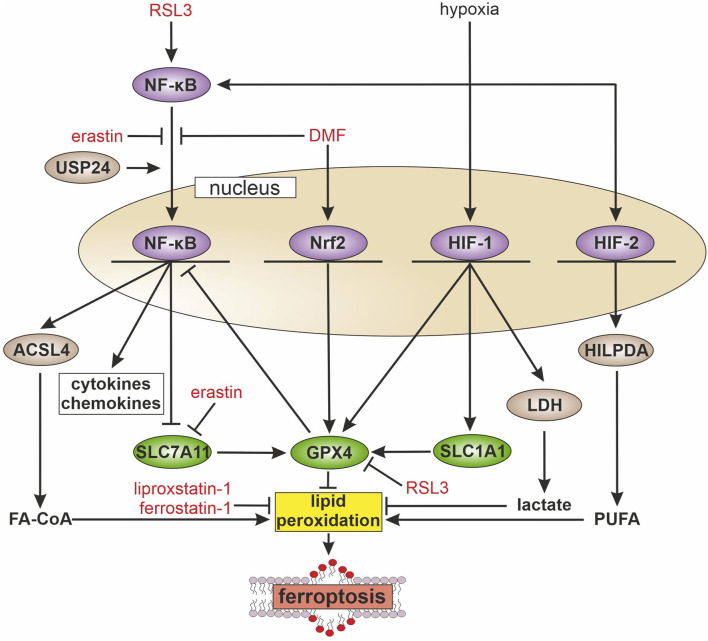
FIGURE 1
FIGURE 1
Inflammatory pathways and ferroptosis During inflammation multiple signaling cascades are activated, e.g., the transcription factors nuclear factor kappa-light-chain-enhancer of activated B cells (NF-κB), nuclear factor erythroid 2-related factor 2 (Nrf2), and hypoxia-inducible factor (HIF). NF-κB is activated by ras-selective lethal small molecule 3 (RSL3) and the ubiquitin-specific protease 24 (USP24), while erastin and dimethyl fumarate (DMF) block its activation. Activated NF-κB increases the transcription of long-chain-fatty-acid-CoA ligase 4 (ACSL4), which facilitates fatty acyl CoA (FA-CoA) synthesis and ferroptosis. Further, NF-kB blocks the expression of solute carrier family 7 member 11 (SLC7A11), with consequences for glutathione synthesis and glutathione peroxidase 4 (GPX4) activity, which abolishes lipid peroxidation. In contrast, Nrf2 increases GPX4 expression and thus, attenuates ferroptosis. HIF-1 enhances solute carrier family 1 member 1 (SLC1A1) expression, which indirectly supports GPX4 activity. Further, HIF-1 protects from ferroptosis by elevating glycolysis, expression of lactate dehydrogenase (LDH), and facilitating lactate production. HIF-2 acts pro-ferroptotic by increasing hypoxia-inducible lipid droplet-associated protein (HILPDA) and polyunsaturated fatty acid (PUFA) release, which in turn increases lipid peroxidation.
FIGURE 2
FIGURE 2
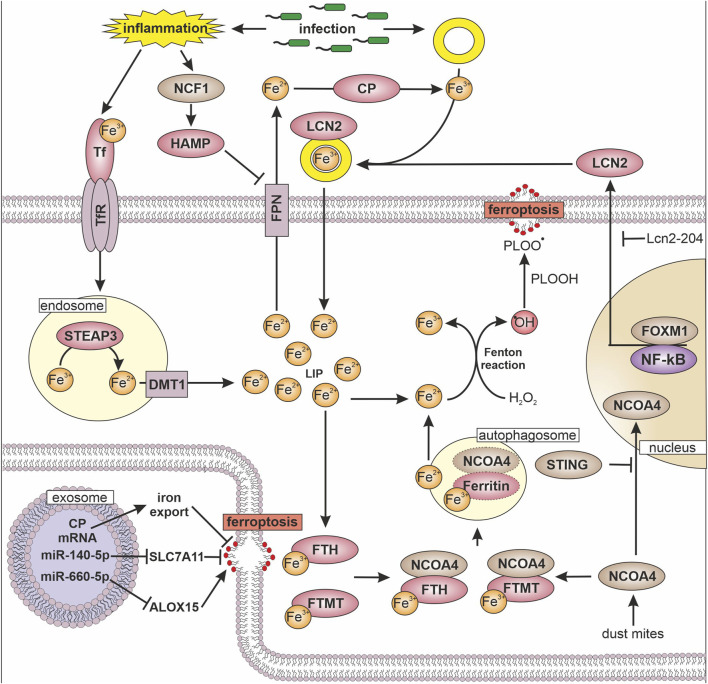
Iron, inflammation, and ferroptosis Transferrin (TF) bound iron (Fe) is internalized into the cell via transferrin receptor (TfR). In endosomes metalloreductase STEAP3 reduces iron (Fe3+ → Fe2+) followed by divalent metal transporter 1 (DMT1) mediated release into the cytosol, where it forms the labile iron pool (LIP). To avoid hydrogen peroxide (H2O2) mediated formation of hydroxyl radical (OH) and conversion of phospholipid hydroperoxide (PLOOH) to phospholipid hydroperoxyl radicals (PLOO), ferritin heavy chain (FTH) and mitochondrial ferritin (FTMT) oxidize and store iron. To release iron from ferritin, nuclear receptor coactivator 4 (NCOA4) marks FTH and FTMT for autophagosome-mediated degradation, which increases the LIP. The transfer of NCOA4 to the nucleus is inhibited by the stimulator of interferon genes (STING). Another way to sequester iron is via lipoclain 2 (LCN2), which is expressed dependent on forkhead box protein M1 (FOXM1) and nuclear factor kappa-light-chain-enhancer of activated B cells (NF-κB), while long non coding RNA Lcn2-204 inhibits LCN2 expression. LCN2 binds siderophore (yellow ring) bound iron and thereby reduces iron availability for pathogens. Export of iron from cells is facilitated by ferroportin (FPN) in close cooperation with ceruloplasmin (CP), which enables iron binding to TF and siderophores. FPN is regulated by hepcidin (HAMP), which is increased by neutrophil cytosolic factor 1 (NCF1) upon inflammatory stimuli. The ability to undergo ferroptosis can be modulated by exosomes, which transfer micro RNAs (miR) or mRNAs to target cells. Following their uptake miRs regulate the expression of solute carrier family 7 member 11 (SLC7A11) and 15-lipoxignase (ALOX15).

References

    1. Bannai S., Tsukeda H., Okumura H. (1977). Effect of antioxidants on cultured human diploid fibroblasts exposed to cystine-free medium. Biochem. Biophys. Res. Commun. 74 (4), 1582–1588. 10.1016/0006-291x(77)90623-4 - DOI - PubMed
    1. Benatzy Y., Palmer M. A., Brüne B. (2022). Arachidonate 15-lipoxygenase type B: regulation, function, and its role in pathophysiology. Front. Pharmacol. 13, 1042420. 10.3389/fphar.2022.1042420 - DOI - PMC - PubMed
    1. Benatzy Y., Palmer M. A., Lütjohann D., Ohno R.-I., Kampschulte N., Schebb N. H., et al. (2024). ALOX15B controls macrophage cholesterol homeostasis via lipid peroxidation, ERK1/2 and SREBP2. Redox Biol. 72, 103149. 10.1016/j.redox.2024.103149 - DOI - PMC - PubMed
    1. Berndt C., Alborzinia H., Amen V. S., Ayton S., Barayeu U., Bartelt A., et al. (2024). Ferroptosis in health and disease. Redox Biol. 75, 103211. 10.1016/j.redox.2024.103211 - DOI - PMC - PubMed
    1. Bersuker K., Hendricks J. M., Li Z., Magtanong L., Ford B., Tang P. H., et al. (2019). The CoQ oxidoreductase FSP1 acts parallel to GPX4 to inhibit ferroptosis. Nature 575 (7784), 688–692. 10.1038/s41586-019-1705-2 - DOI - PMC - PubMed

LinkOut - more resources