


Limited evidence of biased offspring sex allocation in a cavity-nesting conspecific brood parasite
- PMID: 39372888
- PMCID: PMC11453106
- DOI: 10.1093/beheco/arae024
Limited evidence of biased offspring sex allocation in a cavity-nesting conspecific brood parasite
Abstract
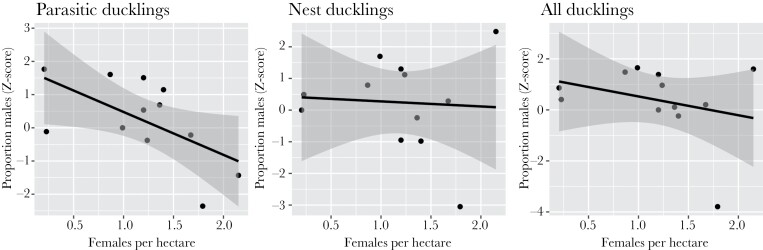
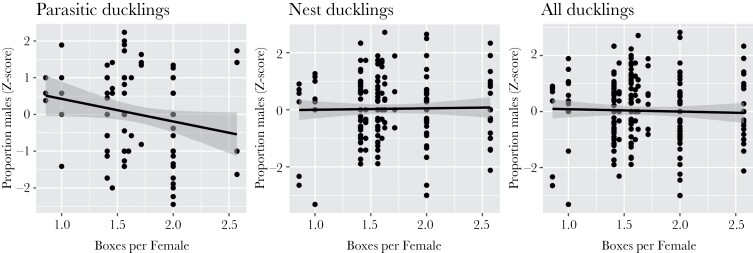
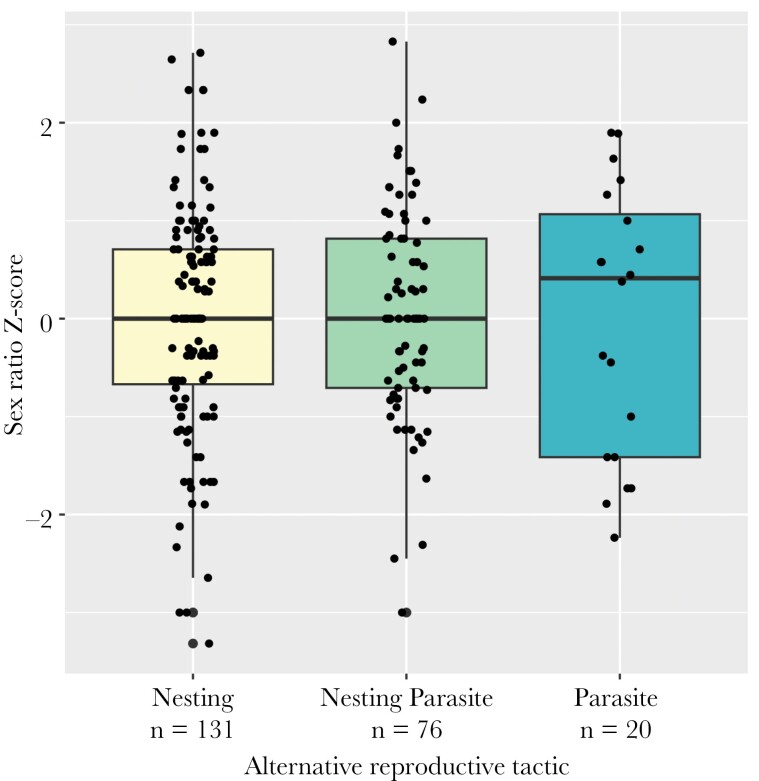
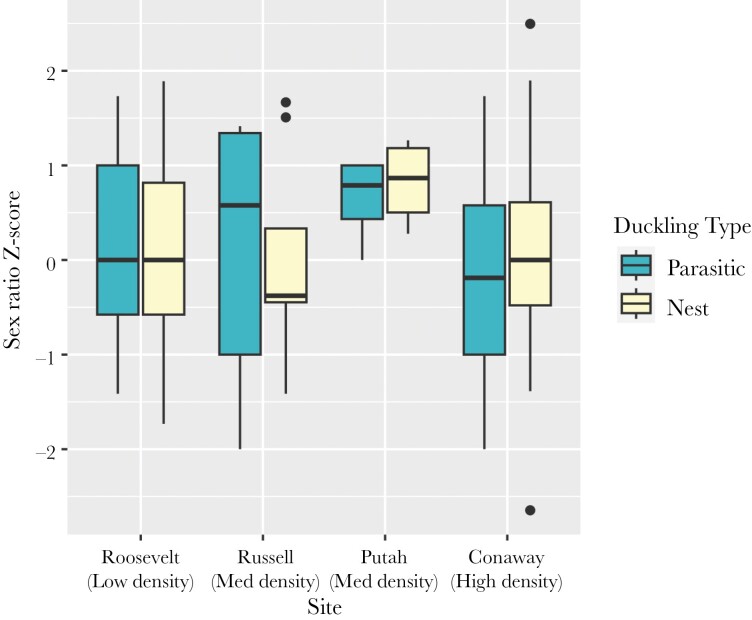
Sex allocation theory predicts that mothers should bias investment in offspring toward the sex that yields higher fitness returns; one such bias may be a skewed offspring sex ratio. Sex allocation is well-studied in birds with cooperative breeding systems, with theory on local resource enhancement and production of helpers at the nest, but little theoretical or empirical work has focused on birds with brood parasitic breeding systems. Wood ducks (Aix sponsa) are a conspecific brood parasite, and rates of parasitism appear to increase with density. Because female wood ducks show high natal philopatry and nest sites are often limiting, local resource competition (LRC) theory predicts that females should overproduce male offspring-the dispersing sex-when competition (density) is high. However, the unique features of conspecific brood parasitism generate alternative predictions from other sex allocation theory, which we develop and test here. We experimentally manipulated nesting density of female wood ducks in 4 populations from 2013 to 2016, and analyzed the resulting sex allocation of >2000 ducklings. In contrast to predictions we did not find overproduction of male offspring by females in high-density populations, females in better condition, or parasitic females; modest support for LRC was found in overproduction of only female parasitic offspring with higher nest box availability. The lack of evidence for sex ratio biases, as expected for LRC and some aspects of brood parasitism, could reflect conflicting selection pressures from nest competition and brood parasitism, or that mechanisms of adaptive sex ratio bias are not possible.
Keywords: alternative reproductive tactic; density; female philopatry; local resource competition; local resource enhancement; nest box study; offspring sex ratio; waterfowl.
© The Author(s) 2024. Published by Oxford University Press on behalf of the International Society for Behavioral Ecology.
Conflict of interest statement
The authors have no conflict of interest to declare.
Figures
References
-
- Åhlund M, Andersson M. Female ducks can double their reproduction. Nature. 2001:414(6864):600–601. - PubMed
-
- Alonzo SH, Sinervo B. The effect of sexually antagonistic selection on adaptive sex ratio allocation. Evol Ecol Res. 2007:9:1097–1117.
-
- Andersson M. Relatedness and the evolution of conspecific brood parasitism. Am Nat. 2001:158(6):599–614. - PubMed
-
- Andersson M. Helping relatives survive and reproduce: inclusive fitness and reproductive value in brood parasitism. Am Nat. 2017:189:138–152. - PubMed
