[Preprint]. 2024 Sep 20:rs.3.rs-4772543.
doi: 10.21203/rs.3.rs-4772543/v1.

The LRRK2 p.L1795F variant causes Parkinson's disease in the European population

Affiliations

The LRRK2 p.L1795F variant causes Parkinson's disease in the European population

Lara M Lange et al. Res Sq. .

Update in

  • The LRRK2 p.L1795F variant causes Parkinson's disease in the European population.
    Lange LM, Levine K, Fox SH, Marras C, Ahmed N, Kuznetsov N, Vitale D, Iwaki H, Lohmann K, Marsili L, Espay AJ, Bauer P, Beetz C, Martin J, Factor SA, Higginbotham LA, Chen H, Leonard H, Nalls MA, Mencacci NE, Morris HR, Singleton AB, Klein C, Blauwendraat C, Fang ZH; Global Parkinson’s Genetics Program (GP2). Lange LM, et al. NPJ Parkinsons Dis. 2025 Mar 25;11(1):58. doi: 10.1038/s41531-025-00896-2. NPJ Parkinsons Dis. 2025. PMID: 40133296 Free PMC article.

Abstract

Pathogenic variants in the LRRK2 gene represent the most common cause of autosomal dominant Parkinson's disease (PD) worldwide. We identified the LRRK2 p.L1795F variant in 14 White/European ancestry PD patients, including two families with multiple affected carriers and seven additional affected individuals with familial PD using genotyping and sequencing data from more than 50,000 individuals through GP2, AMP-PD, PDGENEration, and CENTOGENE. All variant carriers were of White/European ancestry, and those with available genotyping data shared a common haplotype. The clinical presentation of p.L1795F carriers resembles that of other LRRK2 pathogenic variant carriers. Combined with published functional evidence showing strongly enhanced LRRK2 kinase activity, our findings provide conclusive evidence that the LRRK2 p.L1795F variant is pathogenic. It represents a rare cause of PD in the European population but needs to be included in genetic testing efforts and considered for ongoing gene-specific clinical trials.


Conflict of interest statement

Competing interests L.M.L., N.A., K. Lo., and L.A.H. declare no competing interests.

Figures
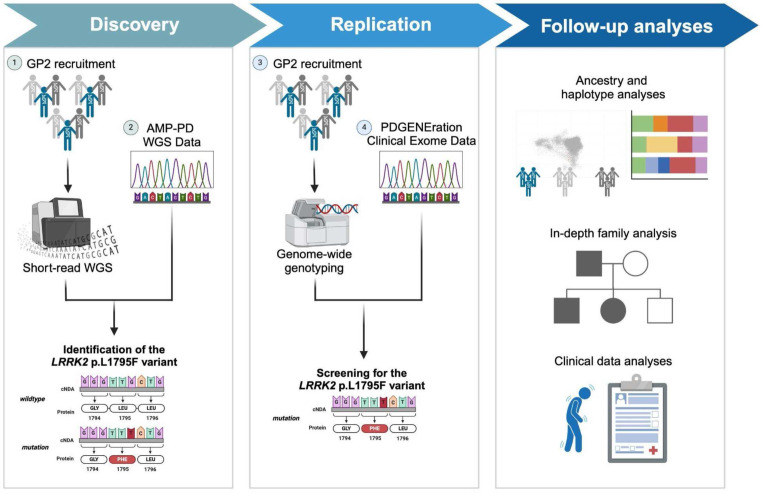
Figure 1.
Figure 1.. Study design and workflow.
Figure created with BioRender.com.
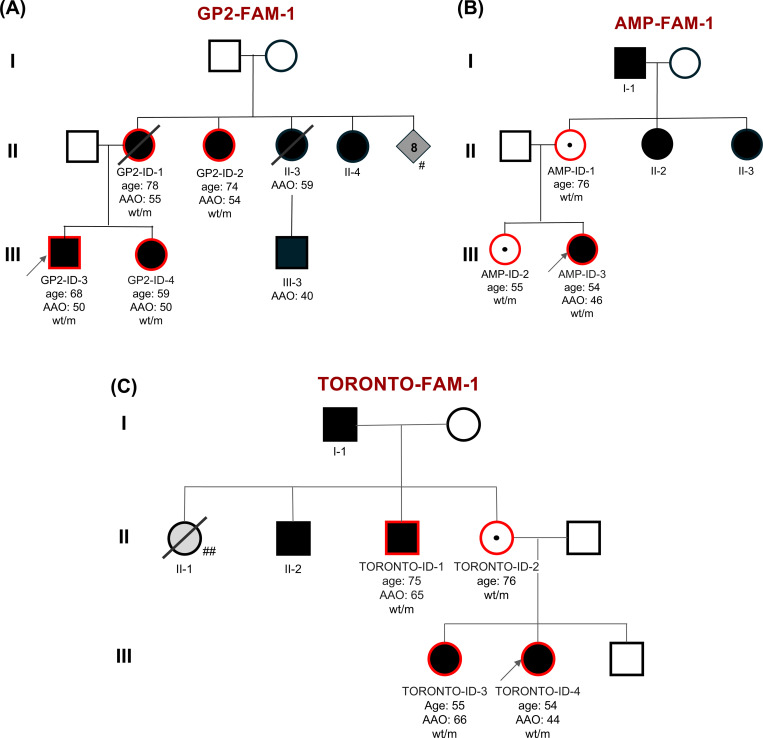
Figure 2.
Figure 2.. Pedigree of Family GP2-FAM-1 (A), AMP-FAM-1 (B), and TORONTO-FAM-1 (C) with the LRRK2 p.L1795F variant.
The pedigrees were drawn based on reported family history and may be incomplete. The index cases are indicated with arrows. Affected individuals are indicated by black symbols: circles (female) and squares (male). Diamond is where sex is undefined. Unaffected individuals are indicated by open symbols. Unaffected variant carriers are indicated by open symbols with a dot in the middle. A diagonal line indicates deceased individuals. Red circle indicates individuals with genetic data available (WGS data for GP2-FAM-1 and AMP-FAM-1, single gene testing for TORONTO-FAM-1). Heterozygous mutant (m) and wild-type (wt) genotypes are indicated with corresponding age at the sample collection (age) and age at motor symptom onset (if known; AAO). (A) The mother of GP2-FAM-1 index was reported to have eight additional siblings (#), several of whom are clinically affected with PD; however, no detailed family history is available for these relatives. (C) One maternal aunt (II-1) of the TORONTO-FAM-1 index was reported to have had Alzheimer’s disease (##).
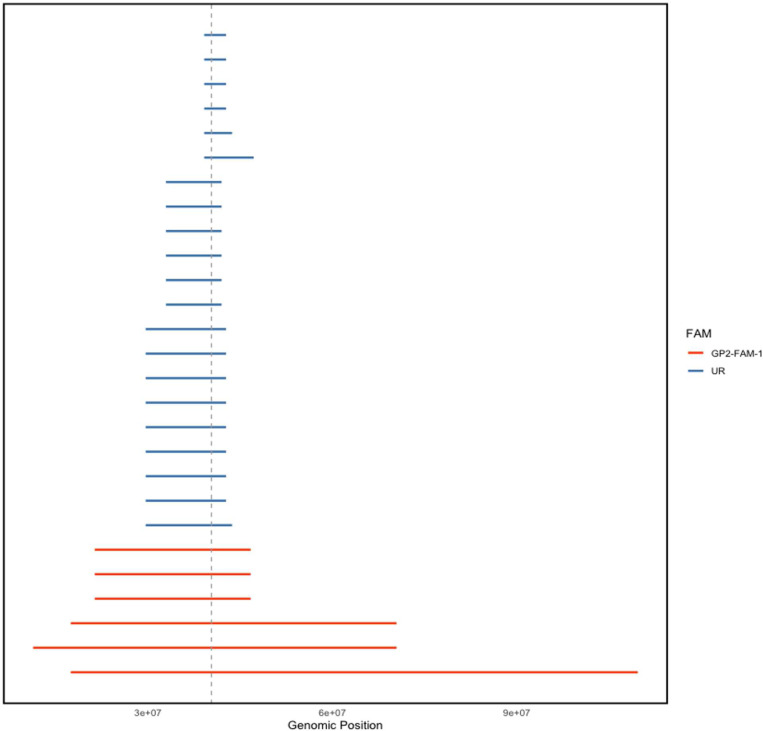
Figure 3.
Figure 3.. Overlapping identity-by-descent segments spanning LRRK2 p.L1795F variant among the variant carriers with genotyping data.
Each line represents an IBD segment inferred between a unique pair. IBD segments have been coloured according to whether both individuals within a pair belong to the same family (GP2-FAM-1) or are otherwise considered unrelated (UR). Vertical grey line represents the genomic position of LRRK2 p.L1795F.

References

    1. Wüllner U. et al. The heterogeneity of Parkinson’s disease. J. Neural Transm. 130, 827–838 (2023). - PMC - PubMed
    1. Westenberger A. et al. Relevance of genetic testing in the gene-targeted trial era: The Rostock Parkinson’s Disease Study. Brain (2024, in press). - PMC - PubMed
    1. Cook L. et al. Parkinson’s Disease Variant Detection and Disclosure: PD GENEration, a North American Study. Brain (2024, in press). - PMC - PubMed
    1. Zimprich A. et al. Mutations in LRRK2 cause autosomal-dominant parkinsonism with pleomorphic pathology. Neuron 44, 601–607 (2004). - PubMed
    1. Paisán-Ruíz C. et al. Cloning of the gene containing mutations that cause PARK8-linked Parkinson’s disease. Neuron 44, 595–600 (2004). - PubMed

Publication types

LinkOut - more resources