Review
. 2024 Dec 4;35(12):2753-2784.
doi: 10.1021/jasms.3c00122. Epub 2024 Oct 7.

New Processes for Ionizing Nonvolatile Compounds in Mass Spectrometry: The Road of Discovery to Current State-of-the-Art

Sarah Trimpin  1   2 Frank S Yenchick  1 Chuping Lee  1 Khoa Hoang  2   3 Milan Pophristic  2   3 Santosh Karki  1   2 Darrell D Marshall  1   2 I-Chung Lu  1   4 Corinne A Lutomski  1 Tarick J El-Baba  1 Beixi Wang  1 Vincent S Pagnotti  3 Anil K Meher  1   2 Shubhashis Chakrabarty  1   2 Lorelei F Imperial  1 Sara Madarshahian  3 Alicia L Richards  1 Christopher B Lietz  1 Abigail Moreno-Pedraza  1 Samantha M Leach  5 Stephen C Gibson  1 Efstathios A Elia  1 Shameemah M Thawoos  1 Daniel W Woodall  1 Dean R Jarois  1 Eric T J Davis  1 Guochao Liao  1 Nisansala S Muthunayake  1 McKenna J Redding  6 Christian A Reynolds  7 Thilani M Anthony  1 Sashiprabha M Vithanarachchi  1 Paul DeMent  1 Adeleye O Adewale  1 Lu Yan  1 James Wager-Miller  8 Young-Hoon Ahn  1 Thomas H Sanderson  7 Karin Przyklenk  7 Miriam L Greenberg  9 Arthur G Suits  1 Matthew J Allen  1 Srinivas B Narayan  10 Joseph A Caruso  11 Paul M Stemmer  11 Hien M Nguyen  1 Steffen M Weidner  12 Kevin J Rackers  13 Ana Djuric  14 Vladimir Shulaev  15 Tamara L Hendrickson  1 Christine S Chow  1 Mary Kay H Pflum  1 Scott M Grayson  6 Vladislav V Lobodin  16 Zhongwu Guo  1 Chi-Kung Ni  17 J Michael Walker  8 Ken Mackie  8 Ellen D Inutan  1   2   18 Charles N McEwen  2   3
Affiliations
Review

New Processes for Ionizing Nonvolatile Compounds in Mass Spectrometry: The Road of Discovery to Current State-of-the-Art

Sarah Trimpin et al. J Am Soc Mass Spectrom. .

Abstract

This Perspective covers discovery and mechanistic aspects as well as initial applications of novel ionization processes for use in mass spectrometry that guided us in a series of subsequent discoveries, instrument developments, and commercialization. Vacuum matrix-assisted ionization on an intermediate pressure matrix-assisted laser desorption/ionization source without the use of a laser, high voltages, or any other added energy was simply unbelievable, at first. Individually and as a whole, the various discoveries and inventions started to paint, inter alia, an exciting new picture and outlook in mass spectrometry from which key developments grew that were at the time unimaginable, and continue to surprise us in its simplistic preeminence. We, and others, have demonstrated exceptional analytical utility. Our current research is focused on how best to understand, improve, and use these novel ionization processes through dedicated platforms and source developments. These ionization processes convert volatile and nonvolatile compounds from solid or liquid matrixes into gas-phase ions for analysis by mass spectrometry using, e.g., mass-selected fragmentation and ion mobility spectrometry to provide accurate, and sometimes improved, mass and drift time resolution. The combination of research and discoveries demonstrated multiple advantages of the new ionization processes and established the basis of the successes that lead to the Biemann Medal and this Perspective. How the new ionization processes relate to traditional ionization is also presented, as well as how these technologies can be utilized in tandem through instrument modification and implementation to increase coverage of complex materials through complementary strengths.


Conflict of interest statement

Conflict of Interest

The corresponding author is a shareholder of MSTM, LLC.

Figures
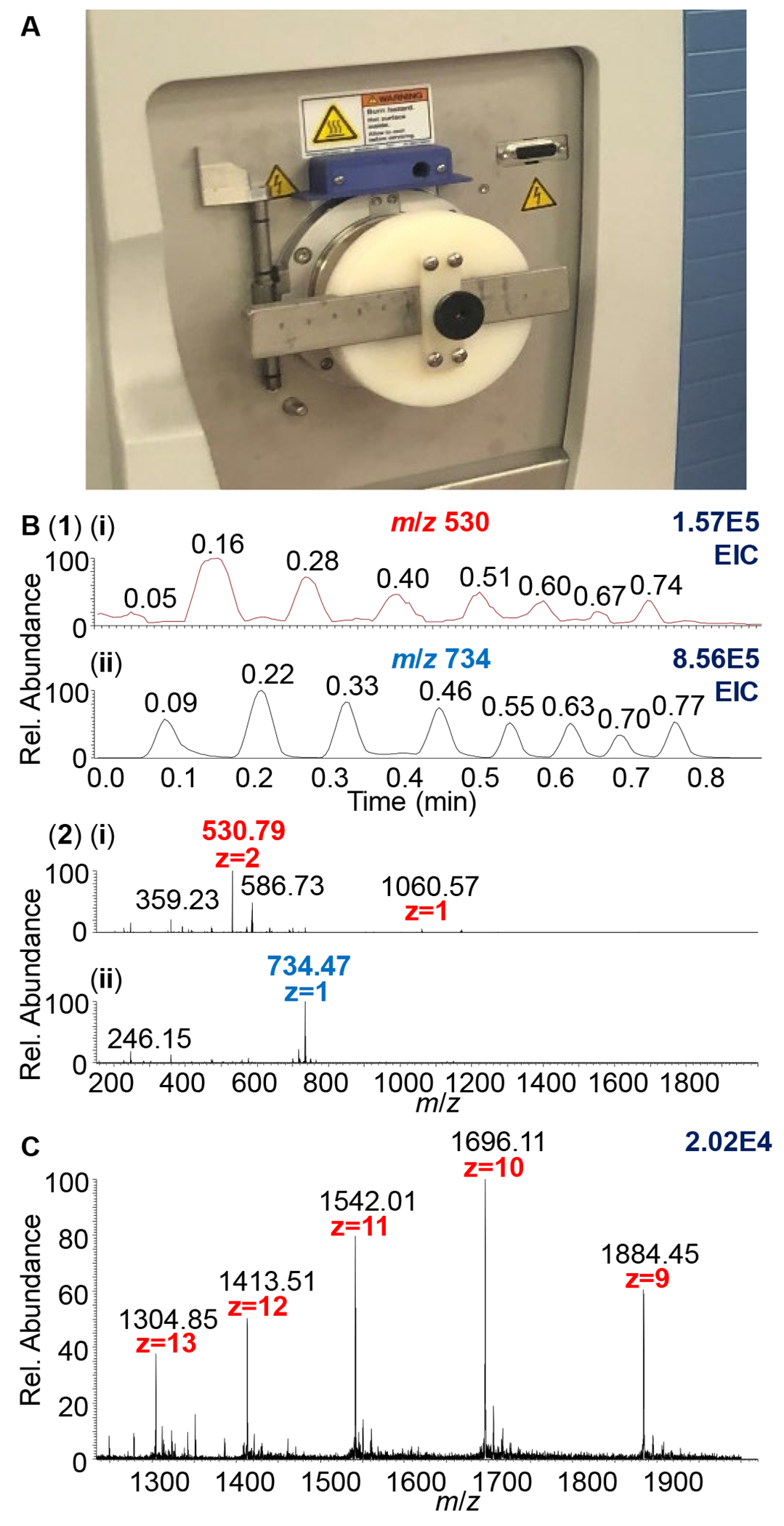
Figure 1.
Figure 1.
Sampling by vMAI-MS directly from AP into sub-AP of the mass spectrometer. (A) Photograph of the source setup using plate introduction in which each matrix:analyte sample is exposed to the sub-AP in successions; (B1) Chronograms displaying 2 samples acquired in less than 4 s per sample and (B2) mass spectra of the two compounds: (i) bradykinin and (ii) azithromycin. (C) Mass spectrum of the multiply charged ions of myoglobin, molecular weight ~ 16.9 kDa.
Figure 2.
Figure 2.
(A) MSTM vMAI/vMALDI prototype manual rapid analysis vacuum source; (1) valve plate, (2) sample plate (glass slide required for TG vMALDI), (3) spacer plate with channels therethrough, (4) channel positions where samples applied to sample plate align, (5) laser beam (represented by pointed blue arrow) aligned with channel in flange (not shown) to vacuum for TG vMALDI. Ionization in vMAI occurs when a spacer plate channel aligned with a vMAI sample aligns with the flange channel and thus exposed to vacuum. Multisample plates are exchanged in ca. 2 sec. (B) vMAI mass spectrum of 2 picomoles of ubiquitin in detergent using 3-NBN as matrix applied to a glass slide. Instrument Q-Exactive Focus. Movie-S01 is included to demonstrate the acquisition of myoglobin in detergent using the plate vMAI/vMALDI source.
Figure 3.
Figure 3.
Analysis of surfaces with solvent-assisted ionization using the MSTM Pen. The mass spectrum shows in red the pesticide thiabendazole m/z 202.04; the highest abundance of the pesticide was found in the stem area of the apple. Inset: photograph of the setup: (1) manual MSTM platform with (2) fused silica capillary from the (3) MSTM Pen sampling of the (4) surface of an apple. Data were acquired on Thermo Orbitrap Exactive mass spectrometer. See a more detailed description of the MSTM Pen in Figure S1C inset, Movie-S04 and compare with Figure S13.
Figure 4.
Figure 4.
Bacterial strain differentiation using two ionization methods, MAI and ESI, on the same platform and mass spectrometer. (A) Photograph of the automated Ionique multi-ionization platform mounted on a Thermo Q-Exactive Focus Orbitrap without any further modifications (source override included in platform) and Movie-S04 shows the operation. (B) Differentiation of bacteria using 3D-PCA: (1) under standard MAI conditions, 4 out of 5 E. coli strains were correctly discriminated using 3D-PCA analyses. As a comparison, using (2) typical ESI conditions, only 2 of 5 were clearly separated.
Figure 5.
Figure 5.
Ionique automated MAI-IMS-MS of an isomeric mixture of β-amyloid (1–42) and reverse peptide (42–1): (A) total mass spectrum and (B) 2-dimensional plot of IMS-MS with the color code indicating the ion abundances of the respective charge states detected from +3 to +7. Insets: extracted drift time distributions. Data were acquired on a Waters SYNAPT G2S mass spectrometer using the MSTM automated multimode Ionique platform replacing the ESI source using the retrofitted MSTM inlet tube modification and the matrix 3-NBN (100 mg of 3-NBN was prepared in 3 mL of 3:1 (v:v) ACN:water). The drift time results compare well with those obtained by LSI-IMS-MS on a SYNAPT G2.
Figure 6.
Figure 6.
Fast analysis using TG laser ablation-SAI-MS on an IMS-MS instrument. (A) Photographs of the source setup with inset: green arrow indicates the path of the laser beam through the bottom of the optically transparent well plate. (1) Nd:YAG laser beam locally heats the solvent (methanol) containing the analyte (erythromycin) in the well plate, (2) focusing lens, (3) mirror, (4) automated XYZ-stage equipped with the custom built plate holder to secure the well plate, (5) well plate in close proximity to a customized inlet entrance, (6) inlet entrance of bent MSTM inlet tube. (B) (1) TIC at 2 sec acquisition of laser firing at 1 Hz, (2) TIC of 1 sec acquisition 1 Hz, (3) EIC of 1 sec acquisition of m/z 734 with laser firing at 1Hz, and (C) mass spectra from (1) from B(1), (2) from (B2), and (3) from (B2) at higher laser repetition rate. The Nd:YAG laser was operated at 532 nm wavelength, Movie-S05 shows the operation of the entire system. Multiply charged ions are shown in Figure S46. Data acquired on a commercial Z-spray source of a Waters SYNAPT G2S; for specific details and additional results, refer to Figures S45–S48.
Figure 7.
Figure 7.
Use of a vacuum probe source for vMAI-MS: (A) Photographs: (1) the source housing open and the approximate position of the probe relative to the entrance to the mass spectrometer, (2) source housing closed as used for analyses. (B) (1) (i) swine liver tissue to be analyzed being touched with the end of probe and (ii) with matrix solution applied to end of probe and dried. (2) (i) Tissue in solvent solution used for extraction, (ii) probe with extract solution and matrix dried on the tip. (C) Mass spectra: (1) from B1 and (2) from B2. The extracted solution was mixed with 3-NBN in acetonitrile (3:1 v/v), and 0.1 μL was applied to the end of the probe for the acquisition. Data acquired on a SYNAPT G2 mass spectrometer. Tentative assignments are based on m/z and published work (Ref. –240): TG: triacylglycerol; PC: phosphatidylcholine; SM: sphingomyelin. Assignments in blue are only observed by direct, in red by extraction, and in purple by both approaches. The ion at m/z 663 is a commonly observed using 3-NBN as matrix.
Scheme 1.
Scheme 1.. Timeline for the Path of Discoveries of New Ionization Processes Developed into Ionization Methods with Applicability Ranging from Imaging to Liquid Chromatography and Spanning Pressure Regimes from Above Atmospheric Pressure (AP) to Low Pressure (High Vacuum).a
a Inlet ionization (in red color) is referred to when the ionization is assisted by an inlet tube, preferably heated, that connects a higher pressure with a lower pressure region by default available with AP ionization mass spectrometers. Depending on the vendor, mass spectrometer specific ion source configurations can be used “as is” or with inlet modifications. In MAI, a laser is not used to initiate ionization of the matrix:analyte sample. An inlet tube is also used with SAI, but the matrix is a liquid, typically the solvent used to dissolve the analyte. Vacuum ionization (in blue) is referred to when the matrix:analyte is introduced directly into the sub-AP of the mass spectrometer, typically on a substrate without use of an inlet tube. vLSI proved that a heated inlet tube was not necessary; instead, multiply charged ions are obtained from a thermal process assisted by the laser. Without the use of a laser, using the matrix 3-nitrobenzonitrile (3-NBN) under vacuum (vMAI) conditions, the matrix:analyte sample produces ESI-like charge states. Using vMAI, the changes in the instrument can be as minimal as with inlet ionization, or substantial, by replacing the source and inlet to the mass spectrometer. The purple color combines substantially the aspects of inlet and vacuum ionization. MSTM products include manual and automated Ionique platforms and sources developed through the National Science Foundation (NSF) STTR and SBIR funding.

References

    1. Trimpin S; Inutan ED Matrix Assisted Ionization in Vacuum, a Sensitive and Widely Applicable Ionization Method for Mass Spectrometry. J. Am. Soc. Mass Spectrom 2013, 24(5), 722–732. - PubMed
    1. Inutan ED; Trimpin S Matrix Assisted Ionization Vacuum (MAIV), a New Ionization Method for Biological Materials Analysis using Mass Spectrometry. Mol. Cell Proteomics 2013, 12(3), 792–796. - PMC - PubMed
    1. Trimpin S; Wang B; Lietz CB; Marshall DD; Richards AL; Inutan ED New Ionization Processes and Applications for Use in Mass Spectrometry. Crit. Rev. Biochem. Mol 2013, 4(5), 409–429. - PubMed
    1. Trimpin S “Magic” Ionization Mass Spectrometry. J. Am. Soc. Mass Spectrom 2016, 27(1), 4–21. - PMC - PubMed
    1. Peacock PM; Zhang W-J; Trimpin S Advances in Ionization for Mass Spectrometry. Anal. Chem 2017, 89(1), 372–388. - PubMed

LinkOut - more resources
