. 2025 Jan 14;9(1):127-131.
doi: 10.1182/bloodadvances.2024014446.

Acquired BCL2 variants associated with venetoclax resistance in acute myeloid leukemia

Affiliations

Acquired BCL2 variants associated with venetoclax resistance in acute myeloid leukemia

Fiona C Brown et al. Blood Adv. .
No abstract available


Conflict of interest statement

Conflict-of-interest disclosure: A.H.W. has served on advisory boards for Novartis, AstraZeneca, Astellas, Janssen, Jazz, Amgen, Roche, Pfizer, AbbVie, Servier, Gilead, Bristol Myers Squibb, and BeiGene; has consulted for AbbVie, Servier, Novartis, Shoreline, and Aculeus; receives research funding to the institution from Novartis, AbbVie, Servier, Bristol Myers Squibb, Syndax, Astex, AstraZeneca, and Amgen; and serves on speaker’s bureau for AbbVie, Novartis, Bristol Myers Squibb, Servier, and Astellas. A.H.W., F.C.B., T.M., R.B., G.P., D.C.S.H., and P.C. are employees of the Walter and Eliza Hall Institute (WEHI). WEHI receives milestone and royalty payments related to the development of venetoclax. Current and past employees of WEHI may be eligible for financial benefits related to these payments. A.H.W. and P.C. receive such a financial benefit. C.C.C. has served on advisory boards for AbbVie, Pfizer, and Sumitomo Pharma Oncology and on speaker’s bureau for Bristol Myers Squibb, AstraZeneca, and AbbVie. A.E.P. has served on advisory boards or consulted for AbbVie, Genentech, Bristol Myers Squibb, Astellas, Daiichi Sankyo, Immunogen, Rigel, Syndax, Schrödinger, Aptose, Curis, and Foghorn; and receives research funding to the institution from AbbVie, Astellas, Daiichi Sankyo, FujiFilm, and Syndax. The remaining authors declare no competing financial interests.

Figures

None
Graphical abstract
Figure 1.
Figure 1.
A trio of BCL2 variants identified upon venetoclax and azacitidine progression. (A) Fish plot representation showing changes in clonal architecture over time (x-axis), with bone marrow blasts (%) and treatments administered shown. Variants were characterized using a clinical NGS panel and relapse clonal architecture from single-cell DNA sequence. (B-D) Multiomic single-cell characterization of bone marrow from day 487 (panel A). (B) Two-dimensional UMAP plot showing specific phenotypic populations based on antibody tags (right). Mononuclear cells clustered into 4 main blood cell compartments including AML blast cells (red). Identified DNA clones (blue, orange, and green) are overlaid onto phenotypic populations (left). (C) The proportion of cells either wild-type (WT) or heterozygote for indicated GATA2 and BCL2 variants. (D) Proportion of each mutant clone within specified blood cell lineages. AZA, azacitidine; CLAG, cladribine, cytarabine, granulocyte colony-stimulating factor; CR, complete remission; HD, high-dose; HET, heterozygous; HOM, homozygous; mido, midostaurin; UMAP, Uniform Manifold Approximation and Projection; VEN, venetoclax; 7 + 3, cytarabine/daunorubicin.
Figure 2.
Figure 2.
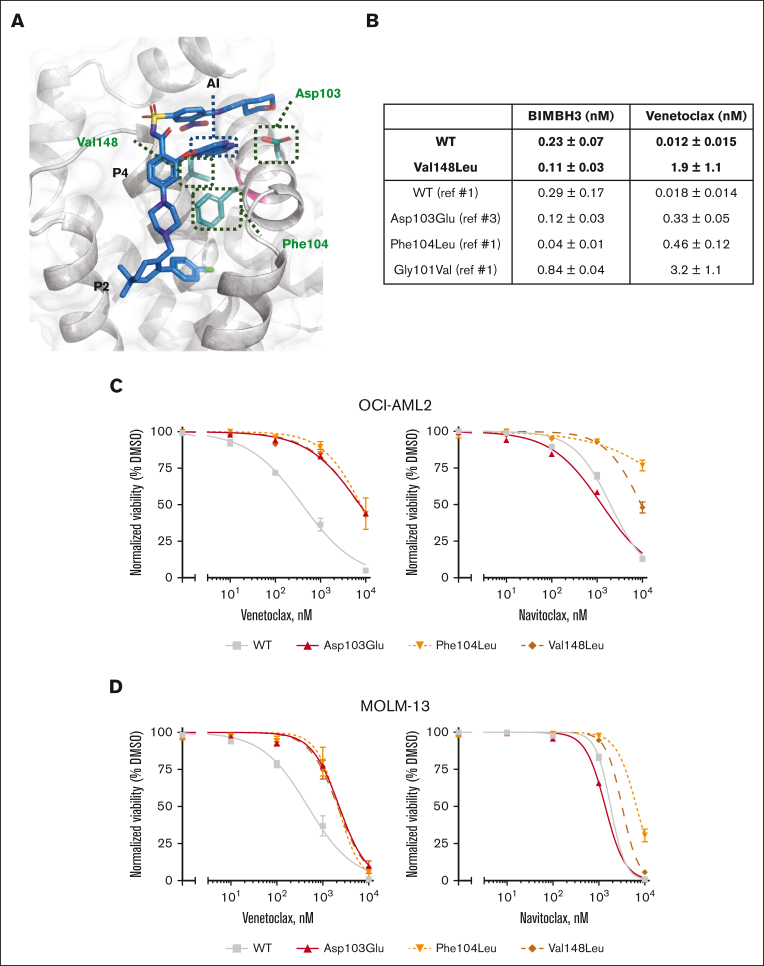
BCL2 variants have reduced activity to VEN in AML cells. (A) Structure of the BCL2 protein with venetoclax (blue) binding in the BCL2 groove. The positions of the 3 mutated residues are illustrated (green). P2 and P4 pockets and the azaindole side chain of venetoclax are indicated. (B) Table summarizing the binding affinities of BIM or venetoclax for WT or Val148Leu BCL2 as determined by direct binding assays in comparison with previously documented binding affinities for Asp103Glu, Phe104Leu, and Gly101Val BCL2 mutants. Data represent means ± 1 standard deviation (SD) of 3 independent experiments with curves and fits shown in supplemental Figures 2 and 3. (C-D) BCL2 WT, Asp103Glu, Phe104Leu, and Val148Leu were overexpressed in (C) OCI-AML2 and (D) MOLM-13 AML cell lines. In vitro viability assessed by flow cytometric enumeration of cells excluding propidium iodide upon exposure to indicated concentrations of venetoclax or navitoclax for 48 hours. Data represent means ± 1 SD of at least 3 independent experiments.

References

    1. Blombery P, Anderson MA, Gong J-N, et al. Acquisition of the recurrent Gly101Val mutation in BCL2 confers resistance to venetoclax in patients with progressive chronic lymphocytic leukemia. Cancer Discov. 2019;9(3):342–353. - PubMed
    1. Tausch E, Close W, Dolnik A, et al. Venetoclax resistance and acquired BCL2 mutations in chronic lymphocytic leukemia. Haematologica. 2019;104(9):e434–e437. - PMC - PubMed
    1. Blombery P, Thompson ER, Nguyen T, et al. Multiple BCL2 mutations cooccurring with Gly101Val emerge in chronic lymphocytic leukemia progression on venetoclax. Blood. 2020;135(10):773–777. - PMC - PubMed
    1. Blombery P, Birkinshaw RW, Nguyen T, et al. Characterization of a novel venetoclax resistance mutation (BCL2 Phe104Ile) observed in follicular lymphoma. Br J Haematol. 2019;186(6):e188–e191. - PubMed
    1. Chyla B, Daver N, Doyle K, et al. Genetic biomarkers of sensitivity and resistance to venetoclax monotherapy in patients with relapsed acute myeloid leukemia. Am J Hematol. 2018;93(8):E202–E205. - PMC - PubMed