


Recruitment of emergency department patients to a prospective observational study
- PMID: 39375594
- PMCID: PMC11460232
- DOI: 10.1186/s12245-024-00717-y
Recruitment of emergency department patients to a prospective observational study
Abstract
Background: The dynamic environment of the emergency department (ED) poses unique challenges to the execution of well-designed research. There is limited investigation into the viability of studies conducted in the ED. This paper offers a systematic evaluation of our recruitment of emergency patients for a prospective observational research study, shedding light on the intricate landscape of research feasibility within the ED setting.
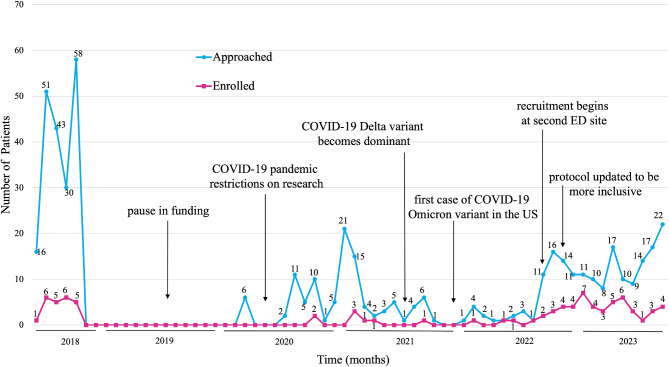
Results: Research coordinators dedicated 2816.83 h to screening, recruiting, and enrolling patients between June 2018 and September 2023, having to stop recruitment twice due to financial constraints and the COVID-19 pandemic. 485 patients were approached and 84 of them were enrolled, resulting in a 31.94% enrollment rate, with approximately 2.8 participants recruited per month. Of those enrolled, 77 completed all study endpoints. Most participants were Hispanic (n = 44; 52.3%) and/or Black (n = 37; 44%), middle-aged (µ = 51.7 years), and female (n = 48; 57.1%). Participant recruitment was challenged by competing mindsets, the COVID-19 pandemic, and high staff turnover.
Conclusions: Recruiting emergency patients for a prospective observational study is feasible given adequate staffing and financial resources. Standardizing feasibility assessments for the recruitment of patients in the emergency department is important to the success of future study.
Keywords: Asymptomatic hypertension; Diversity; Emergency research; Feasibility; Health equity; Hypertension; Prospective observational; Racial and ethnic diversity; Recruitment.
© 2024. The Author(s).
Conflict of interest statement
The authors declare no competing interests.
Figures

References
-
- Shea S, Thomas Bigger J, Campion J, Fleiss JL, Rolnitzky LM, Schron E et al. Enrollment in clinical trials: Institutional factors affecting enrollment in the Cardiac Arrhythmia Suppression Trial (CAST). Controlled Clinical Trials [Internet]. 1992 Dec [cited 2023 Nov 15];13(6):466–86. https://linkinghub.elsevier.com/retrieve/pii/019724569290204D - PubMed
-
- Bjornson-Benson WM, Stibolt TB, Manske KA, Zavela KJ, Youtsey DJ, Sonia Buist A. Monitoring recruitment effectiveness and cost in a clinical trial. Controlled Clinical Trials [Internet]. 1993 Apr [cited 2023 Nov 15];14(2):52–67. https://linkinghub.elsevier.com/retrieve/pii/0197245693900248 - PubMed
-
- Durkin DA, Kjelsberg MO, Sonia Buist A, Connett JE, Owens GR. Recruitment of participants in the Lung Health Study, I: Description of Methods. Controlled Clinical Trials [Internet]. 1993 Apr [cited 2023 Nov 15];14(2):20–37. https://linkinghub.elsevier.com/retrieve/pii/0197245693900226 - PubMed
-
- Williams GH. Funding for Patient-Oriented Research: Critical Strain on a Fundamental Linchpin. JAMA [Internet]. 1997 Jul 16 [cited 2023 Nov 22];278(3):227. http://jama.jamanetwork.com/article.aspx?doi=10.1001/jama.1997.035500300... - PubMed
-
- Cofield SS, Conwit R, Barsan W, Quinn J. Recruitment and Retention of Patients into Emergency Medicine Clinical Trials. Academic Emergency Medicine [Internet]. 2010 Oct [cited 2023 Nov 8];17(10):1104–12. https://onlinelibrary.wiley.com/doi/10.1111/j.1553-2712.2010.00866.x - PMC - PubMed
Grants and funding
LinkOut - more resources
Full Text Sources
