


Intraspecific diversity of Erwinia amylovora strains from northern Algeria
- PMID: 39375611
- PMCID: PMC11457352
- DOI: 10.1186/s12866-024-03555-3
Intraspecific diversity of Erwinia amylovora strains from northern Algeria
Abstract
Background: Fire blight, caused by Erwinia amylovora, is the most destructive bacterial disease affecting plants in the Rosaceae family, leading to significant economic losses. In Algeria, this disease has been reported since 2010. This study aimed to investigate the origin of fire blight in Algeria, in order to increase knowledge of the epidemiology of this serious disease and contribute to its management. A comprehensive characterization of 18 E. amylovora isolates recovered from northern Algeria between 2016 and 2021 to evaluate their phenotypical and genotypical diversity was conducted.
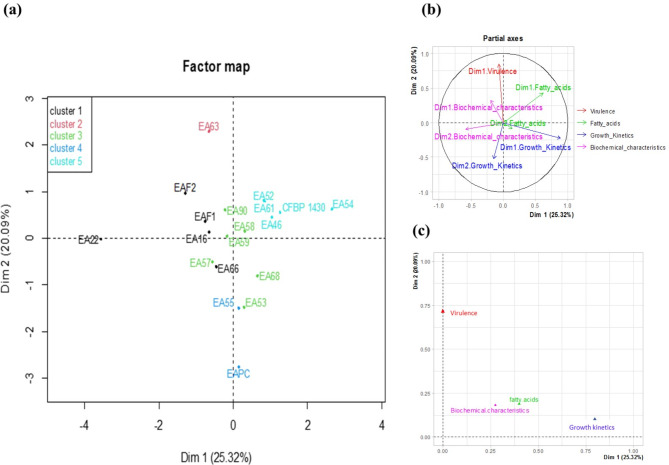
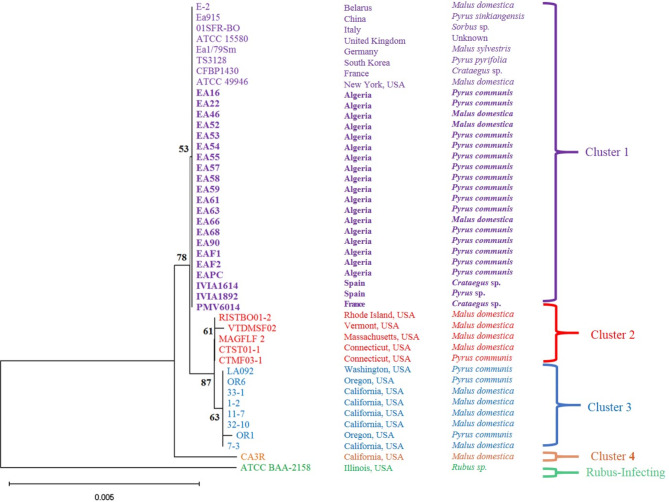
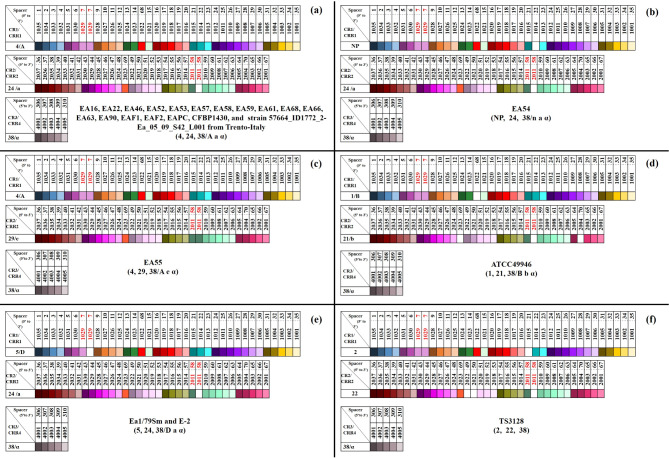
Results: Phenotypic differences, particularly in growth kinetics, virulence, and fatty acid profiles, allowed differentiation of strains into five groups, possibly indicating distinct introduction events. Genetic characterization revealed that only one strain lacked the ubiquitous plasmid pEA29, which is correlated with reduced virulence, while none harbored the pEI70 plasmid. Phylogenetic analysis using concatenated sequences of the recA, groEL, rpoS, ams, and hrpN genes grouped Algerian strains with those from a broadly prevalent clade. CRISPR genotyping identified a novel CR1 pattern and three genotypes, two of them previously unreported.
Conclusions: This study represents the first phenotypic, genetic, and phylogenetic investigation of E. amylovora strains in the region, and provides valuable information on the possible pathways of the introduction of this fire blight pathogen in northern Africa. The findings suggest one or more introduction events from a common ancestor, likely originating in northern Italy, followed by dispersal in various regions of Algeria.
Keywords: Erwinia amylovora; CRISPR; Diversity; Fatty acid profile; Fire blight; Growth kinetics; MLST; Plasmids; Virulence.
© 2024. The Author(s).
Conflict of interest statement
The authors declare no competing interests.
Figures
References
-
- Marco-Noales E, Peñalver J, Navarro I, Gorris MT, Morente MC, Balguerías C, et al. Iberian wild pear (Pyrus bourgaeana) is a new host of Erwinia amylovora, the causal agent of fire blight. Plant Dis. 2017;101:502. - DOI
-
- Vanneste JL. What is fire blight? Who is Erwinia amylovora? How to control it? In: Vanneste JL, editor. Fire blight the disease and its causative agent, Erwinia amylovora. New York: CABI Publishing; 2000.
-
- Doolotkeldieva T, Bobushova S, Carnal S, Rezzonico F. Genetic characterization of Erwinia amylovora isolates detected in the wild walnut fruit forest of South Kyrgyzstan. J Plant Pathol. 2021;103:109–20. - DOI
-
- Denning W. On the decay of apple trees. New York Soc Promot Agric Arts Manuf Trans. 1794;2:219–22.
-
- Pedroncelli A, Puopolo G. This tree is on fire: a review on the ecology of Erwinia amylovora, the causal agent of fire blight disease. J Plant Pathol. 2023. 10.1007/s42161-023-01397-y - DOI
MeSH terms
Substances
Grants and funding
LinkOut - more resources
Full Text Sources
Research Materials
