


Low-intensity extracorporeal shock wave therapy for Peyroniès disease: a systematic review and meta-analysis
- PMID: 39375617
- PMCID: PMC11459888
- DOI: 10.1186/s12894-024-01607-4
Low-intensity extracorporeal shock wave therapy for Peyroniès disease: a systematic review and meta-analysis
Abstract
Background: A systematic review of the evidence was conducted to assess the efficacy of low-intensity extracorporeal shock wave therapy (LI-ESWT) for patients with Peyronie`s Disease (PD).
Methods: A comprehensive search of the Cochrane Registry, PubMed and Embase databases was conducted to identify all controlled trials, including randomised controlled trials (RCTs), cohort studies and case-control studies, focusing on the efficacy of LI-ESWT in treating PD, and published before February 2023. The size of plaques, curvature deviation, visual analog scale [VAS] and International Index of Erectile Function (IIEF) were the most commonly used tool to evaluate the treatment effectiveness of LI-ESWT.
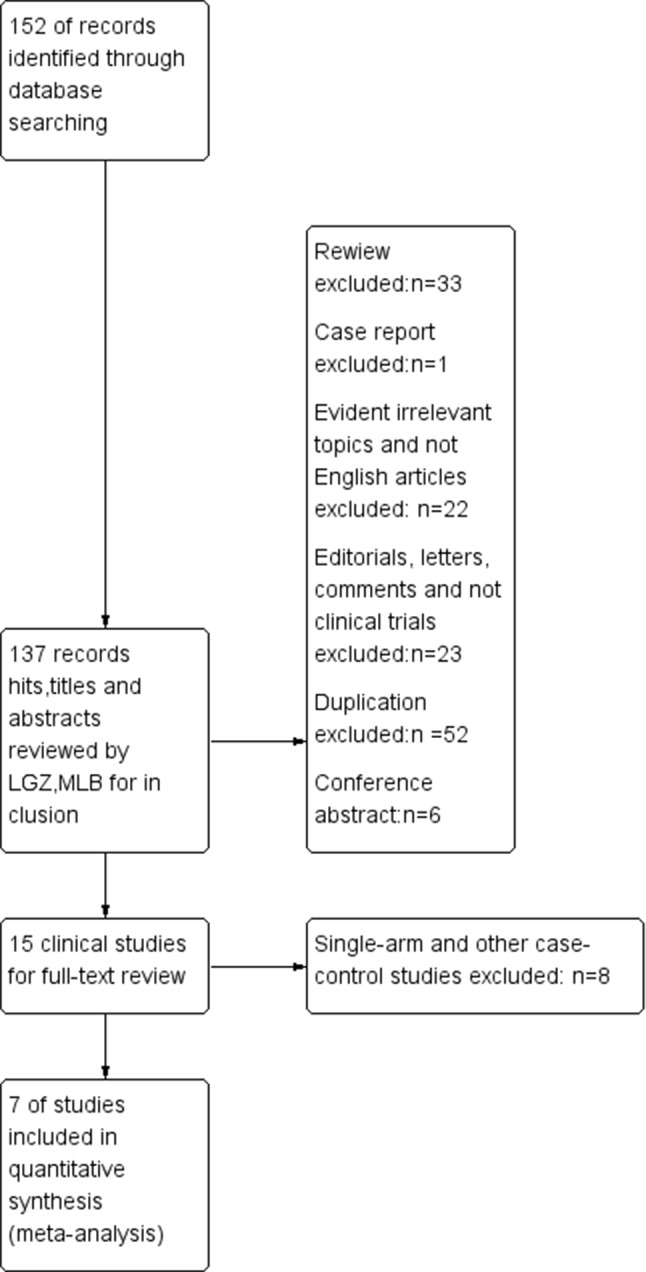
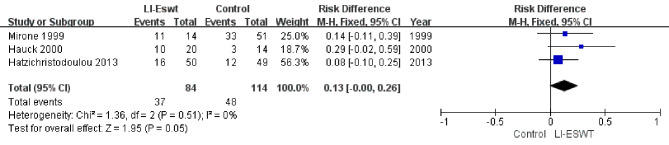
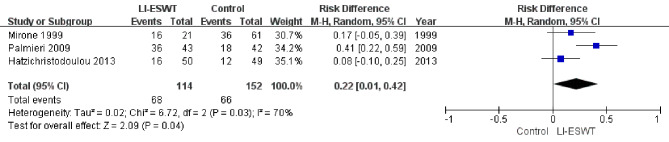
Results: There were 7 studies including 475 patients from 1999 to 2023. The meta-analysis of the data revealed that LI-ESWT could considerably enhance the proportion of men experiencing a reduction in penile plaques (RD 0.27, 95% CI: 0.04-0.50, P = 0.02), improvement in penile curvature (RD: 0.13; 95% CI, 0-0.26; p = 0.05), alleviation of pain (RD 0.22, 95% CI: 0.01-0.42, P = 0.04), and complete remission (RD 0.38, 95% CI 0.23-0.52, P < 0.00001). However, there were no significant differences in improvement of sexual function (MD: 1.44; 95% CI, -3.10-5.97; p = 0.53) between LI-ESWT and the placebo group.
Conclusions: According to these studies, LI-ESWT has the potential to decrease plaque size and improve penile curvature or pain in men with PD. The publication of robust evidence from additional well-designed long-term multicenter randomized controlled trials would provide more confidence regarding use of these devices in patients with PD.
Keywords: Controlled trial; Erection; Meta-analysis; Penile deviation; Peyronie’s disease; Plaque; Shock waves.
© 2024. The Author(s).
Conflict of interest statement
The authors declare no competing interests.
Figures







References
-
- El-Sakka AI. Medical, non-invasive, and minimally invasive treatment for Peyronie’s disease: a systematic review. Andrology. 2021;9(2):511–28. 10.1111/andr.12927. Epub 2020 Nov 14. PMID: 33098745. - PubMed
-
- Goldstein I, Lipshultz LI, McLane M, Hu Y, Xiang Q, Liu G, Vijayan S, Gelbard MK. Long-term safety and curvature deformity characterization in patients previously treated with collagenase clostridium Histolyticum for Peyronie’s Disease. J Urol. 2020;203(6):1191–7. Epub 2020 Jan 10. PMID: 31922462. - PubMed
-
- Chaussy C, Brendel W, Schmiedt E. Extracorporeally induced destruction of kidney stones by shock waves. Lancet. 1980;2(8207):1265-8. 10.1016/s0140-6736(80)92335-1. PMID: 6108446. - PubMed
Publication types
MeSH terms
LinkOut - more resources
Full Text Sources
Miscellaneous
