


Knowledge, attitudes, and practices of paediatric medical officers and registrars on the developmental origins of health and disease in a tertiary women's and children's hospital
- PMID: 39375655
- PMCID: PMC11459700
- DOI: 10.1186/s12909-024-06036-3
Knowledge, attitudes, and practices of paediatric medical officers and registrars on the developmental origins of health and disease in a tertiary women's and children's hospital
Abstract
Background: To mitigate the growing burden of non-communicable diseases, doctors training to become paediatricians should be equipped with concepts and knowledge regarding Developmental Origins of Health and Disease (DOHaD).
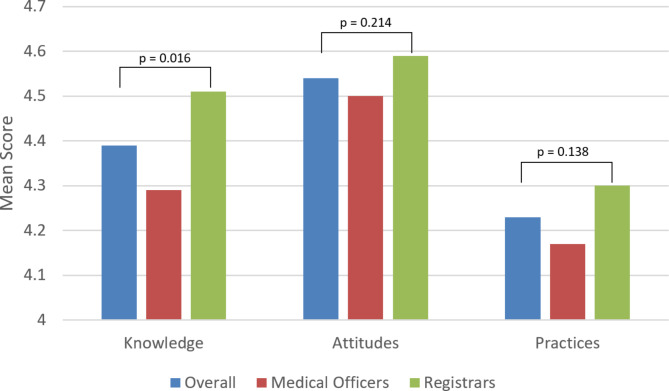
Methods: We assessed the knowledge, attitudes, and practices (KAP) of medical officers, resident physicians, as well as junior and senior residents practising in the paediatric department of a tertiary women's and children's hospital. This was done through a cross-sectional online survey, with questions developed after focused group discussions with domain experts, and responses based on a 5-point Likert scale.
Results: A total of 95 physicians met the inclusion criteria, grouped into Medical Officers (MOs) and Registrars (REGs), and we received a 100% response rate. Results showed that few physicians (n = 22, 23.2%) knew the term DOHaD, and majority rated their colleagues to be inadequately informed (n = 84, 88.4%). Among the physicians, one third (n = 32, 33.7%) were not confident in their ability to counsel patients about initiating healthy feeding practices to prevent future metabolic diseases in their children. However, there was a readiness to be better equipped with DOHaD principles and knowledge, and 95.8% (n = 91) strongly acknowledged the physician's responsibility to optimise early life determinants of cardiometabolic health.
Conclusion: In conclusion, the findings suggest a poor translation of DOHaD concepts, indicating that bridging the gap between DOHaD research knowledge and clinical application represents an unmet need. These principles should be inculcated early in the professional training of all healthcare providers.
Keywords: Attitudes; DOHaD; Knowledge; Medical education; Population health; Practices.
© 2024. The Author(s).
Conflict of interest statement
The authors declare no competing interests.
Figures
References
-
- Hanson MA, Gluckman PD. Developmental origins of health and disease–global public health implications. Best Pract Res Clin Obstet Gynaecol. 2015;29(1):24–31. - PubMed
-
- Penkler M, Hanson M, Biesma R, Müller R. DOHaD in science and society: emergent opportunities and novel responsibilities. J Dev Orig Health Dis. 2019;10(3):268–73. - PubMed
-
- Bianco-Miotto T, Craig JM, Gasser YP, van Dijk SJ, Ozanne SE. Epigenetics and DOHaD: from basics to birth and beyond. J Dev Orig Health Dis. 2017;8(5):513–9. - PubMed
-
- Forouzanfar MH, Alexander L, Anderson HR, Bachman VF, Biryukov S, Brauer M, et al. Global, regional, and national comparative risk assessment of 79 behavioural, environmental and occupational, and metabolic risks or clusters of risks in 188 countries, 1990–2013: a systematic analysis for the global burden of Disease Study 2013. Lancet. 2015;386(10010):2287–323. - PMC - PubMed
MeSH terms
LinkOut - more resources
Full Text Sources
Miscellaneous
