. 2024 Oct 7;23(1):224.
doi: 10.1186/s12943-024-02125-5.

Proapoptotic activity of JNK-sensitive BH3-only proteins underpins ovarian cancer response to replication checkpoint inhibitors

Affiliations

Proapoptotic activity of JNK-sensitive BH3-only proteins underpins ovarian cancer response to replication checkpoint inhibitors

Annapoorna Venkatachalam et al. Mol Cancer. .

Abstract

Recent studies indicate that replication checkpoint modulators (RCMs) such as inhibitors of CHK1, ATR, and WEE1 have promising monotherapy activity in solid tumors, including platinum-resistant high grade serous ovarian cancer (HGSOC). However, clinical response rates are generally below 30%. While RCM-induced DNA damage has been extensively examined in preclinical and clinical studies, the link between replication checkpoint interruption and tumor shrinkage remains incompletely understood. Here we utilized HGSOC cell lines and patient-derived xenografts (PDXs) to study events leading from RCM treatment to ovarian cancer cell death. These studies show that RCMs increase CDC25A levels and CDK2 signaling in vitro, leading to dysregulated cell cycle progression and increased replication stress in HGSOC cell lines independent of homologous recombination status. These events lead to sequential activation of JNK and multiple BH3-only proteins, including BCL2L11/BIM, BBC3/PUMA and the BMF, all of which are required to fully initiate RCM-induced apoptosis. Activation of the same signaling pathway occurs in HGSOC PDXs that are resistant to poly(ADP-ribose) polymerase inhibitors but respond to RCMs ex vivo with a decrease in cell number in 3-dimensional culture and in vivo with xenograft shrinkage or a significantly diminished growth rate. These findings identify key cell death-initiating events that link replication checkpoint inhibition to antitumor response in ovarian cancer.

Keywords: ATR inhibitor; Apoptosis; BH3 proteins; CHK1 inhibitor; High grade serous ovarian cancer; Replication stress; WEE1 inhibitor.


Conflict of interest statement

The authors declare no competing interests.

Figures

Fig. 1
Fig. 1
Analysis of RCM sensitivity in HGSOC PDXs ex vivo. A-D, Single-cell suspensions isolated from the indicated PDXs were plated and allowed to form 3D spheroids for 24 h. Cells were then treated with prexasertib, ceralasertib, or adavosertib for 72 h. Cell viability was assayed using RealTime-Glo™ MT Cell Viability Assay. Error bars, ± sem of three independent experiments. E, Association between % survival at 5 µM prexasertib (left, p = -0.02478) or ceralasertib and adavosertib (right, p = -0.4556 and 0.5437, respectively) with HRD score using Spearman correlation. F, Indicated protein levels across ovarian carcinoma PDX [ordered by % survival at 5 µM to prexasertib (Table S2), with most sensitive toward the left] with serial dilutions of Ovcar5 cells. G, PDXs that were tested for sensitivity to ceralasertib and adavosertib but not prexasertib (ordered by % survival at 5 µM to ceralasertib, with most sensitive on the right)
Fig. 2
Fig. 2
Response of HGSOC PDXs in vivo. Ceralasertib, adavosertib or olaparib were administered to mice bearing orthotopic HGSOC PDX models PH354 (A), PH235 (B), PH061 (C), or PH063 (D) with tumor growth measured by transabominal ultrasound. Following 4 weeks of treatment, tumor growth was observed for a minimum of 60 days unless the tumor met euthanasia criteria. The number of mice under observation is indicated below the x-axis, where text color indicates treatment arm. Shaded areas, 95% confidence intervals; pairwise comparisons for treatment arms are *, *** and ****: p < 0.05, p < 0.001, and p < 0.0001, respectively, for indicated global p value comparisons
Fig. 3
Fig. 3
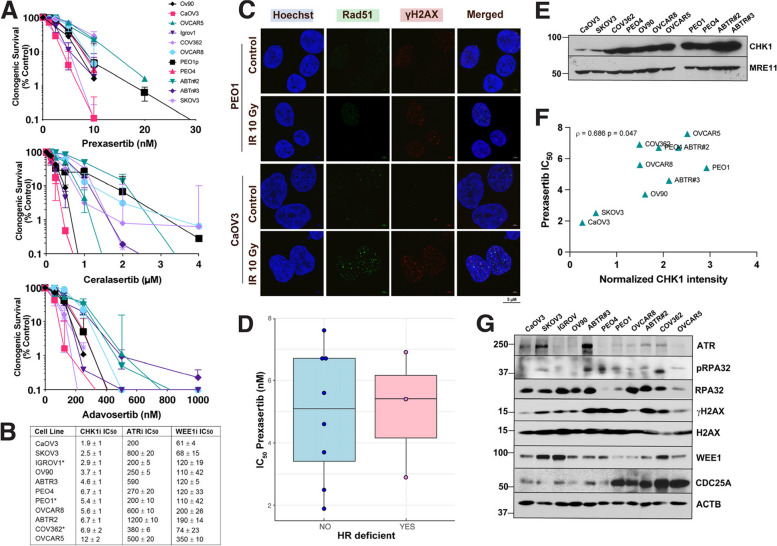
Effect of RCMs on HR deficient and HR proficient ovarian cancer cell lines. A, Cells were treated continuously with CHK1i (prexasertib), ATRi (ceralasertib) or WEE1i (adavosertib) in a clonogenic assay. Results are expressed as a percentage of colonies formed relative to cells treated with diluent alone. Error bars, ± sem from three or more independent experiments. B, Relative IC50s were estimated by linear regression from data in panel A. * indicates cell lines with a deleterious BRCA1 or BRCA2 mutation. C, To define HR status, cells were subjected to 10 Gy ionizing radiation, incubated for 6 h, fixed, co-stained for nuclear RAD51 and γH2AX, and imaged (100 cells/treatment). Scale bar = 5 µm D, Comparison of prexasertib IC50 in cells with HRD (n = 3) versus HR proficiency (n = 8) using Wilcoxon rank sum test, p = 0.918. E, CHK1 expression by immunoblotting with cell lines on the left ordered by IC50 to prexasertib and PEO1 cell line derivatives grouped to the right. F, Association between prexasertib IC50 and CHK1 levels (r = 0.686). G, Whole cell lysates from indicated cell lines (ordered by IC50 to prexasertib, with most sensitive on the left) were harvested for immunoblotting with β-actin (ACTB) as the loading control
Fig. 4
Fig. 4
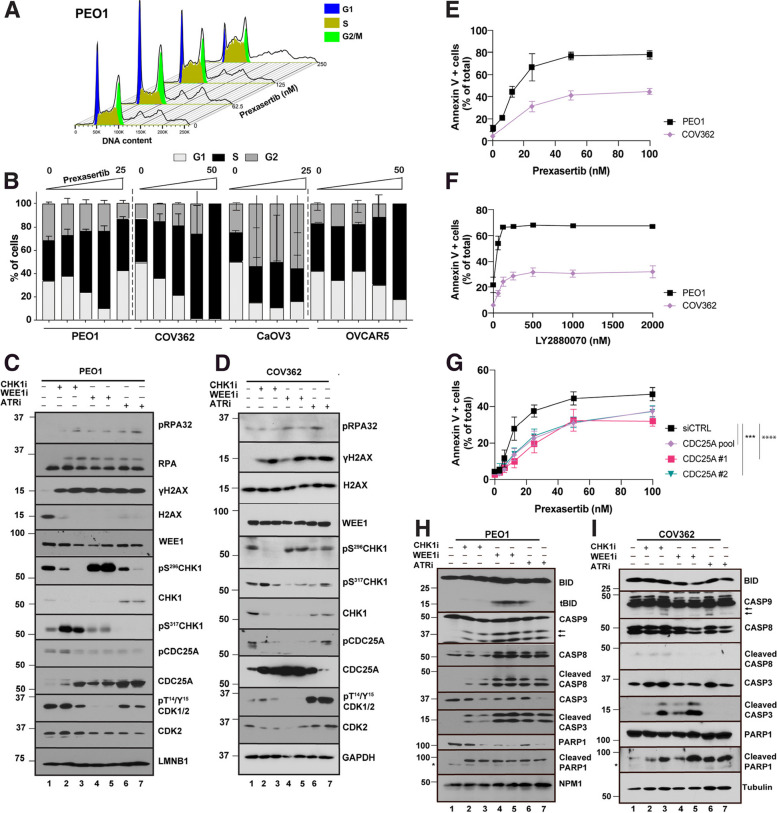
CDC25A contributes to CHK1i-induced apoptosis. A, Representative histogram showing cell cycle analysis in PEO1 cells treated with prexasertib for 24 h. B, Cell cycle distributions of PEO1, COV362, CaOV3, and Ovcar5 cells treated with increasing prexasertib for 24 h, stained with propidium iodide, and analyzed by flow cytometry. C, D, PEO1 (C) and COV362 (D) cells were treated with the caspase inhibitor Q-VD-OPh (5 µM) along with diluent, prexasertib (10 and 20 nM), ceralasertib (2 and 4 µM), or adavosertib (750 and 1000 nM) for 72 h and immunoblotted for indicated proteins. These concentrations were used in subsequent experiments unless otherwise specified. E, F, PEO1 and COV362 cells were treated with prexasertib (E) or LY2880070 (F) for 5 days and analyzed for Annexin V + cells by flow cytometry. G, Annexin V + cells in PEO1 cells treated with indicated siRNAs, followed by prexasertib treatment. siCDC25A pool vs siCTRL, ***p < 0.001; siCDC25A#1 vs siCTRL, ****p < 0.0001; siCDC25A#2 vs siCTRL, **p < 0.001 using two-way ANOVA with Dunnett’s multiple comparisons test. H, I, PEO1 cells (H) and COV362 cells (I) were treated for 72 h with diluent, prexasertib, ceralasertib, or adavosertib in the absence of caspase inhibitors and analyzed for cleavage of caspase substrates. Error bars in B and E–G, mean ± sem from 3 independent experiments. Arrows indicate cleavage products of caspase 9. * Indicates non-specific band
Fig. 5
Fig. 5
JNK and AP-1 stress responses promote CHK1i, ATRi and WEE1i apoptosis in ovarian carcinoma. A, Cells were treated with diluent or prexasertib (20 nM) for 48 h and analyzed by RNAseq. Biological replicates were prepared on three separate days. Heatmap comparing prexasertib treatment to vehicle in PEO1 (left) and COV362 (right). Differentially expressed apoptotic genes (|log2FC|> 2 and p < 0.05 by two-sided t-test, n = 3 per group) are noted in purple and orange. B, Aliquots of PEO1 and COV362 cells independent of those in panel A were treated for 48 h with prexasertib (20 nM) and assayed for the indicated mRNAs by qRT-PCR. C, D, PEO1 (C) and COV362 cells (D) treated with the caspase inhibitor Q-VD-OPh (5 µM) and diluent, prexasertib, ceralasertib, or adavosertib at the concentrations indicated for Fig. 4C were blotted for the indicated proteins. E, PEO1 cells were transfected with the indicated pools of siRNAs, treated with prexasertib for 5 days, and assayed for annexin V binding. F, Immunoblots to assess JNK levels in PEO1 cells transfected with the indicated siRNA pools. G, H, Pooled PEO1 cells transduced with empty vector (EV), FADD sgRNA (G) or BID sgRNA (H) were treated for 5 days with prexasertib and assayed for annexin binding. Error bars in B, E, G, and H, mean ± sem of 3 independent experiments. *, *** and ****: p < 0.05, p < 0.001 and p < 0.0001, respectively, for indicated comparison by unpaired t-test corrected for multiple comparisons. FADD−/− vs PEO1 EV p = 0.1585; PEO1p vs PEO1 EV p = 0.0786; BID−/− #2 vs PEO1 EV p = 0.1850; BID–/– #4 vs PEO1 EV p = 0.0286 using two-way ANOVA with Dunnett’s test for multiple comparisons
Fig. 6
Fig. 6
CHK1i, ATRi, and WEE1i-induced apoptosis is BAX- and BAK-dependent. A-F, Pooled PEO1 (A, C, E) or COV362 cells (B, D, F) transduced with empty vector (EV) or two separate BAX/BAK double knockout clones (DKO) were treated for 5 days with increasing prexasertib (A, B), ceralasertib (C, D), or adavosertib (E, F) and assayed for annexin binding. Error bars, mean ± sem for 3 or more independent experiments. DKO#1, DKO#6 vs PEO1 EV ****p < 0.0001, DKO#2, DKO#13 vs COV362 EV ****p < 0.0001 using two-way ANOVA with Dunnett’s test for multiple comparisons. G, Representative histogram showing CMXRos + cells treated with prexasertib for 5 days. Arrows indicate decrease in the fluorescence peak in prexasertib treated cells. H, Quantitation in PEO1 cells treated with increasing prexasertib, ceralasertib, or adavosertib concentrations for 5 days, stained with MitoTracker CMXRos, and analyzed by flow cytometry
Fig. 7
Fig. 7
CHK1i, ATRi, and WEE1i-induced apoptosis in ovarian cancer cells is driven by combined action of PUMA, BIM and BMF. A, PEO1 and COV362 cells were treated for 48 h with prexasertib (20 nM) and assayed for the indicated mRNA by qRT-PCR. Error bars, ± sem of 3 independent experiments. *, ** and ***, p < 0.05, p < 0.01, and p < 0.001 respectively, for indicated comparison by unpaired t-test corrected for multiple comparisons. B, C, PEO1 (B) and COV362 cells (C) were treated with the caspase inhibitor Q-VD-OPh (5 µM) and diluent, prexasertib, ceralasertib, or adavosertib as indicated for Fig. 4C for 72 h and immunoblotted for the indicated BH3 proteins. D, E, After PEO1 (D) and COV362 (E) cells treated with prexasertib (20 nM) + the caspase inhibitor Q-VD-OPh (5 µM) for 72 h, whole cell lysates, cytosol, and mitochondria were isolated and probed for the indicated proteins. GSTπ and MCL1 served as markers of the cytosolic and mitochondrial fractions respectively. F, 24 h after PEO1 cells were transfected with the indicated siRNAs, prexasertib (20 nM) was added for 5 days and cells were assayed for AnnexinV binding. Error bars, mean ± sem from 3 or more independent experiments. siPUMA-BIM and siPUMA-BMF vs siCTRL, p < 0.01; siPUMA-BIM-BMF-BID-NOXA (siPBBBN) vs siCTRL, p < 0.001; siPUMA-BIM-BMF (siPBB) vs siCTRL, p < 0.0001 using two-way ANOVA with Dunnett’s test for multiple comparisons. G, Immunoblots to assess BH3-only protein levels in PEO1 cells transfected with the indicated siRNA combinations. H, Schematic of BH3-only protein-mediated apoptosis induced by RCMs. I, Immunoblot analysis of potential response predictors in the two CCNEampMYCamp PDXs PH354 and PH235 (top, blue) in comparison to WT PDXs PH061 and PH063 (bottom, black). Each lane contains tumor from a single PDX-bearing mouse after 8 days of the indicated treatments. Dashed line indicates removal of lanes from mice on a separate study

References

    1. Siegel RL, Miller KD, Wagle NS, Jemal A. Cancer statistics, 2023. CA Cancer J Clin. 2023;73:17–48. - PubMed
    1. Geistlinger L, Oh S, Ramos M, Schiffer L, LaRue RS, Henzler CM, et al. Multiomic analysis of subtype evolution and heterogeneity in high-grade serous ovarian carcinoma. Cancer Res. 2020;80:4335–45. - PMC - PubMed
    1. Sung H, Ferlay J, Siegel RL, Laversanne M, Soerjomataram I, Jemal A, et al. Global cancer statistics 2020: GLOBOCAN estimates of incidence and mortality worldwide for 36 cancers in 185 countries. CA Cancer J Clin. 2021;71:209–49. - PubMed
    1. Konstantinopoulos PA, Ceccaldi R, Shapiro GI, D’Andrea AD. Homologous recombination deficiency: exploiting the fundamental vulnerability of ovarian cancer. Cancer Discov. 2015;5:1137–54. - PMC - PubMed
    1. Coleman RL, Oza AM, Lorusso D, Aghajanian C, Oaknin A, Dean A, et al. Rucaparib maintenance treatment for recurrent ovarian carcinoma after response to platinum therapy (ARIEL3): a randomised, double-blind, placebo-controlled, phase 3 trial. Lancet. 2017;390:1949–61. - PMC - PubMed

Substances