Clinical Trial
. 2025 Mar 17;110(4):951-960.
doi: 10.1210/clinem/dgae693.

Efficacy and Safety of TransCon PTH in Adults With Hypoparathyroidism: 52-Week Results From the Phase 3 PaTHway Trial

Affiliations
Clinical Trial

Efficacy and Safety of TransCon PTH in Adults With Hypoparathyroidism: 52-Week Results From the Phase 3 PaTHway Trial

Bart L Clarke et al. J Clin Endocrinol Metab. .

Erratum in

Abstract

Context: Conventional therapy for hypoparathyroidism aims to alleviate symptoms of hypocalcemia but does not address insufficient parathyroid hormone (PTH) levels.

Objective: Assess the long-term efficacy and safety of TransCon PTH (palopegteriparatide) for hypoparathyroidism.

Design: Phase 3 trial with a 26-week, double-blind, placebo-controlled period followed by a 156-week, open-label extension (OLE).

Setting: Twenty-one sites across North America and Europe.

Participants: A total of 82 adults with hypoparathyroidism were randomized and received study drug and 78 completed week 52.

Intervention(s): All OLE participants received TransCon PTH administered once daily.

Main outcome measure(s): Multicomponent efficacy endpoint: proportion of participants at week 52 who achieved normal serum calcium (8.3-10.6 mg/dL) and independence from conventional therapy (≤600 mg/day of elemental calcium and no active vitamin D). Other efficacy endpoints included patient-reported outcomes and bone mineral density. Safety was assessed by 24-hour urine calcium and treatment-emergent adverse events.

Results: At week 52, 81% (63/78) met the multicomponent efficacy endpoint, 95% (74/78) achieved independence from conventional therapy, and none required active vitamin D. Patient-reported outcomes showed sustained improvements in quality of life, physical functioning, and well-being. Mean bone mineral density Z-scores decreased toward age- and sex-matched norms from baseline to week 52. Mean (SD) 24-hour urine calcium excretion decreased from 376 (168) mg/day at baseline to 195 (114) mg/day at week 52. Most treatment-emergent adverse events were mild or moderate and none led to trial discontinuation during the OLE.

Conclusion: At week 52 of the PaTHway trial, TransCon PTH showed sustained efficacy, safety, and tolerability in adults with hypoparathyroidism.

Keywords: hormone replacement therapy; hypocalcemia; hypoparathyroidism; palopegteriparatide; parathyroid hormone; quality of life.


Figures

Figure 1.
Figure 1.
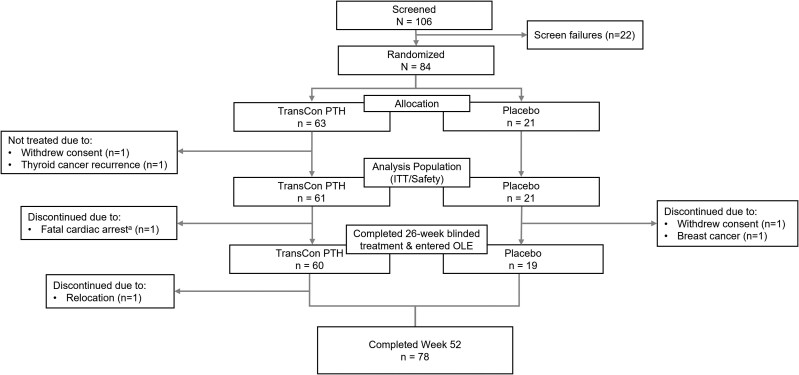
PaTHway trial participant disposition through week 52. A total of 106 participants were screened, 84 met eligibility criteria, and 82 were enrolled in the trial and were randomized to treatment. The intent-to-treat (ITT) analysis population comprised 61 participants in the TransCon PTH and 21 participants in the placebo group who received ≥1 blinded treatment. aFatal cardiac arrest deemed unrelated to study drug. OLE, open-label extension.
Figure 2.
Figure 2.
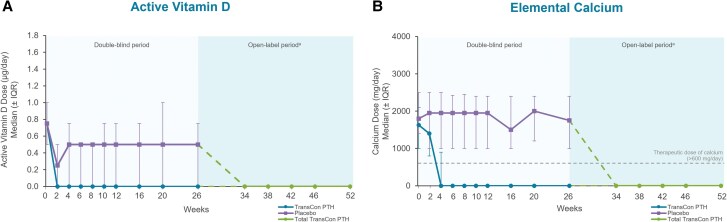
Conventional therapy doses through week 52 of the PaTHway trial. (A) Median (IQR) active vitamin D dose (µg/day). At week 52, none of the participants were taking active vitamin D daily. (B) Median (IQR) elemental calcium dose (mg/day). Per trial protocol, participants were permitted to take calcium ≤600 mg/day as a nutritional supplement, if needed, to meet the recommended dietary intake of calcium. aParticipants randomized to placebo during the blinded period initiated TransCon PTH treatment at week 26. Data are shown separately by randomized treatment allocation through week 26, after which all participants received TransCon PTH during the open-label period (dashed lines). Data are combined for all participants from week 34 through 52. IQR, interquartile range.
Figure 3.
Figure 3.
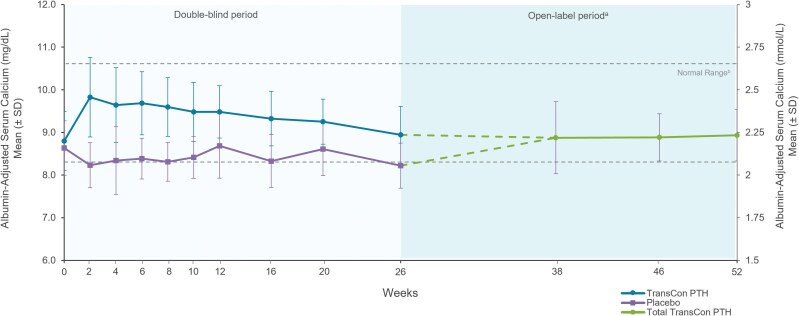
Albumin-adjusted serum calcium with TransCon PTH treatment through week 52. Albumin-adjusted serum calcium levels were maintained within the normal range at all time points in the OLE for all participants, with a mean of 8.9 mg/dL at week 52. aParticipants randomized to placebo during the blinded period initiated TransCon PTH treatment at week 26. Data are shown separately by randomized treatment allocation through week 26, after which all participants received TransCon PTH during the open-label period (dashed lines). Data are combined for all participants from week 38 through 52. bNormal range for serum calcium = 8.3-10.6 mg/dL (2.07-2.64 mmol/L).
Figure 4.
Figure 4.
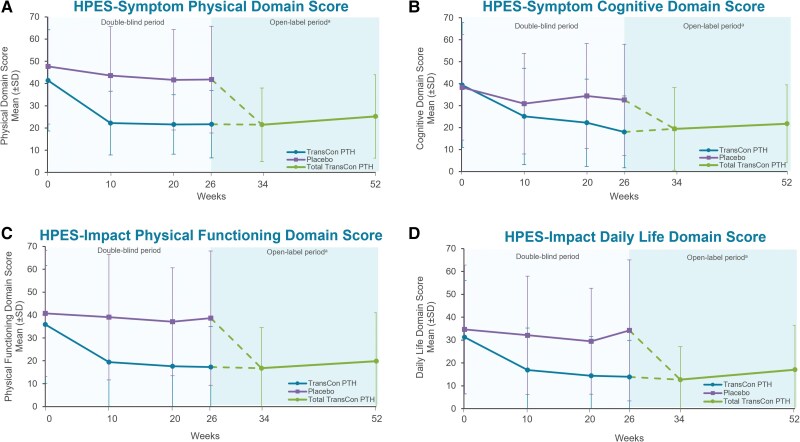
Long-term effect of TransCon PTH on participant-reported symptom burden and impact. The Hypoparathyroidism Patient Experience Scale (HPES) scores showed sustained improvements in hypoparathyroidism-related physical and cognitive symptoms and the impact of disease-specific symptoms on physical functioning and daily life with TransCon treatment at week 52. In participants first treated with placebo, HPES scores from weeks 26 to 52 showed the same rapid improvement as seen in participants treated with TransCon PTH during the blinded period. Higher HPES scores are associated with greater disease burden. aParticipants randomized to placebo during the blinded period initiated TransCon PTH treatment at week 26. Data are shown separately by randomized treatment allocation through week 26, after which all participants received TransCon PTH during the open-label period (dashed lines). Data are combined for all participants from week 34 through 52. Negative error bars (SD) are not displayed for values less than zero.
Figure 5.
Figure 5.
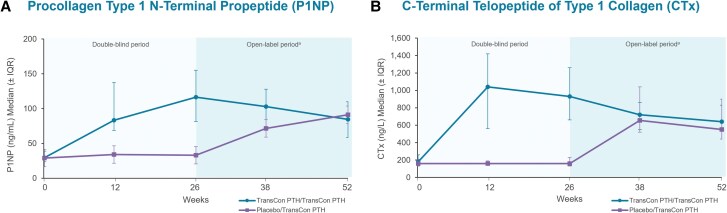
Bone turnover biomarkers through week 52. (A) Serum procollagen type 1 N-terminal propeptide (P1NP) in TransCon PTH/TransCon PTH participants increased from a median of 29.4 ng/mL at baseline to a peak of 116.5 ng/mL at week 26 and was 84.4 ng/mL at week 52. (B) In TransCon PTH/TransCon PTH participants serum C-terminal telopeptide of type 1 collagen (CTx) (baseline median 180.0 ng/L) peaked at 1040.0 ng/L at week 12 and was 640.0 ng/L at week 52. Normal serum biomarker ranges: P1NP (ng/mL) premenopausal women 15 to 59; postmenopausal women 16 to 74; men 14 to 86 and CTx (ng/L) premenopausal women 30 to 570; postmenopausal women 100 to 1010; men 18 to 30 years: 160 to 870; men 31 to 50 years: 90 to 630; men ≥51 years: 40 to 840. aParticipants randomized to placebo during the blinded period initiated TransCon PTH treatment at week 26. IQR, interquartile range.
Figure 6.
Figure 6.
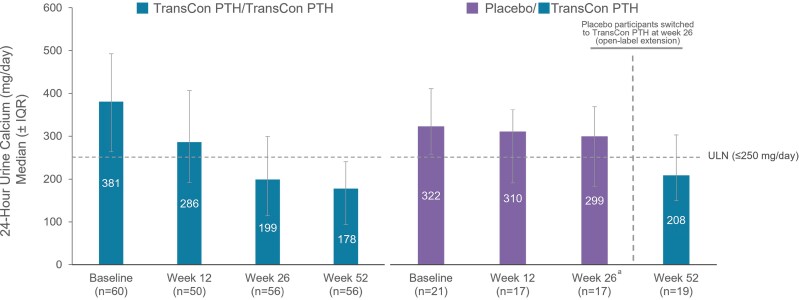
24-Hour urine calcium through week 52. At week 52 of the PaTHway trial, overall median (IQR) 24-hour urine calcium excretion with TransCon PTH was 188.0 (103, 254) mg/day. aParticipants randomized to placebo during the blinded period initiated TransCon PTH treatment at week 26.

References

    1. Brandi ML, Bilezikian JP, Shoback D, et al. Management of hypoparathyroidism: summary statement and guidelines. J Clin Endocrinol Metab. 2016;101(6):2273‐2283. - PubMed
    1. Shoback DM, Bilezikian JP, Costa AG, et al. Presentation of hypoparathyroidism: etiologies and clinical features. J Clin Endocrinol Metab. 2016;101(6):2300‐2312. - PubMed
    1. Khan AA, Bilezikian JP, Brandi ML, et al. Evaluation and management of hypoparathyroidism summary statement and guidelines from the second international workshop. J Bone Miner Res. 2022;37(12):2568‐2585. - PubMed
    1. Mannstadt M, Bilezikian JP, Thakker RV, et al. Hypoparathyroidism. Nat Rev Dis Primers. 2017;3(1):17055. - PubMed
    1. Kontogeorgos G, Mamasoula Z, Krantz E, Trimpou P, Landin-Wilhelmsen K, Laine CM. Low health-related quality of life in hypoparathyroidism and need for PTH analog. Endocr Connect. 2022;11(1):e210379. - PMC - PubMed

Publication types