


Ictal and Postictal Central Apnea in DEPDC5-Related Epilepsy
- PMID: 39376210
- PMCID: PMC11458130
- DOI: 10.1212/NXG.0000000000200183
Ictal and Postictal Central Apnea in DEPDC5-Related Epilepsy
Abstract
Objectives: DEPDC5-related epilepsy carries an increased risk of sudden unexpected death in epilepsy. We evaluated the occurrence and features of ictal central apnea (ICA) in patients with pathogenic sequence variant in DEPDC5.
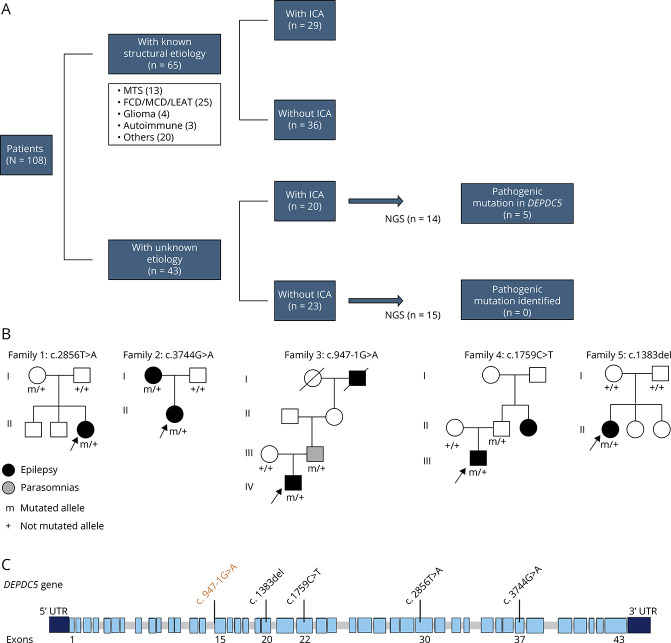
Methods: We reviewed data of 108 patients collected in 2 independent cohorts of patients with focal epilepsy who prospectively underwent long-term video-EEG monitoring (LTVM) with cardiorespiratory polygraphy. All patients underwent (1) at least an overnight polysomnography, (2) a high-field (3T) brain MRI study, and (3) CSF analysis when clinically indicated. Genetic testing (next-generation sequencing [NGS]) was offered for diagnostic purposes to patients with focal epilepsy of unknown etiology.
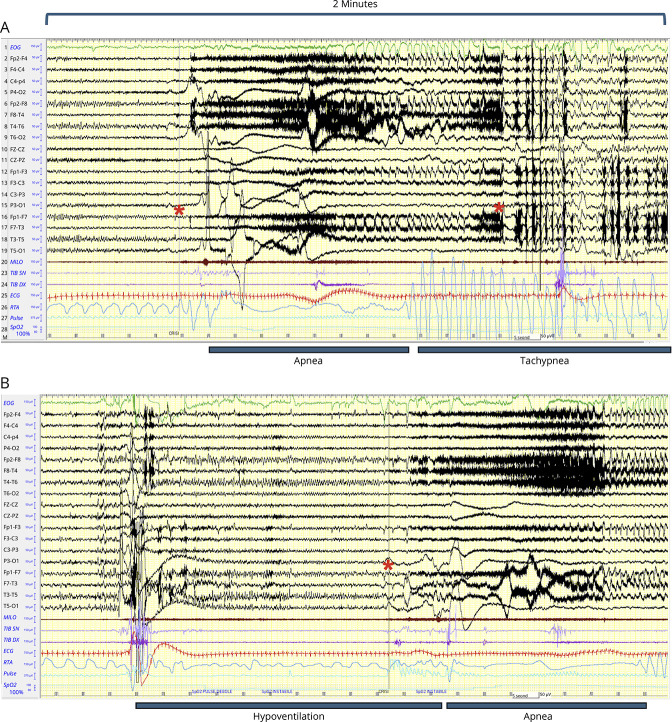
Results: In this cohort, NGS was finally performed in 29 patients, resulting in DEPDC5 pathogenic mutations in 5 patients. According to the presence of ictal apnea events, 5 of 14 patients with ICA showed pathogenic DEPDC5 variants (35%) while none of the 15 patients without ICA showed pathogenic mutation. Notably, DEPDC5 patients showed ICA in all recorded seizures (n = 15) with apnea duration ranging from 20 seconds to more than 1 minute. All seizures were characterized by motor arrest without overt automatic behaviors during ictal apnea. Scalp EEG showed the involvement of temporal lobe leads in all events. Severe oxygen desaturation was observed in 2 cases.
Discussion: In our cohort, ictal central apnea was a common finding in DEPDC5. These results support (1) the need for respiratory polygraphy during LTVM in DEPDC5-related epilepsy and (2) the potential relevance of genetic testing in patients with focal epilepsy of unknown etiology and ictal apnea.
Copyright © 2024 The Author(s). Published by Wolters Kluwer Health, Inc. on behalf of the American Academy of Neurology.
Conflict of interest statement
S. Meletti received research grant support from the Ministry of Health (MOH); has received personal compensation as scientific advisory board member for UCB, Jazz pharmaceuticals, and EISAI. A.E. Vaudano has received speaker's or consultancy fees from Angelini. M. Burani, G. Giovannini, M. Pugnaghi, E. Micalizzi report no disclosures. P. Bonanni has received speaker's or consultancy fees from Angelini, EISAI, Livanova. G.M. Duma, A. Danieli, E. Osanni, F. Mambretti report no disclosures. Go to Neurology.org/NG for full disclosures.
Figures
References
-
- Harden C, Tomson T, Gloss D, et al. . Practice guideline summary: sudden unexpected death in epilepsy incidence rates and risk factors: report of the guideline development, dissemination, and implementation Subcommittee of the American Academy of neurology and the American Epilepsy Society. Neurology. 2017;88(17):1674-1680. doi:10.1212/WNL.0000000000003685 - DOI - PubMed
-
- Baulac S, Baldassari S. DEPDC5-related epilepsy. 2016. [updated 2023 Mar 9]. In: Adam MP, Feldman J, Mirzaa GM, et al., eds. GeneReviews® [Internet]. : University of Washington, Seattle; 1993-2024.
LinkOut - more resources
Full Text Sources
Miscellaneous