


Increased neutrophil counts are associated with poor overall survival in patients with colorectal cancer: a five-year retrospective analysis
- PMID: 39376564
- PMCID: PMC11456424
- DOI: 10.3389/fimmu.2024.1415804
Increased neutrophil counts are associated with poor overall survival in patients with colorectal cancer: a five-year retrospective analysis
Erratum in
-
Corrigendum: Increased neutrophil counts are associated with poor overall survival in patients with colorectal cancer: a five-year retrospective analysis.Front Immunol. 2024 Oct 22;15:1508462. doi: 10.3389/fimmu.2024.1508462. eCollection 2024. Front Immunol. 2024. PMID: 39502697 Free PMC article.
-
Corrigendum: Increased neutrophil counts are associated with poor overall survival in patients with colorectal cancer: a five-year retrospective analysis.Front Immunol. 2025 Mar 20;16:1583828. doi: 10.3389/fimmu.2025.1583828. eCollection 2025. Front Immunol. 2025. PMID: 40181960 Free PMC article.
Abstract
Background: Colorectal cancer (CRC) continues to be a major health concern in today's world. Despite conflictive findings, evidence supports systemic inflammation's impact on CRC patients' survival rates. Therefore, this study aims to assess the prognostic role of the innate immune system in patients with CRC.
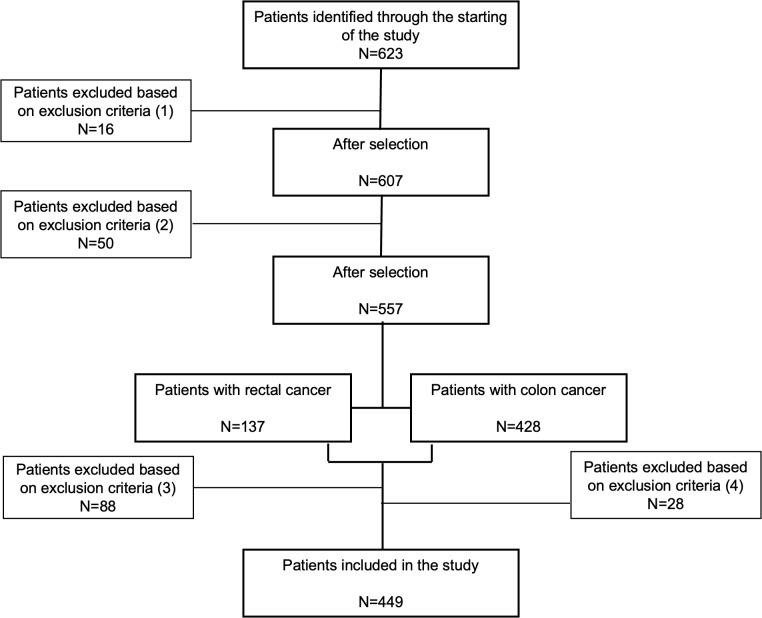
Method: A total of 449 patients were included, with a 5-year follow-up period, and absolute neutrophil counts and their related ratios were measured.
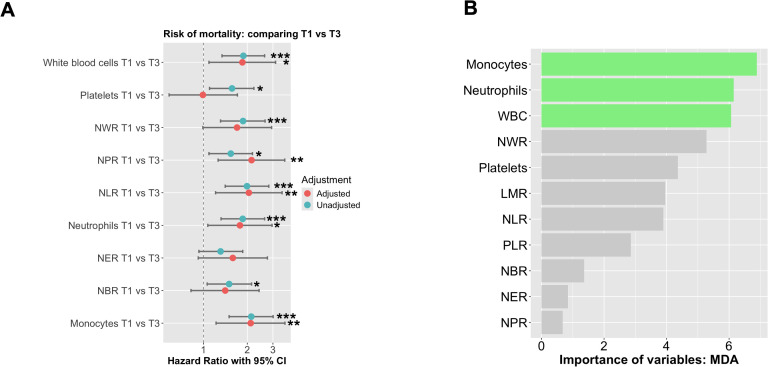
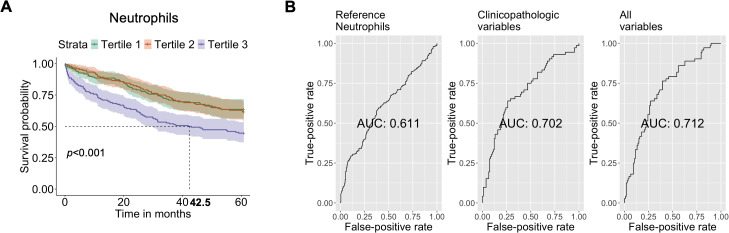
Results: The non-survival group had increased levels of white blood cells, neutrophils (both p<0.001), and monocytes (p=0.038), compared to the survival group, along with other neutrophil-related ratios. We observed increased mortality risk in patients in the highest tertile of white blood cells [HR=1.85 (1.09-3.13), p<0.05], neutrophils [HR=1.78 (95% CI: 1.07-2.96), p<0.05], and monocytes [HR=2.11 (95% CI: 1.22-3.63)], compared to the lowest tertile, after adjusting for all clinicopathological variables. Random forest analysis identified neutrophils as the most crucial variable in predicting survival rates, having an AUC of 0.712, considering all clinicopathological variables. A positive relationship between neutrophil counts and metastasis was observed when neutrophil counts are considered continuous (β=0.92 (0.41), p<0.05) and tumor size (width) when neutrophils were considered as logistic variable (T1 vs T3) [OR=1.42, (95% CI: 1.05-1.98), p<0.05].
Conclusion: This study offers comprehensive insights into the immune factors that impact the prognosis of CRC, emphasizing the need for personalized prognostic tools.
Keywords: colorectal cancer; inflammation; neutrophils; overall survival; prognosis.
Copyright © 2024 Garcia-Flores, Dawid De Vera, Pilo, Rego, Gomez-Casado, Arranz-Salas, Hierro Martín, Alcaide, Torres, Ortega-Gomez, Boughanem and Macias-Gonzalez.
Conflict of interest statement
The authors declare that the research was conducted in the absence of any commercial or financial relationships that could be construed as a potential conflict of interest.
Figures
References
MeSH terms
LinkOut - more resources
Full Text Sources
Medical
