


Interplay between preclinical indices of obesity and neural signatures of fluid intelligence in youth
- PMID: 39379610
- PMCID: PMC11461743
- DOI: 10.1038/s42003-024-06924-w
Interplay between preclinical indices of obesity and neural signatures of fluid intelligence in youth
Abstract
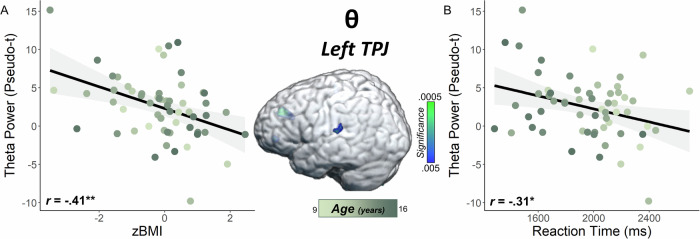
Pediatric obesity rates have quadrupled in the United States, and deficits in higher-order cognition have been linked to obesity, though it remains poorly understood how deviations from normal body mass are related to the neural dynamics serving cognition in youth. Herein, we determine how age- and sex-adjusted measures of body mass index (zBMI) scale with neural activity in brain regions underlying fluid intelligence. Seventy-two youth aged 9-16 years underwent high-density magnetoencephalography while performing an abstract reasoning task. The resulting data were transformed into the time-frequency domain and significant oscillatory responses were imaged using a beamformer. Whole-brain correlations with zBMI were subsequently conducted to quantify relationships between zBMI and neural activity serving abstract reasoning. Our results reveal that participants with higher zBMI exhibit attenuated theta (4-8 Hz) responses in both the left dorsolateral prefrontal cortex and left temporoparietal junction, and that weaker temporoparietal responses scale with slower reaction times. These findings suggest that higher zBMI values are associated with weaker theta oscillations in key brain regions and altered performance during an abstract reasoning task. Thus, future investigations should evaluate neurobehavioral function during abstract reasoning in youth with more severe obesity to identify the potential impact.
© 2024. The Author(s).
Conflict of interest statement
The authors declare no competing interests.
Figures



References
-
- World Health Organization. Noncommunicable diseases: Childhood overweight and obesity. https://www.who.int/news-room/questions-and-answers/item/noncommunicable... (2020).
-
- Fryar, C. D., Carroll, M. D. & Afful, J. Prevalence of overweight, obesity, and severe obesity among children and adolescents aged 2–19 years: United States, 1963–1965 through 2017–2018. NCHS Health E-Stats. https://www.cdc.gov/nchs/data/hestat/obesity-child-17-18/obesity-child.htm (2020).
MeSH terms
Grants and funding
- F31 DA056296/DA/NIDA NIH HHS/United States
- F31-DA056296/U.S. Department of Health & Human Services | NIH | National Institute on Drug Abuse (NIDA)
- R01 MH121101/MH/NIMH NIH HHS/United States
- R21-ES035146/U.S. Department of Health & Human Services | NIH | National Institute of Environmental Health Sciences (NIEHS)
- 2112455/National Science Foundation (NSF)
- R01 MH116782/MH/NIMH NIH HHS/United States
- R01-MH121101/U.S. Department of Health & Human Services | NIH | National Institute of Mental Health (NIMH)
- R01-MH116782/U.S. Department of Health & Human Services | NIH | National Institute of Mental Health (NIMH)
- P20 GM144641/GM/NIGMS NIH HHS/United States
- P20-GM144641/U.S. Department of Health & Human Services | NIH | National Institute of General Medical Sciences (NIGMS)
- R21 ES035146/ES/NIEHS NIH HHS/United States
- 1539067/National Science Foundation (NSF)
- R21-DC020270/U.S. Department of Health & Human Services | NIH | National Institute on Deafness and Other Communication Disorders (NIDCD)
- R01 EB020407/EB/NIBIB NIH HHS/United States
- R21 DC020270/DC/NIDCD NIH HHS/United States
LinkOut - more resources
Full Text Sources
