


Updated overall survival and ctDNA analysis in patients with EGFR T790M-positive advanced non-small cell lung cancer treated with lazertinib in the phase 1/2 LASER201 study
- PMID: 39379931
- PMCID: PMC11462748
- DOI: 10.1186/s12916-024-03620-8
Updated overall survival and ctDNA analysis in patients with EGFR T790M-positive advanced non-small cell lung cancer treated with lazertinib in the phase 1/2 LASER201 study
Abstract
Background: Lazertinib is a potent, irreversible, third-generation epidermal growth factor receptor (EGFR) tyrosine kinase inhibitor (TKI) with significant efficacy in patients with EGFR T790M-mutated non-small cell lung cancer (NSCLC). This is the final overall survival (OS) report from the phase 1/2 LASER201 study in patients with advanced NSCLC with disease progression on or after prior EGFR TKI therapy.
Methods: Eligible patients were aged ≥ 20 years, with advanced EGFR-mutated NSCLC and previous therapy with EGFR TKI. Patients in this integrated analysis received oral lazertinib 240 mg/day. Endpoints included efficacy and safety; exploratory analyses included associations between circulating EGFR-mutant tumor DNA (ctDNA) and efficacy parameters.
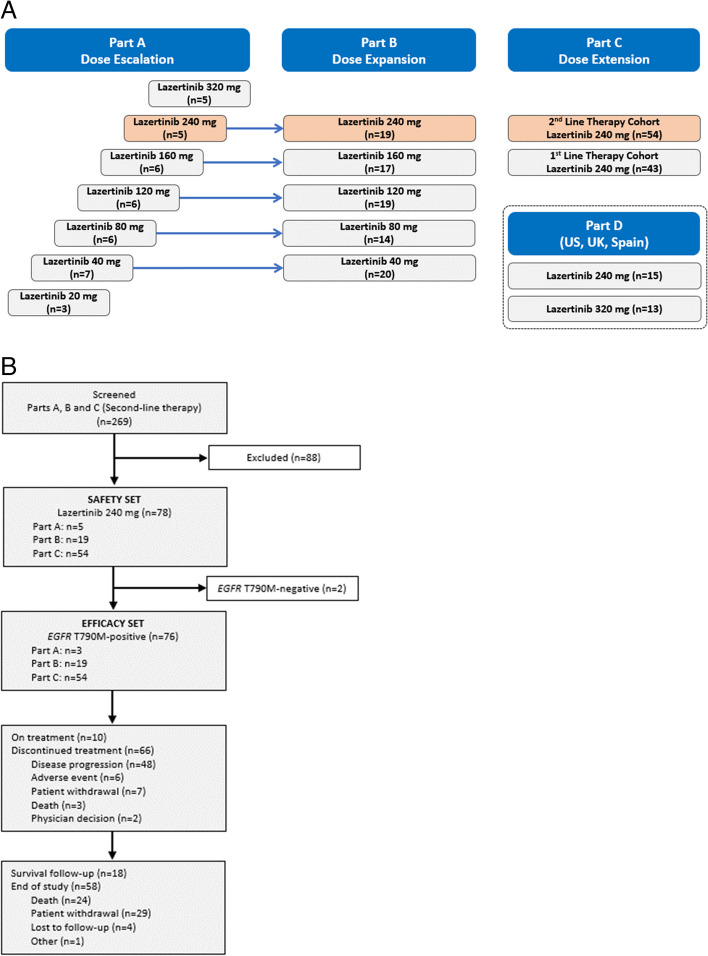
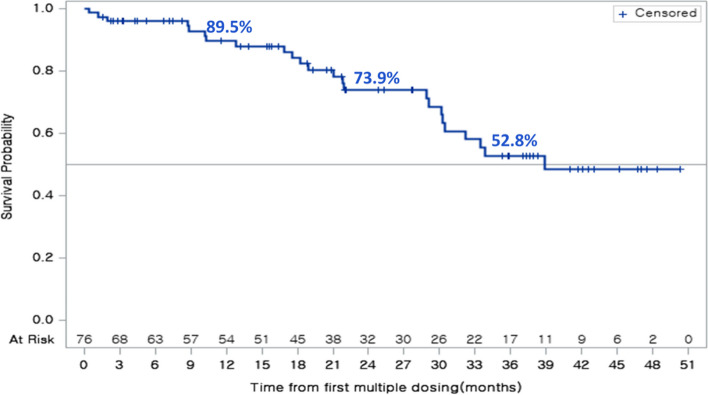
Results: This integrated analysis included 78 patients in Korea who received second- or later-line lazertinib. The median OS was 38.9 months; estimated survival rates at 12, 24, and 36 months were 89.5%, 73.9%, and 52.8%, respectively. The cumulative 12-month incidence of central nervous system progression was 9.4%. EGFR-mutant ctDNA was detected in 46 patients (62.2%) at baseline. The presence of ctDNA at baseline significantly predicted progression-free survival (PFS), disease control rate (DCR), and OS. PFS, response rate, and DCR were significantly associated with EGFR-mutant ctDNA clearance at cycle 3; PFS and OS were significantly associated with ctDNA clearance at cycle 5. The safety profile of lazertinib 240 mg/day was consistent with previous findings.
Conclusions: Lazertinib is a promising treatment option for patients with EGFR T790M-positive NSCLC following disease progression on prior EGFR-directed TKIs. Patients in LASER201 experienced prolonged OS, regardless of their EGFR mutation, brain metastases, or prior brain radiation status. Clearance of plasma EGFR mutations after lazertinib was associated with patient outcomes.
Trial registration: ClinicalTrials.gov identifier NCT03046992.
Keywords: Lazertinib; NSCLC; Overall survival; TKI; ctDNA.
© 2024. The Author(s).
Conflict of interest statement
Ji-Youn Han reports: grants or contracts from Takeda, Ono, Roche, and Pfizer; consulting fees from AstraZeneca, Takeda, Amgen, Janssen, Merck, Novartis, J INTS Bio, Oncobix, and Daiichi Sancho; payments or honoraria for lectures, presentations, speakers’ bureaux, or writing from AstraZeneca, Takeda, Janssen, Pfizer, Merck, Novartis, and Yuhan; payment for expert testimony from AstraZeneca; payment for participating in data safety monitoring boards or advisory boards for AstraZeneca, Janssen, J INTS Bio, and Abion; leadership or fiduciary role in Health Insurance Review and Assessment.
Byoung Chul Cho reports: research funding from MOGAM Institute, LG Chem, Oscotec, Interpark Bio Convergence Corp, GIInnovation, GI-Cell, Abion, Abbvie, AstraZeneca, Bayer, Blueprint Medicines, Boehringer Ingelheim, Champions Oncology, CJ Bioscience, CJ Blossom Park, Cyrus, Dizal Pharma, Genexine, Janssen, Lilly, MSD, Novartis, Nuvalent, Oncternal, Ono, Regeneron, Dong-A ST, Bridgebio therapeutics, Yuhan, ImmuneOncia, Illumina, Kanaph Therapeutics, Therapex, J INT Sbio, Hanmi, CHA Bundang Medical Center, and Vertical Bio AG; royalties from Champions Oncology, Crown Bioscience, Imagen, and Pearl River Bio GmbH; consulting fees from Abion, BeiGene, Novartis, AstraZeneca, Boehringer-Ingelheim, Roche, BMS, CJ, CureLogen, Cyrus Therapeutics, Ono, Onegene Biotechnology, Yuhan, Pfizer, Eli Lilly, GI-Cell, Guardant, HK Inno-N, Imnewrun Biosciences Inc., Janssen, Takeda, MSD, Janssen, Medpacto, Blueprint Medicines, and RandBio, Hanmi; payments for presentations from ASCO, AstraZeneca, Guardant, Roche, ESMO, IASLC, Korean Cancer Association, Korean Society of Medical Oncology, Korean Society of Thyroid-Head and Neck Surgery, Korean Cancer Study Group, Novartis, MSD, The Chinese Thoracic Oncology Society, Pfizer; payments for advisory boards from KANAPH Therapeutic Inc, BridgeBio, Cyrus Therapeutics, Guardant Health, Oscotec Inc, J INTS BIO, Therapex Co., Ltd, Gliead, and Amgen; membership of the board of directors of J INTS BIO; stock ownership in TheraCanVac Inc, Gencurix Inc, BridgeBio, KANAPH Therapeutic Inc, Cyrus Therapeutics, Interpark Bio Convergence Corp., and J INTS BIO; employee of Yonsei University Health System; and founder of DAAN Biotherapeutics.
Myung-Ju Ahn reports: consulting fees from AstraZeneca, Roche, MSD, Merck, Takeda, ONO, Novartis, Lilly, Amgen, Yuhan Corporation, and Alpha Pharmaceuticals; and payments or honoraria for lectures, presentations, speakers’ bureaux, or writing from AstraZeneca, Roche, MSD, Merck, Takeda, Ono, Novartis, Lilly, Amgen, and Yuhan Corporation.
Ki Hyeong Lee reports: grants or contracts from Merck Serono; and consulting fees from MSD, Pfizer, Eli Lilly, Yuhan, AstraZeneca, and BMS.
Yun-Gyoo Lee reports: payments or honoraria for lectures, presentations, speakers’ bureaux, or writing from AstraZeneca, MSD, Yuhan, Lilly, and Boehringer Ingelheim; payment for participating in data safety monitoring boards or advisory boards for BeiGene, Takeda, Guardant Health, Yuhan Corporation, Ono, and Novartis.
Dong-Wan Kim reports: clinical trial research funding (to institution) from Alpha Biopharma, Amgen, AstraZeneca, Boehringer-Ingelheim, BridgeBio, BMS, Chong Keun Dang, Daiichi-Sankyo, GSK, Hanmi, Janssen, Merck, Meurs, Mirati, MSD, Novartis, ONO Pharmaceutical, Pfizer, Roche/Genentech, Takeda, TP Therapeutics, Xcovery; laboratory research funding (to institution) from InnoN; medical writing assistance from Amgen, AstraZeneca, Boehringer-Ingelheim, BridgeBio, BMS, Chong Keun Dang, Daiichi-Sankyo, GSK, Pfizer, MSD, Merck, Merus, Novartis, Roche, Takeda; honoraria from the Korean Association for Lung Cancer, Korean Cancer Association, Korean Society of Medical Oncology, Taiwan Lung Cancer Society, Asian Thoracic Oncology Research Group; travel support for attending meetings from the International Association for the Study of Lung Cancer, Asian Thoracic Oncology Research Group, and the Taiwan Lung Cancer Society; unpaid participation on advisory boards for Amgen, AstraZeneca, BMS/ONO Pharmaceuticals, Daiichi-Sankyo, GSK, Janssen, Meck, MSD, Pfizer, SK Biopharm, and Takeda; member of board of directors for the Asian Thoracic Oncology Research Group, Korean Association for Lung Cancer, Korean Cancer Association, Korean Society of Medical Oncology; and paid scientific advisor for the Health Insurance Review and Assessment Service, Republic of Korea.
Young Joo Min reports no conflicts.
Sang-We Kim reports no conflicts.
Eun Kyung Cho reports participation in a data safety monitoring meeting for the Yuhan Corporation for the present study and receipt of study drug from the Yuhan Corporation for the present study.
Joo-Hang Kim reports no conflicts.
Gyeong-Won Lee reports no conflicts.
Sung Sook Lee reports no conflicts.
Na Mi Lee is employed by the Yuhan Corporation.
Hyun Woo Jang is employed by the Yuhan Corporation.
Heewon Han is employed by the Yuhan Corporation.
Hyejoo Park is employed by the Yuhan Corporation.
Jieon Lee is employed by the Yuhan Corporation.
Figures
References
-
- Oxnard GR, Arcila ME, Sima CS, Riely GJ, Chmielecki J, Kris MG, Pao W, Ladanyi M, Miller VA. Acquired resistance to EGFR tyrosine kinase inhibitors in EGFR-mutant lung cancer: distinct natural history of patients with tumors harboring the T790M mutation. Clin Cancer Res. 2011;17(6):1616–22. - PMC - PubMed
-
- Planchard D, Popat S, Kerr K, Novello S, Smit EF, Faivre-Finn C, Mok TS, Reck M, Van Schil PE, Hellmann MD, et al. Metastatic non-small cell lung cancer: ESMO Clinical Practice Guidelines for diagnosis, treatment and follow-up. Ann Oncol. 2018;29(Suppl 4):iv192–237. - PubMed
-
- Wu YL, Planchard D, Lu S, Sun H, Yamamoto N, Kim DW, Tan DSW, Yang JC, Azrif M, Mitsudomi T, et al. Pan-Asian adapted Clinical Practice Guidelines for the management of patients with metastatic non-small-cell lung cancer: a CSCO-ESMO initiative endorsed by JSMO, KSMO, MOS, SSO and TOS. Ann Oncol. 2019;30(2):171–210. - PubMed
-
- Lau SCM, Ou SI. And still they come over troubled waters: Can Asia’s third-generation EGFR tyrosine kinase inhibitors (furmonertinib, aumolertinib, rezivertinib, limertinib, befotertinib, SH-1028, and lazertinib) affect global treatment of EGFR+ NSCLC. J Thorac Oncol. 2022;17(10):1144–54. - PubMed
Publication types
MeSH terms
Substances
Associated data
LinkOut - more resources
Full Text Sources
Medical
Research Materials
Miscellaneous
