. 2024 Oct 8;22(1):223.
doi: 10.1186/s12915-024-02017-6.

Global analysis of neuropeptide receptor conservation across phylum Nematoda

Affiliations

Global analysis of neuropeptide receptor conservation across phylum Nematoda

Luca Golinelli et al. BMC Biol. .

Abstract

Background: The phylum Nematoda is incredibly diverse and includes many parasites of humans, livestock, and plants. Peptide-activated G protein-coupled receptors (GPCRs) are central to the regulation of physiology and numerous behaviors, and they represent appealing pharmacological targets for parasite control. Efforts are ongoing to characterize the functions and define the ligands of nematode GPCRs, with already most peptide GPCRs known or predicted in Caenorhabditis elegans. However, comparative analyses of peptide GPCR conservation between C. elegans and other nematode species are limited, and many nematode GPCRs remain orphan. A phylum-wide perspective on peptide GPCR profiles will benefit functional and applied studies of nematode peptide GPCRs.

Results: We constructed a pan-phylum resource of C. elegans peptide GPCR orthologs in 125 nematode species using a semi-automated pipeline for analysis of predicted proteome datasets. The peptide GPCR profile varies between nematode species of different phylogenetic clades and multiple C. elegans peptide GPCRs have orthologs across the phylum Nematoda. We identified peptide ligands for two highly conserved orphan receptors, NPR-9 and NPR-16, that belong to the bilaterian galanin/allatostatin A (Gal/AstA) and somatostatin/allatostatin C (SST/AstC) receptor families. The AstA-like NLP-1 peptides activate NPR-9 in cultured cells and are cognate ligands of this receptor in vivo. In addition, we discovered an AstC-type peptide, NLP-99, that activates the AstC-type receptor NPR-16. In our pan-phylum resource, the phylum-wide representation of NPR-9 and NPR-16 resembles that of their cognate ligands more than those of allatostatin-like peptides that do not activate these receptors.

Conclusions: The repertoire of C. elegans peptide GPCR orthologs varies across phylogenetic clades and several peptide GPCRs show broad conservation in the phylum Nematoda. Our work functionally characterizes the conserved receptors NPR-9 and NPR-16 as the respective GPCRs for the AstA-like NLP-1 peptides and the AstC-related peptide NLP-99. NLP-1 and NLP-99 are widely conserved in nematodes and their representation matches that of their receptor in most species. These findings demonstrate the conservation of a functional Gal/AstA and SST/AstC signaling system in nematodes. Our dataset of C. elegans peptide GPCR orthologs also lays a foundation for further functional studies of peptide GPCRs in the widely diverse nematode phylum.

Keywords: C. elegans; Nematodes; Neuropeptide; Peptide GPCR; Phylogenetics.


Conflict of interest statement

The authors declare that they have no competing interests.

Figures

Fig. 1
Fig. 1
In silico pipeline for identifying C. elegans NP-GPCR orthologs in the nematode phylum. A resource of 161 known and predicted C. elegans NP-GPCRs was used to search for homologs in predicted proteomes of 125 nematode species using a Hidden Markov Model (hhmbuild, hmmsearch and hmmtop), yielding 15,929 protein sequences. The predicted NP-GPCRs were used in clustering and phylogenetic analyses to identify orthologs of C. elegans NP-GPCR candidates. Orphan NP-GPCR candidates of C. elegans that show broad conservation in the nematode phylum (C50H11.13, F13H6.5, F59D12.1, FRPR-5, NPR-9, NPR-16, and NPR-19) are prioritized for functional studies. MSA, Multiple Sequence Alignment; TM, TransMembrane; CLANS, CLuster ANalysis of Sequences
Fig. 2
Fig. 2
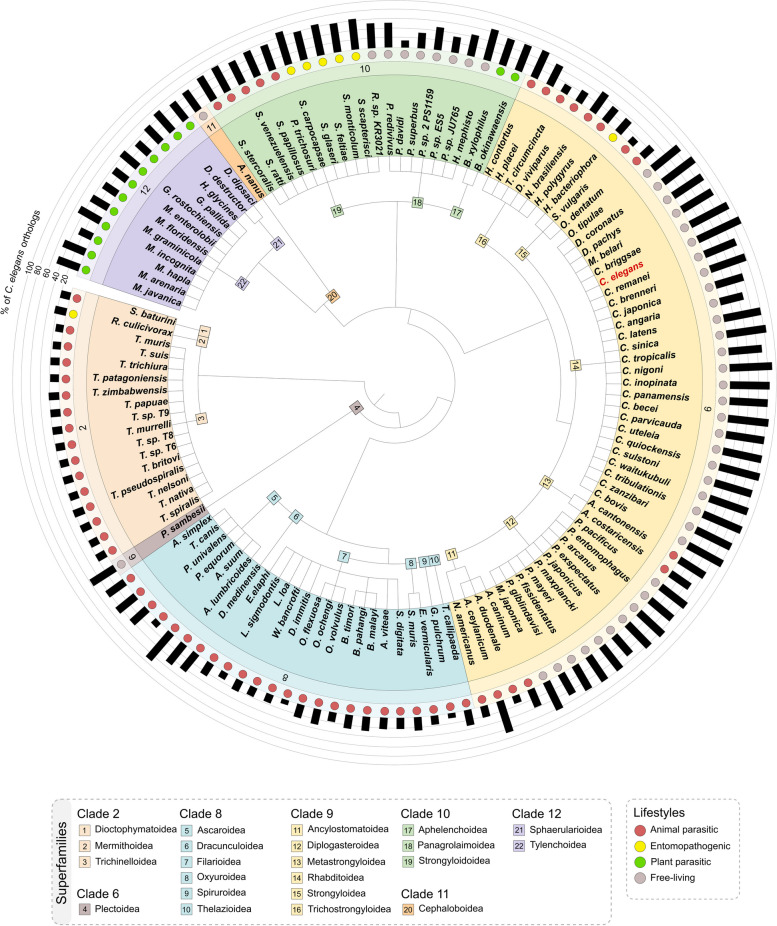
Cladogram of nematode species used in this study. To construct a pan-phylum resource of putative nematode NP-GPCRs, we used predicted proteomes of 125 nematode species, covering 7 out of 12 nematode clades (2, 6, 8, 9, 10, 11, 12 according to Holterman et al. [38]). Clade 9 is the most represented clade with 50 species, whereas for clades 6 and 11 only one species was found for which a predicted protein dataset was available. Boxed numbers indicate superfamilies within each clade [19, 20, 111]. Nematode lifestyles are classified as animal parasitic, entomopathogenic, plant parasitic, and free-living and indicated by colored dots. Outer skyline shows the overall percentage of C. elegans NP-GPCRs with orthologs found in a given species. Full names of species, historical clade distribution according to Blaxter et al. [112], % values of C. elegans orthologs, and genome quality scores (BUSCO) can be found in Additional file 2: Table S2
Fig. 3
Fig. 3
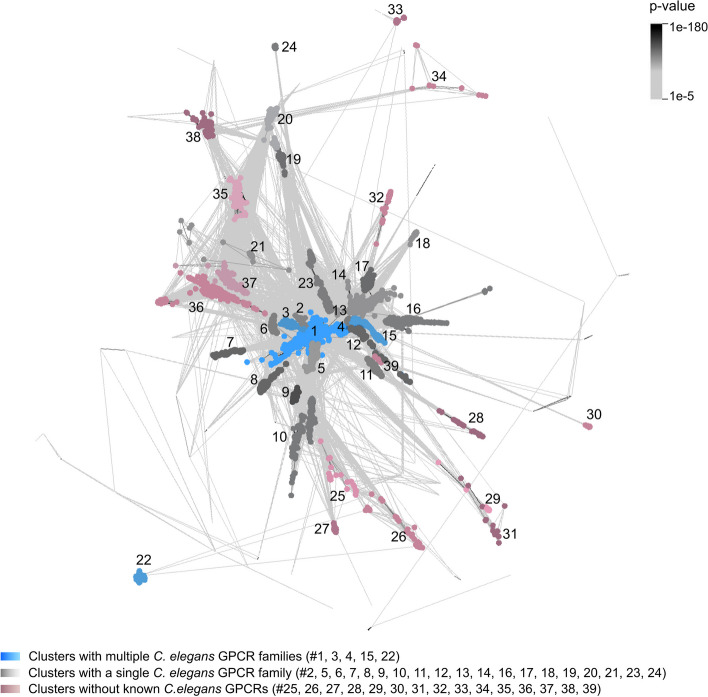
Clustering of 15,929 putative C. elegans NP-GPCR homologs based on sequence similarity. Each dot represents a nematode sequence; edges between dots represent BLAST connections with P value > 1e − 30. Only clusters with more than 5 sequences are color-coded according to the number (zero, one, or multiple) of C. elegans NP-GPCR families represented in each cluster. See also Additional files 3 and 5 for an overview of C. elegans NP-GPCRs and homologs in each cluster
Fig. 4
Fig. 4
The complement of C. elegans NP-GPCR orthologs varies for different nematode clades and lifestyles. a Heatmap representing the percentage of orthologs for each C. elegans NP-GPCR family in a given species, averaged per clade. See also Additional file 3: Table S1 for corresponding cluster numbers, and for names and C. elegans representatives of NP-GPCR families. b Percentage of C. elegans NP-GPCR orthologs identified in each species per clade. c Percentage of C. elegans NP-GPCRs orthologs in animal parasitic nematodes (APN) is lower than in entomopathogenic (EPN), plant pathogenic (PPN), and free-living (FLN) nematodes. Horizontal red lines in b and c represent the mean value. Intensity of data points in these two panels refers to BUSCO scores (genome quality) of each species (see Additional file 2: Table S2). d Percentage of nematode species with orthologs of C. elegans NP-GPCRs having specific (one-to-one) or more promiscuous (one-to-multiple, multiple-to-multiple) ligand interactions. Mean values are displayed as black vertical lines. See Additional file 7: Table S1 for classification of receptors according to their ligand interaction profile. Gray circles represent individual C. elegans GPCRs, and red circles highlight the three most promiscuous ones (DMSR-1, DMSR-7, FRPR-8). Individual values are available in Additional file 3: Table S1
Fig. 5
Fig. 5
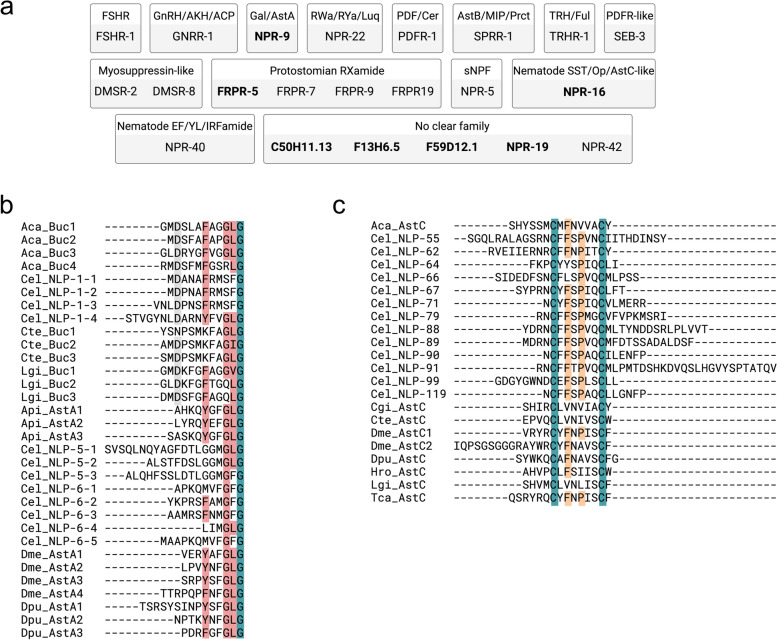
C. elegans NP-GPCRs with pan-phylum representation in nematodes. a Among the top 20% of the conserved C. elegans NP-GPCRs that have at least one ortholog in most species, seven (NPR-9, FRPR-5, NPR-16, C50H11.13, F13H6.5, F59D12.1, and NPR-19) are still orphan receptors. b Amino acid sequence alignment of AstA/buccalin-like peptides. Amino acids highlighted in green are conserved in all peptide sequences; amino acids in red match the C-terminal sequence motif [F/Y]XXG[L/I/V]G, characteristic of the AstA/buccalin peptide family [1]. Amino acids highlighted in gray are buccalin-specific. c Amino acid sequence alignment of AstC/somatostatin-like peptides. Amino acids in green are identical in all peptides; amino acids in orange are conserved in 60% of all peptide sequences. Aplysia californica (Aca), Acyrthosiphon pisum (Api), Caenorhabditis elegans (Cel), Crassostrea gigas (Cgi), Capitella teleta (Cte), Drosophila melanogaster (Dme), Daphnia pulex (Dpu), Helobdella robusta (Hro), Lottia gigantea (Lgi), and Tribolium castaneum (Tca)
Fig. 6
Fig. 6
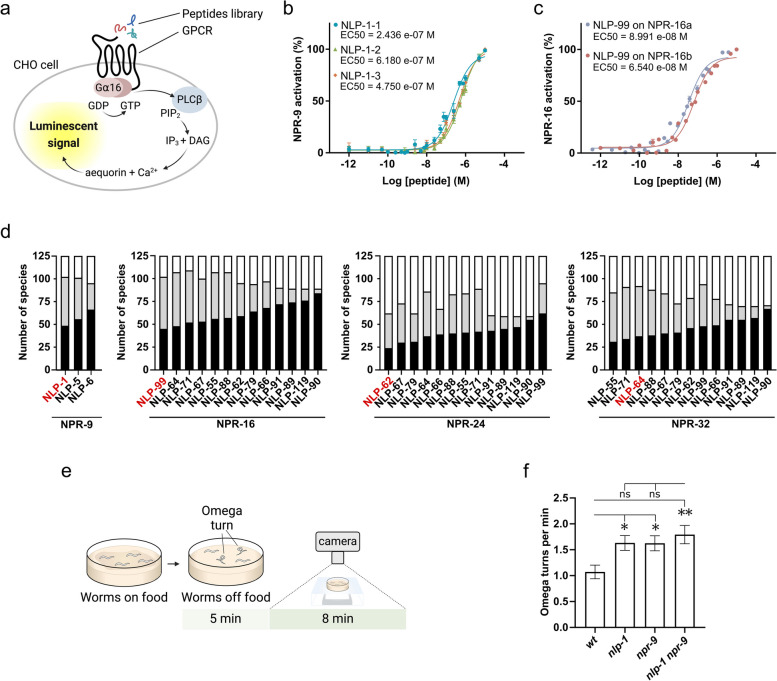
Deorphanization of C. elegans Gal/AstA-type and SST/AstC-type receptors. a Cell-based reverse pharmacology approach for receptor deorphanization. Each receptor is transiently expressed in CHO cells together with the promiscuous Gα16 protein, which couples to many GPCRs and directs intracellular signaling to phospholipase Cβ (PLCβ) activity [36, 125, 126, 135]. This results in the release of calcium from intracellular storage sites, eliciting a luminescent signal from the calcium indicator aequorin. b NPR-9 is activated by three peptides encoded by the nlp-1 gene (NLP-1–1 = MDANAFRMSFamide, NLP-1–2 = MDPNAFRMSFamide, NLP-1–3 = VNLDPNAFRMSFamide) with similar potencies. EC50 for NLP-1–1 = 243.6 nM (logEC50 (M) = − 6.613, with 95% confidence interval (CI) = − 6.709 to − 6.519), for NLP-1–2 = 618.0 nM (logEC50 (M) = − 6.209, with 95% CI = − 6.266 to − 6.153), and for NLP-1–3 = 475.0 nM (logEC50 (M) = − 6.319, with 95% CI = − 6.383 to − 6.256). c Both receptor isoforms of NPR-16 are activated by the AstC-like peptide NLP-99 (GDGYGWNDCEFSPLSCLL, disulfide bridge C9-C16). EC50 for isoform a = 89.9 nM (logEC50 (M) = − 7.046, with 95% CI = − 7.113 to -6.979), and for isoform b = 65.4 nM (logEC50 (M) = − 7.184, with 95% CI = − 7.244 to − 7.125). b, c concentration-dependent activation curves are plotted as percentage of the highest peptide-evoked response (100% activation) using a nonlinear regression model. Error bars indicate Standard Error of Mean (SEM) with n ≥ 6. d Evolutionary conservation of the Gal/AstA-like receptor NPR-9 and the SST/AstC-like receptors NPR-16, NPR-24, and NPR-32, with peptides belonging to the same family. Black bars represent the number of species with mismatches in precursor-receptor conservation, meaning either only the peptide or the receptor is found. Gray and white bars indicate the number of species in which both peptide and receptor orthologs have been identified (gray), or in which none of the two were found (white). Confirmed peptide ligands of receptors are indicated in red and rank among the best scoring peptide precursors (with the lowest number of mismatches between peptide and receptor representation in nematode predicted proteomes). e Schematic representation of local search behavior assay. f Both nlp-1 and npr-9 mutants show increased turning behavior compared to wild-type animals upon removal from food. Double mutants of nlp-1 and npr-9 do not significantly differ in turning compared to the single mutants. Data are presented as mean + / − SEM including n > 6 assays with 10–15 animals tested for each strain per replicate. Statistical significance between different conditions was calculated using one-way ANOVA with Dunnett multiple comparisons test correction. * p < 0.05, ** p < 0.01. Individual data available in Additional file 9: Tables S1-S4

References

    1. Mirabeau O, Joly JS. Molecular evolution of peptidergic signaling systems in bilaterians. PNAS. 2013;110:E2028–37. 10.1073/pnas.1219956110. - PMC - PubMed
    1. Elphick MR, Mirabeau O, Larhammar D. Evolution of neuropeptide signalling systems. J Exp Biol. 2018;221. 10.1242/jeb.151092 - PMC - PubMed
    1. Jékely G. Global view of the evolution and diversity of metazoan neuropeptide signaling. PNAS. 2013;110:8702–7. 10.1073/pnas.1221833110. - PMC - PubMed
    1. Jékely G. The chemical brain hypothesis for the origin of nervous systems. Phil Trans R Soc B. 2021;376. 10.1098/rstb.2019.0761 - PMC - PubMed
    1. Seidah NG, Chretien M. Proprotein and prohormone convertases: A family of subtilases generating diverse bioactive polypeptides. Brain Res. 1999;848:45–62. 10.1016/S0006-8993(99)01909-5. - PubMed

LinkOut - more resources