Review
. 2024 Mar 25;6(5):743-748.
doi: 10.1016/j.jhsg.2024.01.021. eCollection 2024 Sep.

Ballistic Nerve Injuries: State of the Evidence and Approach to the Patient Based on Experience

Affiliations
Review

Ballistic Nerve Injuries: State of the Evidence and Approach to the Patient Based on Experience

Jeffrey G Stepan. J Hand Surg Glob Online. .

Abstract

Nerve injuries secondary to gunshot wounds (GSWs) have been traditionally thought of as neurapraxic injuries with high likelihood of complete recovery. A review of the literature, however, highlights the misconceptions surrounding ballistic nerve injuries and their treatments. Contrary to this accepted dogma, approximately 30% to 60% of GSWs to the upper extremity may result in nerve injury requiring repair or reconstruction. Surgical exploration following ballistic injury reveals that 20% to 55% of nerves were lacerated requiring repair or grafting. Despite these numbers, outcomes after nerve repair or grafting are limited, and the limited data show evidence of poor functional recovery. In our experience, delayed exploration of GSW-related nerve injuries in patients without signs of functional recovery demonstrate large neuromas in continuity often requiring meticulous dissection and excision with resulting large gaps that require reconstruction. This has led us to explore options to identify patients with nerve deficits after GSWs who may benefit from earlier exploration. Others advocate for the exploration of all ballistic nerve injuries, which would represent a logistical challenge in high volume centers and may lead to unnecessary explorations of in continuity nerves. To facilitate identification of nerve injury following GSWs, we have explored the utilization of early ultrasound to identify patients with nerve lacerations that may benefit from early exploration (1-2 weeks after injury). Earlier exploration can lead to less technically challenging surgery, shorter nerve gaps, and more time for the nerve to recover. Herein, we present a series of cases to help illustrate this approach to the patient. Although early exploration and repair versus grafting of nerves may have benefits as outlined above, there are little to no data on outcomes of nerve repair or grafting in ballistic injuries in the more acute setting, 1 to 2 weeks after injury. Further research is needed both with regards to diagnosis and utilization of ultrasound, as well as postoperative outcomes in patients with ballistic nerve injuries to help guide our ever-evolving treatment protocols.

Keywords: Ballistic; Brachial plexus; Gunshot wound; Nerve.


Conflict of interest statement

No benefits in any form have been received or will be received related directly to this article.

Figures

Figure 1
Figure 1
Examples of neuromas in continuity after GSW with no return of function. A Neuroma in continuity 2.5 months from GSW injury of the ulnar nerve at the elbow. B Neuroma in continuity 6 months from GSW injury of the ulnar nerve at the elbow. C Neuroma in continuity 3.5 months from GSW injury of the ulnar nerve proximal to the elbow.
Figure 2
Figure 2
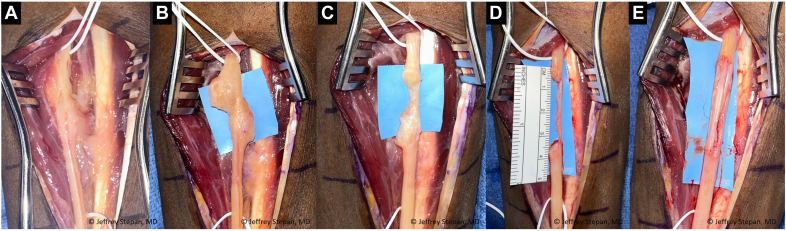
This patient sustained an injury to the ulnar nerve 2.5 months prior to exploration. The nerve was not explored during ulnar shaft fixation and referred to the hand service. A Large neuroma in continuity scarred to the surrounding soft tissues in the forearm. B Ulnar nerve dissected free from the soft tissues with large neuroma. C After excision of neuroma and internal neurolysis with a few remaining intact fascicles. D A 3-cm gap after cutting back to healthy fascicles. E Sural nerve cabled autograft to span the graft.
Figure 3
Figure 3
GSW injury sustained with median nerve deficit and radial shaft fracture. A Initial Spot film radiographs of the right forearm. B Intraoperative fluoro demonstrating fixation of the radial shaft fracture. C Exploration of the median nerve at time of fracture fixation 8 days after injury demonstrating a partial nerve laceration. D Intraneural dissection and identification of healthy fascicles and injured fascicles. E Nerve grafting of the median nerve.
Figure 4
Figure 4
GSW injury sustained with partial median nerve deficit and radial shaft fracture. A PA wrist radiographs. B Intraoperative fluoro demonstrating fixation of the radial shaft fracture in a bridge construct. C Exploration of the median nerve at time of fracture fixation 10 days after injury demonstrating a partial nerve laceration. D Intraneural dissection and identification of healthy fascicles and injured fascicles. E Nerve grafting of the median nerve.
Figure 5
Figure 5
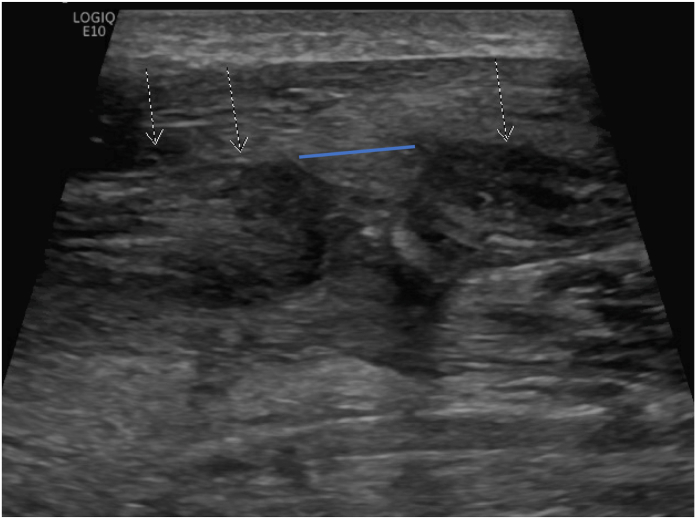
This ultrasound image demonstrates a median nerve not in continuity. This is a clinical image of the median nerve seem in the longitudinal axis from the patient in Figure 2. The arrows represent fascicles of the proximal and distal stumps of the median nerve; however, no fascicles bridging the gap (blue line).
Figure 6
Figure 6
This patient sustained bilateral GSW sustaining a left elbow periarticular injury with decreased sensation in the median nerve distribution and weak but intact anterior interosseous nerve function. The patient also sustained a right ulnar shaft fracture and ulnar nerve injury that underwent an unlar nail and ulnar nerve grafting (not depicted). A AP and lateral images of the periarticular ballistic elbow injury. B The patient underwent open reduction internal fixation on initial presentation, postoperative images are seen with metallic fragments noted in the anterior soft tissues. C The patient eventually underwent median nerve exploration with identification of a metallic fragment embedded within perineural scar tissue likely causing the patient’s unremitting pain.

References

    1. Zwald M.L., Van Dyke M.E., Chen M.S., et al. Emergency department visits for firearm injuries before and during the COVID-19 pandemic—United States, January 2019–December 2022. MMWR Morb Mortal Wkly Rep. 2023;72:333–337. - PMC - PubMed
    1. Baum G.R., Baum J.T., Hayward D.M.B. NoGunshot wounds: balistics, pathology, and treatment recommendations with a focus on retained bullets. Orthop Res Rev. 2022;14:293–317. - PMC - PubMed
    1. Omer G.E. Injuries to nerves of the upper extremity. J Bone Joint Surg Am. 1974;56(8):1615–1624. - PubMed
    1. Omer G.E. Results of untreated peripheral nerve injuries. Clin Orthop Relat Res. 1982;163:15–19. - PubMed
    1. Veltre D.R., Tornetta P., Krause P., et al. Gunshot fractures of the forearm: a multicenter evaluation. J Orthop Trauma. 2021;35(10):E364–E370. - PubMed

LinkOut - more resources