


A Scoping Review on the Management of Open Fractures in African Trauma and Orthopaedics Centres
- PMID: 39381475
- PMCID: PMC11459879
- DOI: 10.7759/cureus.68925
A Scoping Review on the Management of Open Fractures in African Trauma and Orthopaedics Centres
Abstract
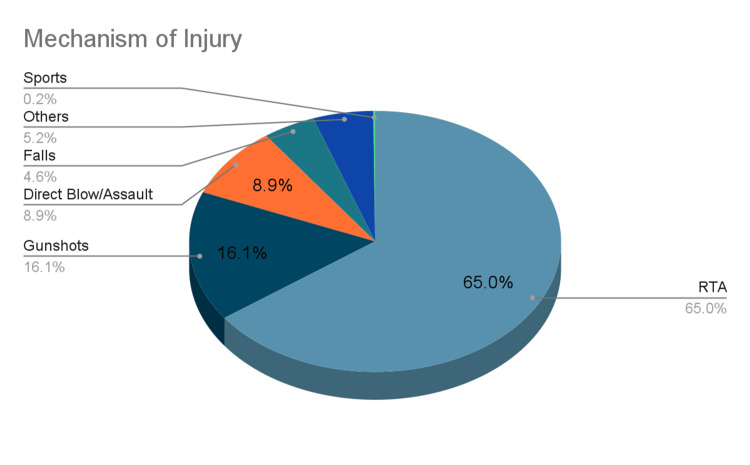
An open fracture is when the fractured part of a bone is exposed to the external environment by breaching the overlying soft tissue and skin. Open fractures often arise from high-energy injuries, and the risk of microbial contamination is high. There is a need to understand the management of open fractures in Africa by assessing the overall prevalence of open fractures, the mechanisms of injury, management approaches and outcomes. A literature search was conducted using PubMed, African Journal Online, and Google Scholar regarding open fracture management in Africa from inception till date. Thirty-nine (39) studies were included in this review. Road traffic accidents represented the majority of all mechanisms of open fractures, with the Tibia being the most affected bone. 320 cases were classified as Gustilo Anderson Type 1, with 487 classified as Type 2. Type 3 was divided into 3A (330), 3B (248), and 3C (34). Most studies recorded the immediate administration of intravenous antibiotics, but tetanus prophylaxis was only given in 13 studies, while initial debridement and washout were done in 35 studies. External fixators and Kirschner wires were most used for initial fixation. Follow-up for patients was between six weeks to 50 months. There were 645 cases of malunion, 83 cases of non-union, and 88 patients who had delayed union. There were 147 cases of wound infection and 119 cases of pin tract infections. Our findings emphasize the need for standardized protocols and robust emergency services to manage open fractures within Africa.
Keywords: africa; external fixator; gustilo anderson classification; open fracture; open fracture management; open reduction and internal fixation; open tibia fracture; trauma.
Copyright © 2024, Zubair et al.
Conflict of interest statement
Conflicts of interest: In compliance with the ICMJE uniform disclosure form, all authors declare the following: Payment/services info: All authors have declared that no financial support was received from any organization for the submitted work. Financial relationships: All authors have declared that they have no financial relationships at present or within the previous three years with any organizations that might have an interest in the submitted work. Other relationships: All authors have declared that there are no other relationships or activities that could appear to have influenced the submitted work.
Figures
References
-
- Standards for the Management of Open Fractures. Oxford Academic; 2020. Prehospital and Emergency Department Care, Including Prophylactic Antibiotics; pp. 1–10.
-
- Open fractures: evaluation and management. Zalavras CG, Patzakis MJ. https://journals.lww.com/jaaos/fulltext/2003/05000/Open_Fractures__Evalu.... J Am Acad Orthop Surg. 2003;11:212–219. - PubMed
-
- Prevention of infection in open fractures. Zalavras CG. Infect Dis Clin North Am. 2017;31:339–352. - PubMed
-
- Management of open fractures. An analysis of 673 cases. Gustilo RB. https://pubmed.ncbi.nlm.nih.gov/5547087/ Minn Med. 1971;54:185–189. - PubMed
Publication types
LinkOut - more resources
Full Text Sources