


Genetic influences, lifestyle and psychosocial aspects in relation to metabolically healthy obesity and conversion to a metabolically unhealthy state
- PMID: 39382007
- PMCID: PMC11618251
- DOI: 10.1111/dom.16004
Genetic influences, lifestyle and psychosocial aspects in relation to metabolically healthy obesity and conversion to a metabolically unhealthy state
Abstract
Aims: About 10%-30% of individuals with obesity are metabolically healthy, but the specific characteristics of the metabolically healthy obesity (MHO) phenotype remain unclear. We aimed to examine how physical activity, education, depressive symptoms and genetic predisposition to obesity differ between individuals with MHO and those with metabolically unhealthy obesity (MUO), and whether these factors predict stability in MHO or conversion to a metabolically unhealthy state.
Materials and methods: We retrieved data on 9809 individuals with obesity from the Health and Retirement Study collected between 2006 and 2016. We compared how physical activity, education, depressive symptoms and a polygenic score for higher body mass index (BMI) (PGSBMI) differed cross-sectionally between MHO and MUO using logistic regression. We then examined if the same factors predict conversion to a metabolically unhealthy state over 4 years in individuals with MHO.
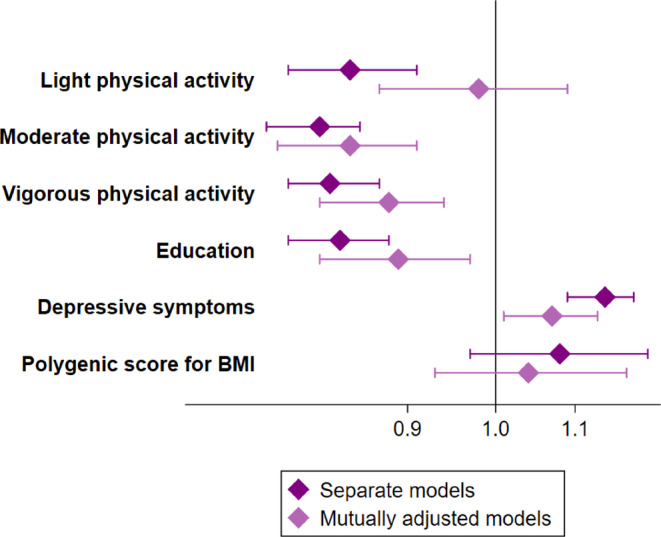
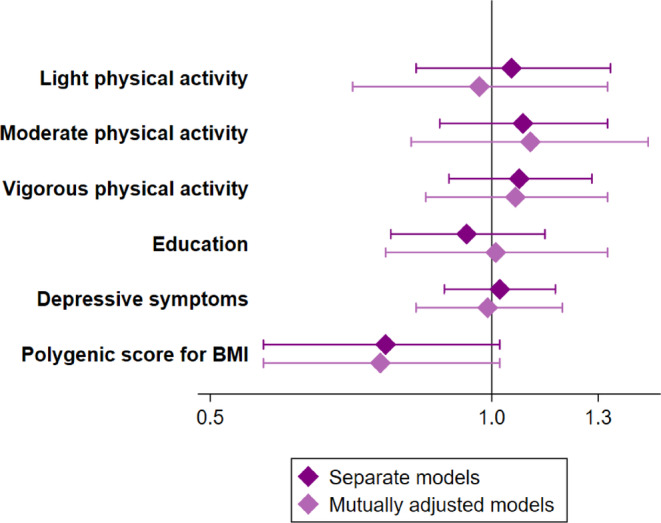
Results: Individuals with MHO had higher physical activity (odds ratio [OR] = 0.81), higher education (OR = 0.83) and lower depressive symptoms (OR = 1.14) compared to those with MUO but did not differ in the PGSBMI. The associations were slightly attenuated in mutually adjusted models. None of the factors were associated with conversion from MHO to a metabolically unhealthy state. However, a higher PGSBMI indicated 24% lower risk of conversion to a metabolically unhealthy state (p = 0.07).
Conclusions: Physical activity, education and depressive symptoms differed between MHO and MUO, even when mutually adjusted for, but did not predict conversion from a metabolically healthy to unhealthy state. Although not statistically significant, the results indicated that those with genetically predicted high BMI are more likely to maintain MHO and not convert to a metabolically unhealthy state.
Keywords: body mass index; metabolically healthy obesity; obesity; population study.
© 2024 The Author(s). Diabetes, Obesity and Metabolism published by John Wiley & Sons Ltd.
Conflict of interest statement
The authors have no conflicts of interest to declare.
Figures
References
-
- Schulze MB, Stefan N. Metabolically healthy obesity: from epidemiology and mechanisms to clinical implications. Nat Rev Endocrinol. 2024;20:397–409. - PubMed
MeSH terms
Grants and funding
- 2024-02197/Loo and Hans Osterman's Foundation
- 2022-00672/The Swedish Research Council for Health, Working Life and Welfare
- 2023-01854/Foundation for Geriatric Diseases at Karolinska Institutet
- 2023-01855/Loo and Hans Osterman's Foundation
- Strategic Research Program in Epidemiology (SFOepi) at Karolinska Institutet
LinkOut - more resources
Full Text Sources
Medical
