[Preprint]. 2024 Sep 27:2024.09.25.614766.
doi: 10.1101/2024.09.25.614766.

Challenges and advances for huntingtin detection in cerebrospinal fluid: in support of relative quantification

Affiliations

Challenges and advances for huntingtin detection in cerebrospinal fluid: in support of relative quantification

Rachel J Harding et al. bioRxiv. .

Update in

Abstract

Huntington disease (HD) is a progressive and devastating neurodegenerative disease caused by expansion of a glutamine-coding CAG tract in the huntingtin (HTT) gene above a critical threshold of ~35 repeats resulting in expression of mutant HTT (mHTT). A promising treatment approach being tested in clinical trials is HTT lowering, which aims to reduce levels of the mHTT protein. Target engagement of these therapies in the brain are inferred using antibody-based assays to measure mHTT levels in the cerebrospinal fluid (CSF), which is frequently reported as absolute mHTT concentration based on a monomeric protein standard used to generate a standard curve. However, patient biofluids are a complex milieu of different mHTT protein species, suggesting that absolute quantitation is challenging, and a single, recombinant protein standard may not be sufficient to interpret assay signal as molar mHTT concentration. In this study, we used immunoprecipitation and flow cytometry (IP-FCM) to investigate different factors that influence mHTT detection assay signal. Our results show that HTT protein fragmentation, protein-protein interactions, affinity tag positioning, oligomerization and polyglutamine tract length affect assay signal intensity, indicating that absolute HTT quantitation in heterogeneous biological samples is not possible with current technologies using a single standard protein. We also explore the binding specificity of the MW1 anti-polyglutamine antibody, commonly used in these assays as a mHTT-selective reagent and demonstrate that mHTT binding is preferred but not specific. Furthermore, we find that MW1 depletion is not only incomplete, leaving residual mHTT, but also non-specific, resulting in pull down of some wildtype HTT protein. Based on these observations, we recommend that mHTT detection assays report only relative mHTT quantitation using normalized arbitrary units of assay signal intensity, rather than molar concentrations, in the assessment of central nervous system HTT lowering in ongoing clinical and preclinical studies, and that MW1-depletion not be used a method for quantifying wildtype HTT protein.

Keywords: Biomarkers; Huntingtin Detection; Huntingtin Lowering Therapies; Huntington’s Disease.


Figures
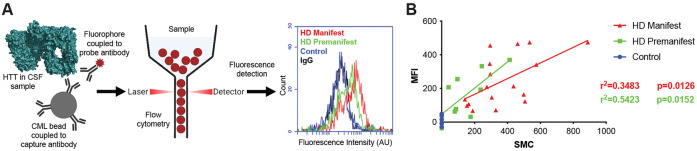
Figure 1.
Figure 1.. IP-FCM to detect mHTT and comparison of assay with Singulex approach.
A. IP-FCM assay workflow to detect mHTT in biofluid samples. B. Head-to-head comparison of IP-FCM with Singulex mHTT detection assay approaches with the same biofluid sample set from control, premanifest, and manifest HD participants shows good agreement of the methodologies. R-squared and p-values calculated from simple linear regression analysis.
Figure 2.
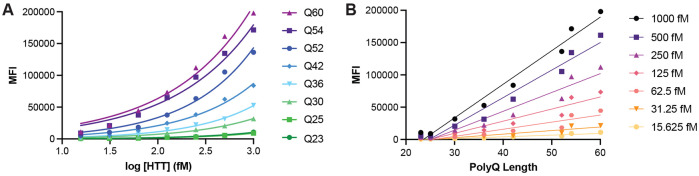
Figure 2.. HTT protein concentration and polyQ tract length influence IP-FCM assay signal.
HDB4/MW1 IP-FCM assay analysis of C-terminal FLAG tagged full-length HTT with polyQ tract lengths spanning Q23 to Q60. Assay signal (mean fluorescence intensity – MFI) is plotted as A. a function of protein concentration or B. polyQ tract length. Graphs shown are generated from a representative replicate dataset, N=3.
Figure 3.
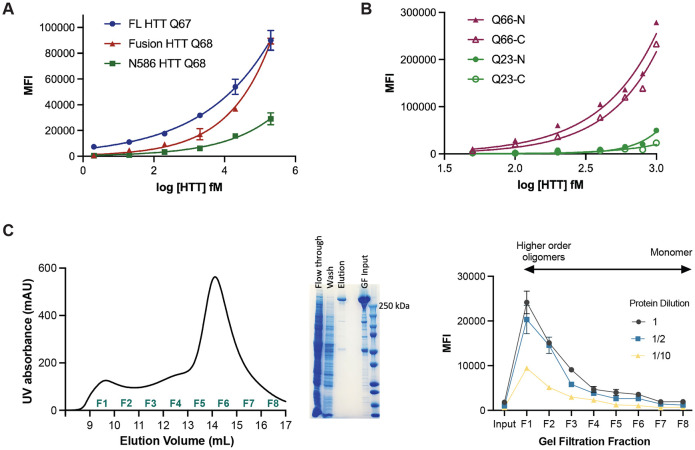
Figure 3.. IP-FCM HTT detection assay signal is influenced by protein fragmentation, the position of the affinity tag and the oligomerization state of the protein.
A. MW1-HDB4 IP-FCM analysis of full-length (FL) HTT, fusion HTT Q68 and N586 HTT Q68 protein with approximately the same Q-length. B. HDB4/MW1 IP-FCM analysis of full-length HTT with polyQ tracts spanning either 23 or 66 glutamines, with N or C-terminal FLAG-tag. C. Left – Gel filtration (GF) trace of FLAG-affinity chromatography purified full-length HTT Q54 applied to Superose6 10/300 GL column which elutes across fractions 1-8 (F1-F8). Middle – SDS-PAGE analysis of FLAG-affinity chromatography flow through, wash, elution and GF input fractions. Right - HDB4/MW1 IP-FCM analysis of concentration normalized GF fractions F1-F8 at different dilutions. IP-FCM graphs shown are generated from a representative replicate dataset, N=3.
Figure 4.
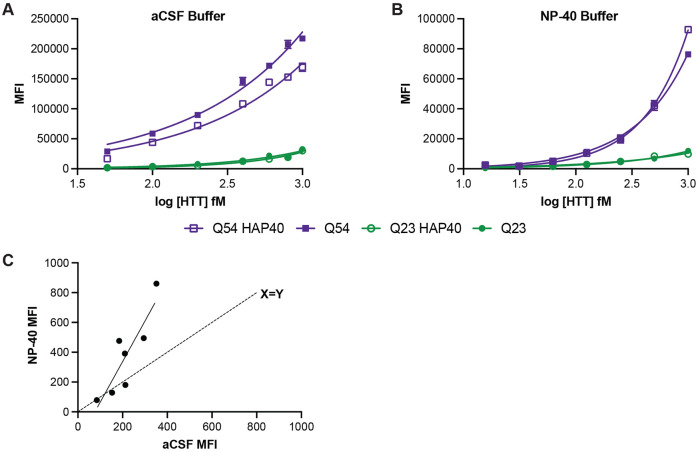
Figure 4.. Detergent can alter IP-FCM assay signal for some HTT proteins.
HDB4/MW1 IP-FCM analysis of HTT and HTT-HAP40 with either Q23 or Q54 in A. artificial CSF (aCSF) or B. 1% (v/v) NP-40-containing buffer. Graphs shown are generated from a representative replicate dataset, N=3. C. Comparison of assay signal obtained from human CSF samples diluted 1:1 in either aCSF and or NP-40 buffer.
Figure 5.
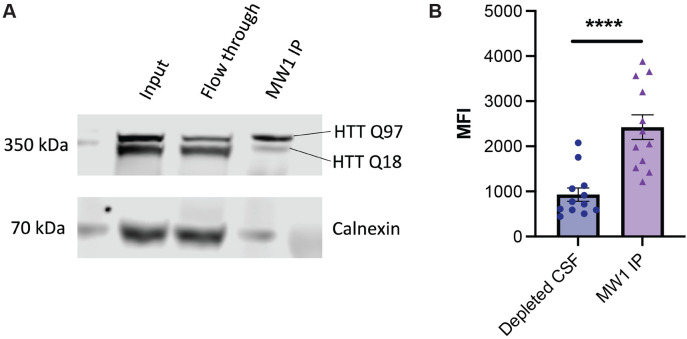
Figure 5.. MW1 depletion of mHTT is both incomplete and non-specific in HD mouse brain lysate and CSF.
A. HTT allele separation Western blot analysis of Hu97/18 brain lysate used for MW1 immunoprecipitation (IP). Fractions corresponding to the IP input, flow through (depleted) and elution (IP captured) are shown, with Calnexin as a control. B. HDB4/MW1 IP-FCM analysis of Hu97/18 mouse CSF after depletion by MW1 shows residual mHTT protein in depleted CSF.
Figure 6.
Figure 6.. MW1 binding to HTT in different assay formats is dependent on polyQ tract length but is not specific for mHTT.
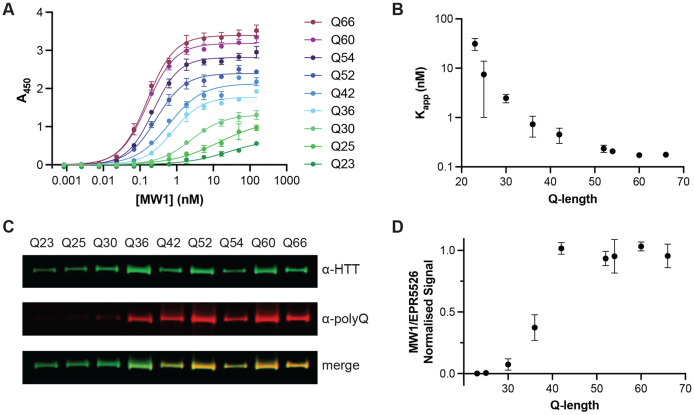
A. Representative ELISA showing binding profile of MW1 to full-length HTT allelic series spanning Q23 to Q66. Error bars are S.D. of three intra-assay replicates. Data fitted in GraphPad Prism with specific binding with hill slope model. B. Mean Kapp (apparent KD) from three independent ELISA replicates plotted as a function of HTT polyQ tract length. Error bars are S.D. of three inter-assay replicates. C. Representative western blot analysis of full-length HTT allelic series spanning Q23 to Q66 with ~5 ng loaded per lane. Blots probed with both α-HTT EPR5526 and α-polyQ MW1 shown separately and merged. Full data in Supplementary Figure 4. D. Mean normalised MW1/EPR5526 signal from three independent western blot replicates plotted as a function of Q-length. Error bars are S.D. of three inter-assay replicates.

References

    1. Addgene. 2024.
    1. Aviolat H, Pinto RM, Godschall E, Murtha R, Richey HE, Sapp E, Vodicka P, Wheeler VC, Kegel-Gleason KB, DiFiglia M. 2019. Assessing average somatic CAG repeat instability at the protein level. Sci Rep 9:19152. doi:10.1038/s41598-019-55202-x - DOI - PMC - PubMed
    1. Benn CL, Sun T, Sadri-Vakili G, McFarland KN, DiRocco DP, Yohrling GJ, Clark TW, Bouzou B, Cha J-HJ. 2008. Huntingtin Modulates Transcription, Occupies Gene Promoters In Vivo, and Binds Directly to DNA in a Polyglutamine-Dependent Manner. J Neurosci 28:10720–10733. doi:10.1523/JNEUROSCI.2126-08.2008 - DOI - PMC - PubMed
    1. Bennett MJ, Huey-Tubman KE, Herr AB, West AP, Ross SA, Bjorkman PJ. 2002. A linear lattice model for polyglutamine in CAG-expansion diseases. Proc Natl Acad Sci U S A 99:11634–11639. doi:10.1073/pnas.182393899 - DOI - PMC - PubMed
    1. Boyanapalli R, Xu D, Goyal J, Daldin M, Gennari N, Bresciani A, Panzara M. 2022. A Novel Quantitative Wild-type Huntingtin (wtHTT) Protein Biomarker Method for Human Cerebrospinal Fluid.

Publication types

LinkOut - more resources