. 2024 Sep 19;10(19):e38105.
doi: 10.1016/j.heliyon.2024.e38105. eCollection 2024 Oct 15.

Novel quinoline-4-carboxamide derivatives potentiates apoptosis by targeting PDK1 to overcome chemo-resistance in colorectal cancer: Theoretical and experimental results

Affiliations

Novel quinoline-4-carboxamide derivatives potentiates apoptosis by targeting PDK1 to overcome chemo-resistance in colorectal cancer: Theoretical and experimental results

Shalini V et al. Heliyon. .

Abstract

A series of novel N,2-diphenyl-6-(aryl/heteroaryl)quinoline-4-carboxamide derivatives were designed and synthesized using the Suzuki coupling reaction and evaluated them for their anticancer activity. These compounds were screened for anti-colon cancer activity through in-silico studies by molecular docking and molecular dynamics studies. Furthermore, the density functional theory was used to determine the molecule's electrical properties. The molecular electrostatic potential map is used to evaluate the charge distribution on the molecule surface. Unveiling that the compound 7a (binding energy of -10.2 kcal/mol) has good inhibition activity compared to other synthesized compounds (7b-7j) as well as the standard drug Gefitinib. The stability of the compound 7a with the 1OKY protein was confirmed through molecular dynamics simulation studies, indicating potential anti-colon cancer activity against phosphoinositide dependent protein kinase-1 (PDK1). The in-silico ADMET pharmacokinetic properties indicate adherence to Lipinski's rule of five for favorable safety profiles and the compound falls within the optimal range for physicochemical and pharmacokinetic properties, which is comparable to that of the standard medication drug Gefitinib. The synthesized library of compounds was further evaluated for their in-vitro anticancer potency against colon, pancreatic and breast cancer cells. The results demonstrated that the compounds effectively suppressed the proliferative potential of the screened cells in a concentration-dependent manner, as revealed by MTT assay. The anticancer potential of these molecules was further evaluated by acridine orange/PI, and Hoechst/PI which demonstrates the potential of molecules to induce apoptosis in cancer cells. Further investigations and optimization of these derivatives could lead to the development of effective anticancer strategies.

Keywords: ADMET; Chemo-resistance; Colorectal cancer; DFT; Molecular docking; Molecular dynamics; PDK1; Quinoline-4-carboxamide derivatives.


Conflict of interest statement

The authors declare that they have no known competing financial interests or personal relationships that could have appeared to influence the work reported in this paper.

Figures

Image 1
Graphical abstract
Fig. 1
Fig. 1
The quinoline based drugs as anticancer agents.
Scheme 1
Scheme 1
Synthesis of N,2-diphenyl-6-(aryl/heteroaryl) quinoline-4-carboxamide derivatives (7a-j).
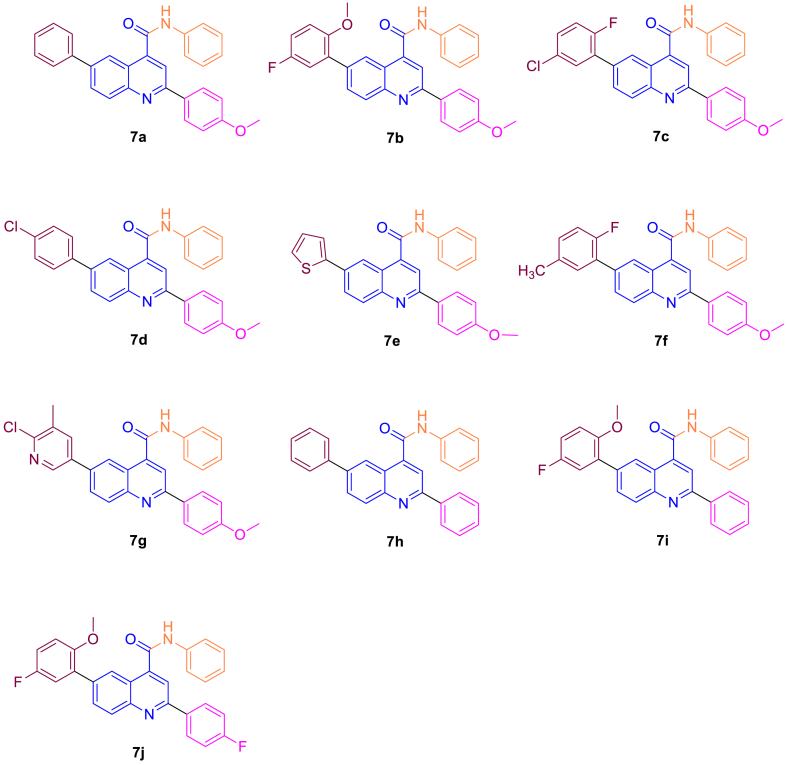
Fig. 2
Fig. 2
Structure of newly synthesized N,2-diphenyl-6-(aryl/heteroaryl) quinoline-4-carboxamide derivatives.
Fig. 3
Fig. 3
(a) Frontier molecular orbital distribution, (b) Molecular electrostatic potential map of the 7a compound revealing the electrophilic and nucleophilic regions.
Fig. 4
Fig. 4
Surface view of the lowest conformer with best docking pose of the molecule 7a with 1OKY protein and unveiling the 2D interactions with active site amino acids are represented by different colours. (For interpretation of the references to color in this figure legend, the reader is referred to the Web version of this article.)
Fig. 5
Fig. 5
Cartoon view of the lowest conformer with best docking pose of the molecule 7a with 1OKY protein and corresponding amino acids interacting distances.
Fig. 6
Fig. 6
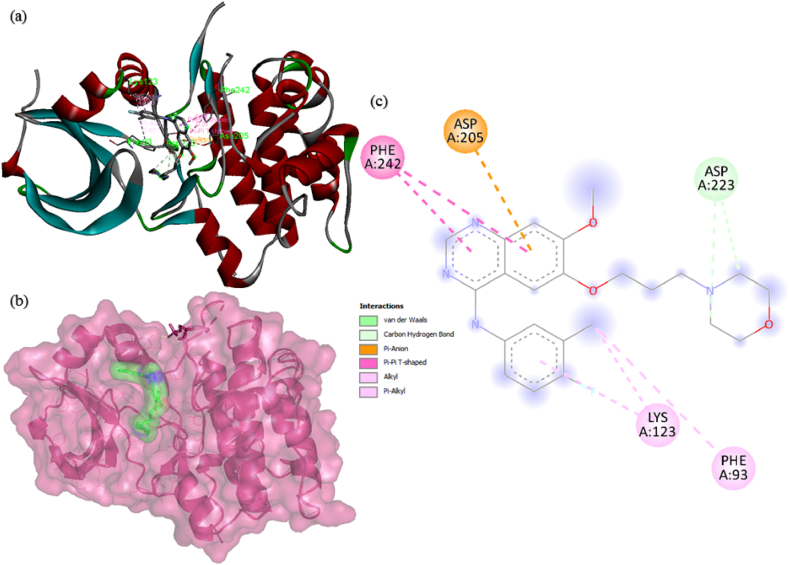
Cartoon view and surface view of the docking of the standard drug Gefitinib with 1OKY protein and corresponding amino acids interactions.
Fig. 7
Fig. 7
RMSD plots of 1OKY-ligand complex over MD production run.
Fig. 8
Fig. 8
RMSF plots of 1OKY-ligand complex over the period of 100 ns.
Fig. 9
Fig. 9
Protein-ligand contact maps of 1OKY-ligand complex and over the period of 100 ns.
Fig. 10
Fig. 10
The 2D schematic of the rotatable bonds present in the ligand assigned with different colour codes for 1OKY-ligand complex over the period of 100 ns.
Fig. 11
Fig. 11
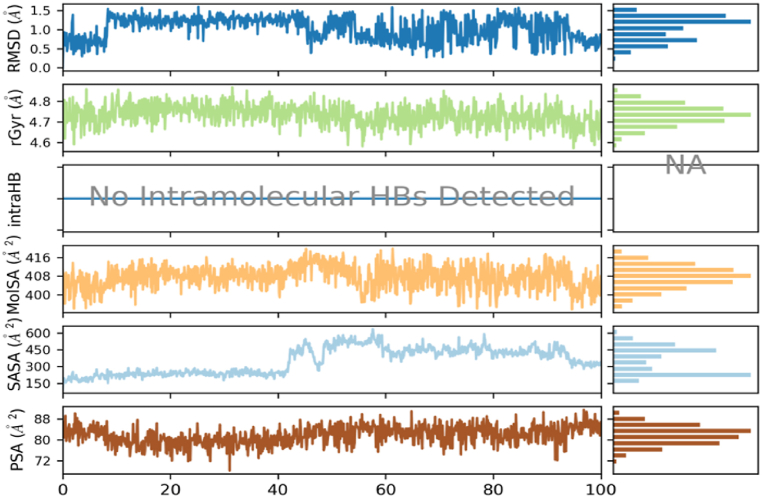
RMSD, radius of gyration (rGyr), molecular surface area (MolSA), solvent accessible surface area (SASA), and polar surface area (PSA) of 1OKY-ligand complex.
Fig. 12
Fig. 12
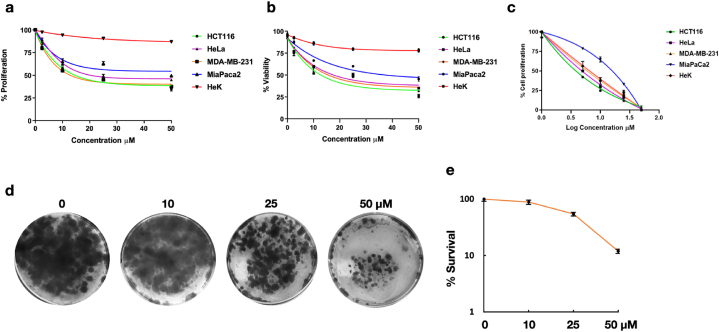
Compound 7a effect on cell proliferation and colony formation: Cells treated with various concentration of compound subjected MTT and Trypan assay (a) Cell proliferation by MTT (b) percentage viability by trypan (c) Cell proliferation by MTT with Standard drug Doxorubicin (d) Foci formation assay(e) percentage survival graph. DMSO treated cells served as control. Each experiment was repeated thrice error bars were represent the SEM of control with treated groups.
Fig. 13
Fig. 13
Compound 7a effect on cell survival: cells treated with various concentration of compound subjected to acridine orange/Pi dual staining, (a) Acridine orange/PI dual staining images (b) histogram analysis of percentage survival cells. DMSO treated cells served as control. Each experiment was repeated thrice and minimum of 200 cells were counted and error bars were represent the SEM of control with treated groups. (For interpretation of the references to color in this figure legend, the reader is referred to the Web version of this article.)
Fig. 14
Fig. 14
Compound 7a effect on nuclear membrane deformation: Cells treated with various concentration of compound subjected to Hoechst/PI dual staining, (a) Hoechst/PI staining images, (b) histogram analysis of live and dead cells. DMSO treated cells served as control. Each experiment was repeated thrice error bars were represent the SEM of control with treated groups.
Fig. 15
Fig. 15
(a) BOILED-EGG depicts gastrointestinal absorption and brain penetration of the compound 7a. (b) The pharmacokinetic and Drug-Score of compound 7a (The pink area represents the optimal range for each property). (For interpretation of the references to color in this figure legend, the reader is referred to the Web version of this article.)

References

    1. Sung H., Ferlay J., Siegel R.L., Laversanne M., Soerjomataram I., Jemal A., Bray F. Global cancer statistics 2020: GLOBOCAN estimates of incidence and mortality worldwide for 36 cancers in 185 countries. CA A Cancer J Clinicians. 2021;71:209–249. doi: 10.3322/caac.21660. - DOI - PubMed
    1. Chao A., Thun M.J., Connell C.J., McCullough M.L., Jacobs E.J., Flanders W.D., Rodriguez C., Sinha R., Calle E.E. Meat consumption and risk of colorectal cancer. JAMA. 2005;293:172–182. - PubMed
    1. Colditz G.A., Cannuscio C.C., Frazier A.L. Cancer Causes and Control. 1997;8:649–667. doi: 10.1023/A:1018458700185. [No title found] - DOI - PubMed
    1. Ridouane Y., Lopes G., Ku G., Masud H., Haaland B. Targeted first-line therapies for advanced colorectal cancer: a Bayesian meta-analysis. Oncotarget. 2017;8 - PMC - PubMed
    1. Sara J.D., Kaur J., Khodadadi R., Rehman M., Lobo R., Chakrabarti S., Herrmann J., Lerman A., Grothey A. 5-fluorouracil and cardiotoxicity: a review. Ther Adv Med Oncol. 2018;10 doi: 10.1177/1758835918780140. - DOI - PMC - PubMed

LinkOut - more resources