


Emergence and Rapid Diagnosis of Talaromyces marneffei Infections in Renal Transplant Recipients by Next-Generation Sequencing
- PMID: 39387982
- PMCID: PMC11466905
- DOI: 10.1007/s11046-024-00898-3
Emergence and Rapid Diagnosis of Talaromyces marneffei Infections in Renal Transplant Recipients by Next-Generation Sequencing
Abstract
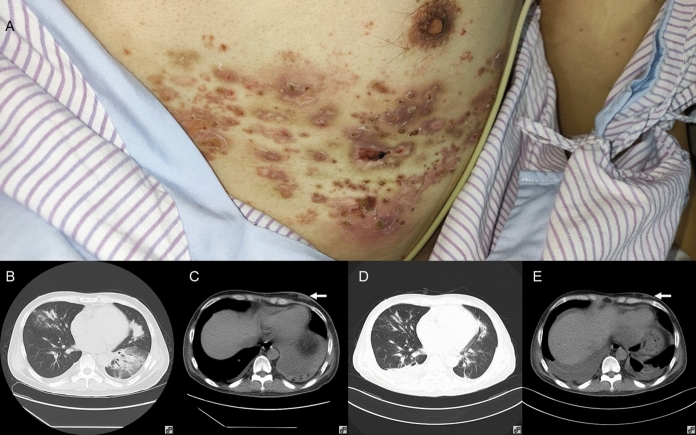
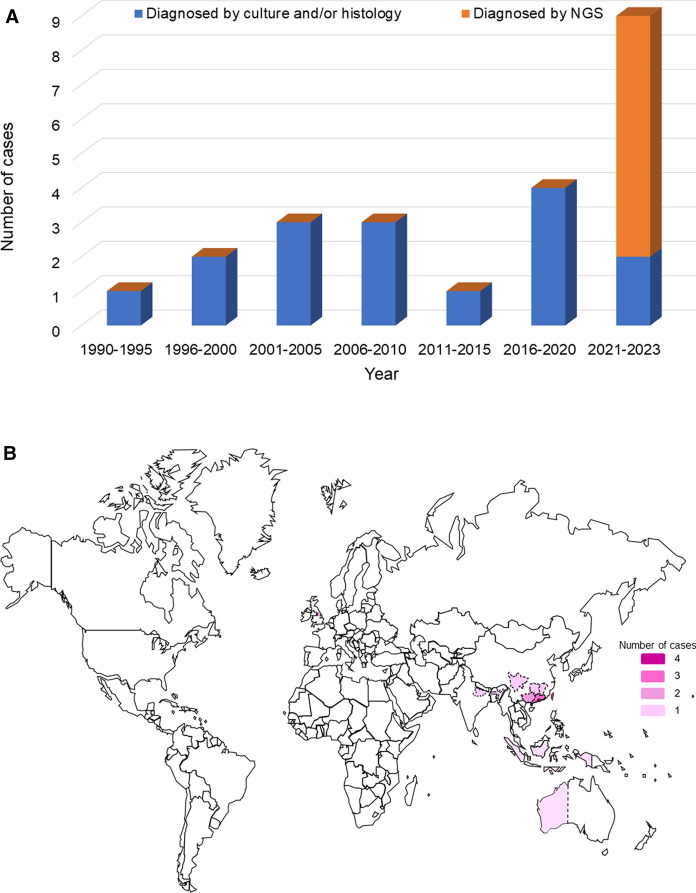
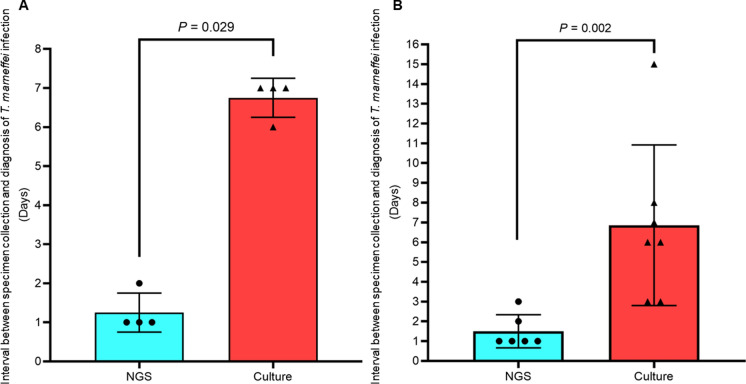
In the last few years, next-generation sequencing (NGS) has emerged as a technology for laboratory diagnosis of many culture-negative infections and slow-growing microorganisms. In this study, we describe the use of metagenomic NGS (mNGS) for rapid diagnosis of T. marneffei infection in a 37-year-old renal transplant recipient who presented with chronic pneumonia syndrome. Bronchoalveolar lavage for mNGS was positive for T. marneffei sequence reads. Prolonged incubation of the bronchoalveolar lavage revealed T. marneffei colonies after 6 days of incubation. Analysis of 23 cases of T. marneffei infections in renal transplant recipients from the literature revealed that the number of cases ranged from 1 to 4 cases per five years from 1990 to 2020; but increased rapidly to 9 cases from 2021 to 2023, with 7 of them diagnosed by NGS. Twenty of the 23 cases were from T. marneffei-endemic areas [southern part of mainland China (n = 9); Hong Kong (n = 4); northeastern India (n = 2); Indonesia (n = 1) and Taiwan (n = 4)]. For the 3 patients from non-T. marneffei-endemic areas [United Kingdom (n = 2) and Australia (n = 1)], they had travel histories to China and Vietnam respectively. The time taken for diagnosis by mNGS [median 1 (range 1 to 2) day] was significantly shorter than that for fungal culture [median 6 (range 3 to 15) days] (P = 0.002). mNGS is useful for picking up more cases of T. marneffei infections in renal transplant recipients as well as providing a rapid diagnosis. Talaromycosis is an emerging fungal infection in renal transplant recipients.
Keywords: Talaromyces marneffei; Next-generation sequencing; Rapid diagnosis; Renal transplant.
© 2024. The Author(s).
Conflict of interest statement
Patrick C. Y. Woo has provided scientific advisory/laboratory services for Gilead Sciences, Incorporated; International Health Management Associates, Incorporated; Merck & Corporation, Incorporated; Micología Molecular S.L. and Pfizer, Incorporated. The funding sources had no role in study design, data collection, analysis, interpretation, or writing of the report. The authors alone are responsible for the content and the writing of the manuscript. The other authors report no conflict of interest.
Figures
References
-
- Tsang CC, Lau SKP, Woo PCY. Sixty years from Segretain’s description: what have we learned and should learn about the basic mycology of Talaromyces marneffei? Mycopathologia. 2019;184(6):721–9. 10.1007/s11046-019-00395-y. - PubMed
-
- Wong SSY, Siau H, Yuen KY. Penicilliosis marneffei–West meets East. J Med Microbiol. 1999;48(11):973–5. 10.1099/00222615-48-11-973. - PubMed
-
- Lau SKP, Xing F, Tsang CC, Tang JYM, Tan YP, Ye H, Lau RWT, Chen JHK, Lo SKF, Woo PCY. Clinical characteristics, rapid identification, molecular epidemiology and antifungal susceptibilities of Talaromyces marneffei infections in Shenzhen, China. Mycoses. 2019;62(5):450–7. 10.1111/myc.12887. - PubMed
-
- Supparatpinyo K, Khamwan C, Baosoung V, Nelson KE, Sirisanthana T. Disseminated Penicillium marneffei infection in southeast Asia. Lancet. 1994;344(8915):110–3. 10.1016/s0140-6736(94)91287-4. - PubMed
-
- Ajello L, Padhye AA, Sukroongreung S, Nilakul CH, Tantimavanic S. Occurrence of Penicillium marneffei infections among wild bamboo rats in Thailand. Mycopathologia. 1995;131(1):1–8. 10.1007/BF01103897. (Erratum in: Mycopathologia 1996;135(3):195-7). - PubMed
Publication types
MeSH terms
Supplementary concepts
Grants and funding
LinkOut - more resources
Full Text Sources
Medical