


The Safety of Alcohol Pharmacotherapies in Pregnancy: A Scoping Review of Human and Animal Research
- PMID: 39388037
- PMCID: PMC11695489
- DOI: 10.1007/s40263-024-01126-8
The Safety of Alcohol Pharmacotherapies in Pregnancy: A Scoping Review of Human and Animal Research
Abstract
Background and objective: Alcohol pharmacotherapies pose unknown teratogenic risks in pregnancy and are therefore recommended to be avoided. This limits treatment options for pregnant individuals with alcohol use disorders (AUD). The information on the safety of these medications during pregnancy is uncertain, prompting a scoping review. The objective of this review was to investigate available information on the safety of alcohol pharmacotherapies in pregnancy.
Methods: Studies published between January 1990 and July 2023 were identified through searches in BIOSIS, Embase, PsycINFO and MEDLINE databases, using terms related to pregnancy and alcohol pharmacotherapies. The alcohol pharmacotherapies investigated were naltrexone, acamprosate, disulfiram, nalmefene, baclofen, gabapentin and topiramate. Studies were screened by two independent reviewers. Covidence software facilitated the management, screening and extraction of studies.
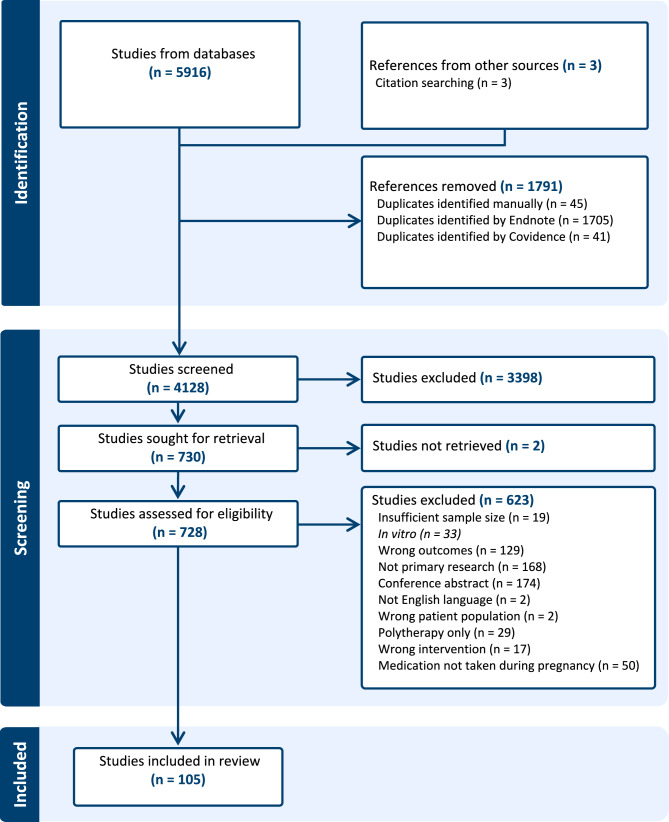
Results: A total of 105 studies were included in the review (naltrexone: 21, acamprosate: 4, disulfiram: 3, baclofen: 3, nalmefene: 0, topiramate: 55, gabapentin: 32) with some studies investigating multiple medications. Studies investigating naltrexone's safety in pregnancy focussed on opioid use disorders, with limited evidence regarding its safety in the context of AUD. Despite concerns about higher rates of some pregnancy complications, studies generally indicate naltrexone as a safer option compared with opioid agonists or alcohol during pregnancy. Acamprosate was not clearly associated with adverse effects of exposure in pregnancy, with two pre-clinical studies suggesting potential neuroprotective properties. Disulfiram has a high risk of congenital anomalies when used in pregnancy, believed to be due to its mechanism of action. Prenatal topiramate has also been associated with an increased risk of congenital anomalies, particularly oral clefts. There were mixed results concerning the safety of prenatal gabapentin and little to no literature investigating the safety of baclofen or nalmefene during pregnancy.
Conclusions: There is insufficient research on the safety of alcohol pharmacotherapies in pregnancy. Despite this, given alcohol's teratogenic effects, naltrexone could be considered to help maintain abstinence in pregnant individuals with AUD, particularly when psychosocial treatments have failed.
© 2024. The Author(s).
Conflict of interest statement
Declarations. Funding: Open Access funding enabled and organized by CAUL and its Member Institutions.No funding was received for conducting this study. EQ, SR and DR are supported by an Australian Government Research Training Program Scholarship at The University of Western Australia. EK is supported by a National Health and Medical Research Council (NHMRC) Investigator Grant (No. 1172978). Conflicts of Interest/Competing Interests: The authors have no conflicts or competing interests to declare that are relevant to the content of this article. Availability of Data and Material: Supporting information can be found in the supplementary material. Ethics Approval: Not applicable. Consent to Participate: Not applicable. Consent for Publication: Not applicable. Code Availability: Not applicable. Author’s Contributions: Conceptualisation was carried out by Ebony Quintrell and Erin Kelty; literature screening and analysis was performed by Ebony Quintrell, Danielle Russell and Sofa Rahmannia; supervision was performed by Erin Kelty, Caitlin S. Wyrwoll and Alexander Larcombe. The first draft of the manuscript was written by Ebony Quintrell and all authors commented on previous versions of the manuscript. All authors read and approved the final manuscript.
Figures
References
-
- Degenhardt L, Charlson F, Ferrari A, et al. The global burden of disease attributable to alcohol and drug use in 195 countries and territories, 1990–2016: a systematic analysis for the Global Burden of Disease Study 2016. The Lancet Psychiatry. 2018;5(12):987–1012. 10.1016/S2215-0366(18)30337-7. - PMC - PubMed
-
- Mallard SR, Houghton LA. Socio-demographic characteristics associated with unplanned pregnancy in New Zealand: implications for access to preconception healthcare. Aust N Z J Obstet Gynaecol. 2013;53(5):498–501. 10.1111/ajo.12074. - PubMed
Publication types
MeSH terms
Substances
LinkOut - more resources
Full Text Sources
Medical
