


Patient preferences for conservative treatment of shoulder pain: a discrete choice experiment
- PMID: 39388636
- PMCID: PMC11878378
- DOI: 10.1093/fampra/cmae050
Patient preferences for conservative treatment of shoulder pain: a discrete choice experiment
Abstract
Background: Shoulder pain is common amongst adults, but little is known about patients' preferences.
Objective: The aim of this study was to determine patients' preferences for treatment options offered for shoulder pain in primary care.
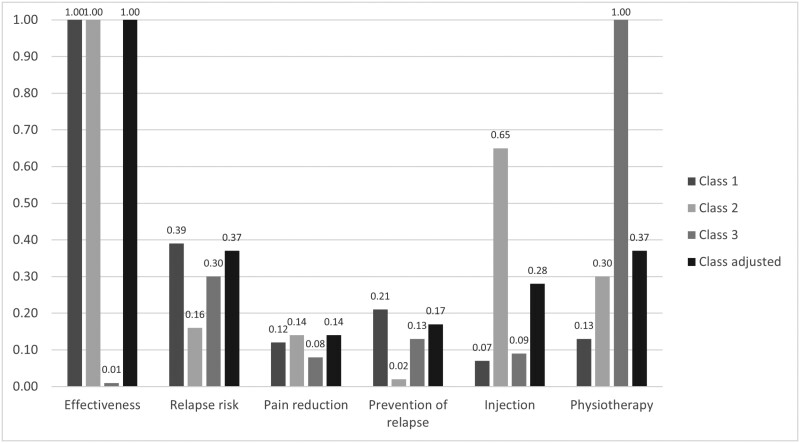
Methods: A discrete choice experiment was used to investigate these preferences. Adults with shoulder pain were asked to make 12 choices between two treatment options, or to opt-out. The attributes of the 12 treatment options were presented as varying in: treatment effectiveness (50%, 70%, or 90%), risk of relapse (10%, 20%, or 30%), time to pain reduction (2 or 6 weeks), prevention of relapse (yes/no), requiring injection (yes/no), and including physiotherapy (none, 6, or 12 sessions). A conditional logit model with latent class analysis was used for the analysis and a class assignment model.
Results: Three hundred and twelve participants completed the questionnaire with mean age of 52 ± 15.2 years. Latent class analysis revealed three groups. Group 1 preferred to opt-out, unless the attributes were highly favorable (90% effectiveness). Group 2 preferred treatment, but not an injection. Group 3 preferred to opt-out and did not opt for treatment. The likelihood of a participant belonging to one of these groups was 68.8%, 9.3%, and 21.9%, respectively. The class assignment was related to having previously received injection or physiotherapy, as they did not prefer that same treatment again.
Conclusion: This study showed that most patients with shoulder pain prefer to opt-out, unless treatment attributes are highly favorable. Characteristics of influence on this decision was whether the patient had received an injection or physiotherapy before.
Keywords: conservative treatment; decision making; exercise therapy; patient preference; primary health care; shoulder pain.
© The Author(s) 2024. Published by Oxford University Press.
Conflict of interest statement
The authors declare no conflict of interest.
Figures
References
-
- Kuijpers T, van der Windt D, van der Heijden G, et al. Systematic review of prognostic cohort studies on shoulder disorders. Pain 2004;109:420–31. - PubMed
MeSH terms
Grants and funding
LinkOut - more resources
Full Text Sources
