


The distinct functional brain network and its association with psychotic symptom severity in men with methamphetamine-associated psychosis
- PMID: 39390430
- PMCID: PMC11468263
- DOI: 10.1186/s12888-024-06112-4
The distinct functional brain network and its association with psychotic symptom severity in men with methamphetamine-associated psychosis
Abstract
Background: Individuals using methamphetamine (METH) may experience psychosis, which usually requires aggressive treatment. Studies of the neural correlates of METH-associated psychosis (MAP) have focused predominantly on the default mode network (DMN) and cognitive control networks. We hypothesize that METH use alters global functional connections in resting-state brain networks and that certain cross-network connections could be associated with psychosis.
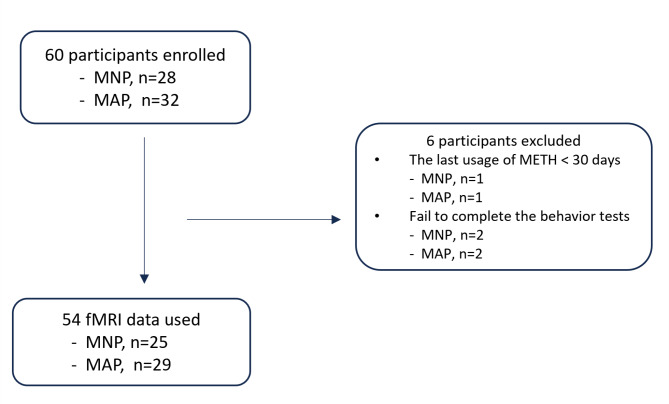
Methods: We recruited 24 healthy controls (CRL) and 54 men with METH use disorder (MUD) who were then divided into 25 without psychosis (MNP) and 29 with MAP. Psychotic symptom severity was assessed using the Positive and Negative Syndrome Scale (PANSS), evaluating (1) large-scale alterations in regional-wise resting-state functional connectivity (rsFC) across 11 brain networks and (2) associations between rsFC and psychotic symptom severity.
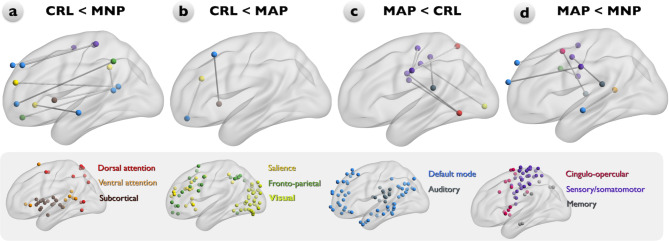
Results: The MUD group exhibited greater rsFC between the salience network (SN)-DMN, and subcortical network (SCN)-DMN compared to the CRL group. The MAP group exhibited decreased rsFC in the sensory/somatomotor network (SMN)-dorsal attention network (DAN), SMN-ventral attention network (VAN), SMN-SN, and SMN-auditory network (AN), whereas the MNP group exhibited increased rsFC in the SMN-DMN and the frontoparietal network (FPN)-DMN compared to CRL. Additionally, the MAP group exhibited decreased rsFC strength between the SMN-DMN, SMN-AN, SMN-FPN, and DMN-VAN compared to the MNP group. Furthermore, across the entire MUD group, the PANSS-Positive subscale was negatively correlated with the DMN-FPN and FPN-SMN, while the PANSS-Negative subscale was negatively correlated with the DMN-AN and SMN-SMN.
Conclusion: MUD is associated with altered global functional connectivity. In addition, the MAP group exhibits a different brain functional network compared to the MNP group.
Keywords: Brain; Functional magnetic resonance imaging (fMRI); Methamphetamine; Neurotransmitter; Psychosis.
© 2024. The Author(s).
Conflict of interest statement
Zhen-An Hwang, Ai-Ling Hsu, Changwei W. Wu, Chun-Hsin Chen, Chun-Hsin Chen, Ming-Chyi Huang, and Wing P. Chan declare no competing or potential conflicts of interest. One author, Chia-Wei Li, is an employee of GE Healthcare in Taiwan. No funding was received from GE Healthcare for publication activities.
Figures

References
-
- Panenka WJ, Procyshyn RM, Lecomte T, MacEwan GW, Flynn SW, Honer WG, Barr AM. Methamphetamine use: a comprehensive review of molecular, preclinical and clinical findings. Drug Alcohol Depend. 2013;129(3):167–79. - PubMed
-
- Huang MC, Yang SY, Lin SK, Chen KY, Chen YY, Kuo CJ, Hung YN. Risk of Cardiovascular diseases and stroke events in methamphetamine users: a 10-Year Follow-Up study. J Clin Psychiatry. 2016;77(10):1396–403. - PubMed
-
- Glasner-Edwards S, Mooney LJ, Marinelli-Casey P, Hillhouse M, Ang A, Rawson R. Methamphetamine Treatment Project Corporate A: clinical course and outcomes of methamphetamine-dependent adults with psychosis. J Subst Abuse Treat. 2008;35(4):445–50. - PubMed
Publication types
MeSH terms
Substances
Grants and funding
LinkOut - more resources
Full Text Sources
Medical
Miscellaneous
