Maternal exposure to airborne particulate matter during pregnancy and lactation induces kidney injury in rat dams and their male offspring: the role of vitamin D in pregnancy and beyond
- PMID: 39390622
- PMCID: PMC11467365
- DOI: 10.23876/j.krcp.23.106
Maternal exposure to airborne particulate matter during pregnancy and lactation induces kidney injury in rat dams and their male offspring: the role of vitamin D in pregnancy and beyond
Abstract
Background: Little is known about the transgenerational effects of maternal exposure to fine particulate matter (PM2.5) on offspring kidney health. This study investigated the effect of maternal administration of PM2.5 or PM2.5 with vitamin D during pregnancy and lactation on renal injury in rat dams and their offspring.
Methods: Nine pregnant Sprague-Dawley rats received oral administration of normal saline, airborne PM2.5, or PM2.5 with vitamin D from gestational day 11 to postpartum day 21. Kidneys of rat dams (n = 3 for each group) and their male offspring (n = 5 for each group) were taken for analysis on postpartum or postnatal day 21.
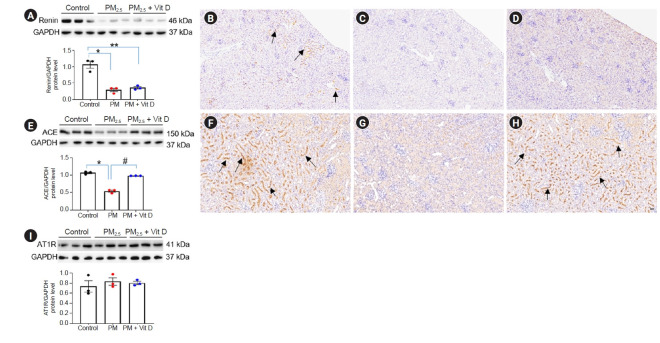
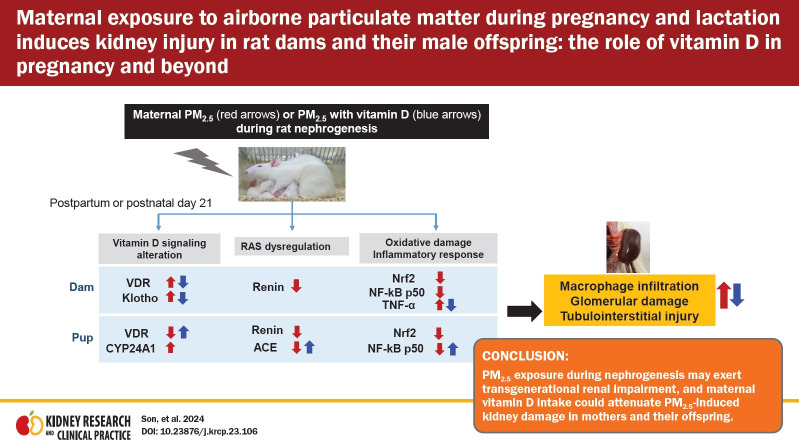
Results: Maternal PM2.5 exposure increased glomerular damage, tubulointerstitial injury, and cortical macrophage infiltration in both dams and pups; all increases were attenuated by vitamin D administration. In dam kidneys, PM2.5 increased the protein expression of vitamin D receptor (VDR), klotho, and tumor necrosis factor-α; vitamin D lessened these changes. The expressions of renin, nuclear factor erythroid 2-related factor 2 (Nrf2), and nuclear factor-kappa B (NF-κB) p50 decreased in rat dams exposed to PM2.5. In offspring kidneys, exposure to maternal PM2.5 reduced the expression of VDR, renin, angiotensin-converting enzyme (ACE), Nrf2, and NF-κB p50, but increased cytochrome P450 24A1 expression. Maternal vitamin D administration with PM2.5 enhanced VDR, ACE, and NF-κB p50 activities in pup kidneys.
Conclusion: PM2.5 exposure during nephrogenesis may exert transgenerational renal impairment, and maternal vitamin D intake could attenuate PM2.5-induced kidney damage in mothers and their offspring.
Keywords: Fetal development; Kidney diseases; Particulate matter; Renin-angiotensin system; Vitamin D.
Conflict of interest statement
All authors have no conflicts of interest to declare.
Figures




References
-
- Oh J, Ye S, Kang DH, Ha E. Association between exposure to fine particulate matter and kidney function: results from the Korea National Health and Nutrition Examination Survey. Environ Res. 2022;212:113080. - PubMed
-
- Li X, Huang S, Jiao A, et al. Association between ambient fine particulate matter and preterm birth or term low birth weight: an updated systematic review and meta-analysis. Environ Pollut. 2017;227:596–605. - PubMed
-
- Morales-Rubio RA, Alvarado-Cruz I, Manzano-León N, et al. In utero exposure to ultrafine particles promotes placental stress-induced programming of renin-angiotensin system-related elements in the offspring results in altered blood pressure in adult mice. Part Fibre Toxicol. 2019;16:7. - PMC - PubMed
Grants and funding
LinkOut - more resources
Full Text Sources
Research Materials
Miscellaneous