


Introducing LADER: A Structured Approach to Effective Professional Interactions for Behavior Analysts
- PMID: 39391201
- PMCID: PMC11461411
- DOI: 10.1007/s40617-023-00900-2
Introducing LADER: A Structured Approach to Effective Professional Interactions for Behavior Analysts
Abstract
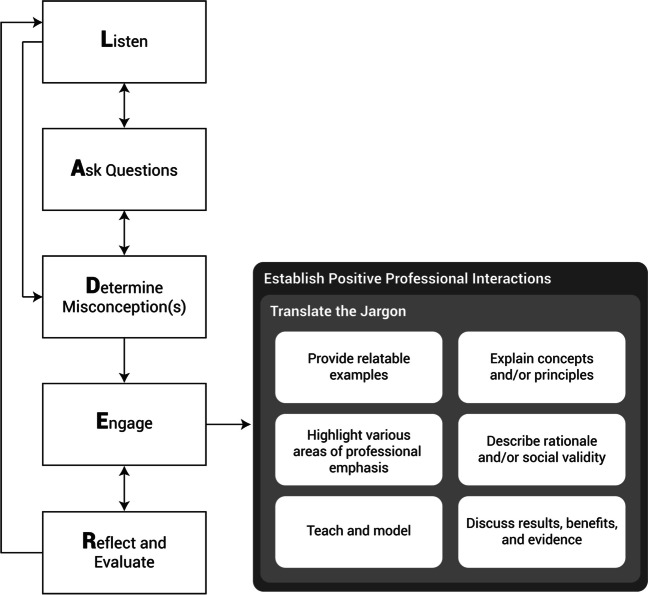
Applied behavior analysis (ABA) is a human service profession using the science of behaviorism to promote meaningful changes in the lives of clients. However, misconceptions, misunderstandings, and false information have plagued our field since its inception and challenge the efficacy of our continued dissemination efforts. Effective science communication skills, especially for fields with a highly technical language such as ABA, promote marked improvements in client outcomes. Herein we introduce LADER, a structured and scaffolded approach to effective professional interactions for behavior analysts. The five components of LADER (listen, ask questions, determine misconceptions, engage, and reflect and evaluate) support analysts in navigating complex and potentially challenging conversations with clients, caregivers, collaborative professionals, and other stakeholders. The experiences and insights of current behavior professionals, and empirical research on effective science communication, underpins the components of LADER. Following a description of LADER, a hypothetical scenario provides readers with a vignette on how to apply LADER in practice.
Keywords: Applied behavior analysis; Effective communication; Misconceptions; Professional engagement.
© Association for Behavior Analysis International 2024. Springer Nature or its licensor (e.g. a society or other partner) holds exclusive rights to this article under a publishing agreement with the author(s) or other rightsholder(s); author self-archiving of the accepted manuscript version of this article is solely governed by the terms of such publishing agreement and applicable law.
Conflict of interest statement
Conflict of InterestThe authors declare that they have no relevant financial or nonfinancial conflicts of interest to disclose.
Figures
References
-
- American Psychological Association. (2016). Ethical principles of psychologists and code of conduct. Retrieved November 1, 2023, from https://www.apa.org/ethics/code
-
- Anderson, T., McClintock, A. S., Andrew, S., Himawan, L., Song, X., & Patterson, C. L. (2016). A prospective study of therapist facilitative interpersonal skills as a predictor of treatment outcome. Journal of Consulting & Clinical Psychology,84(1), 57–66. 10.1037/ccp0000060 - PubMed
Publication types
LinkOut - more resources
Full Text Sources
