


Exploring temporal and sex-linked dysregulation in Alzheimer disease phosphoproteome
- PMID: 39391719
- PMCID: PMC11465087
- DOI: 10.1016/j.isci.2024.110941
Exploring temporal and sex-linked dysregulation in Alzheimer disease phosphoproteome
Abstract
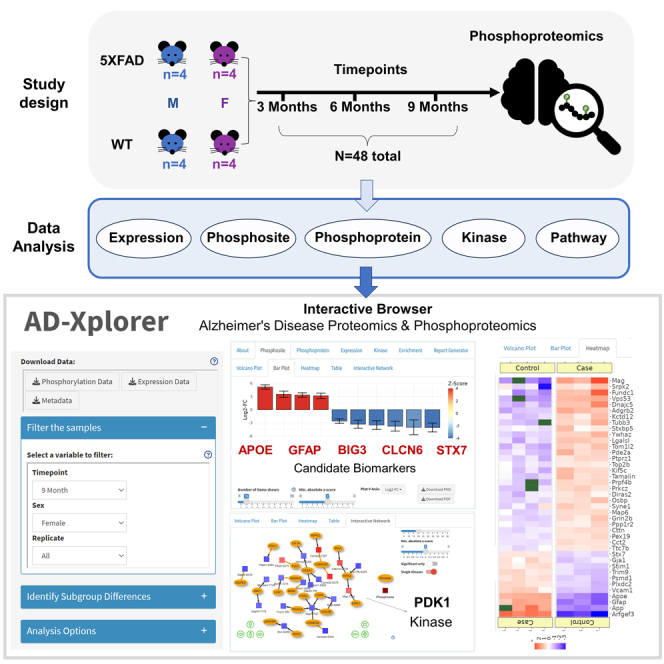
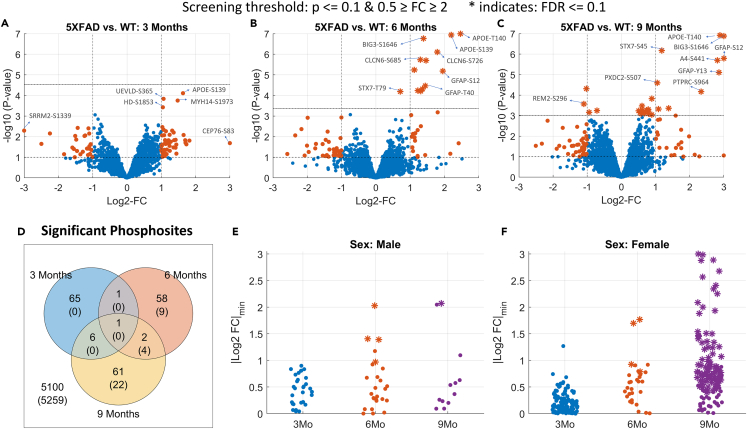
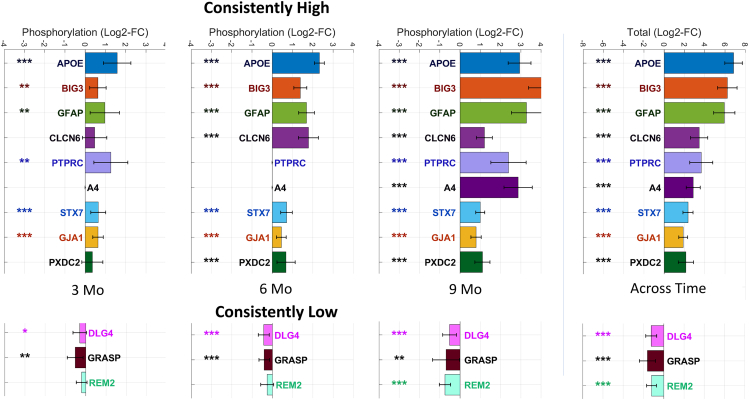
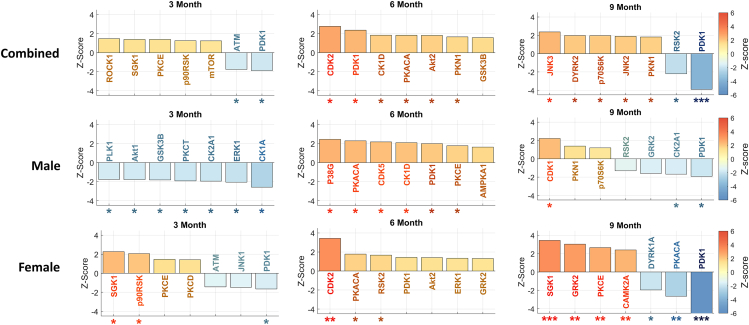
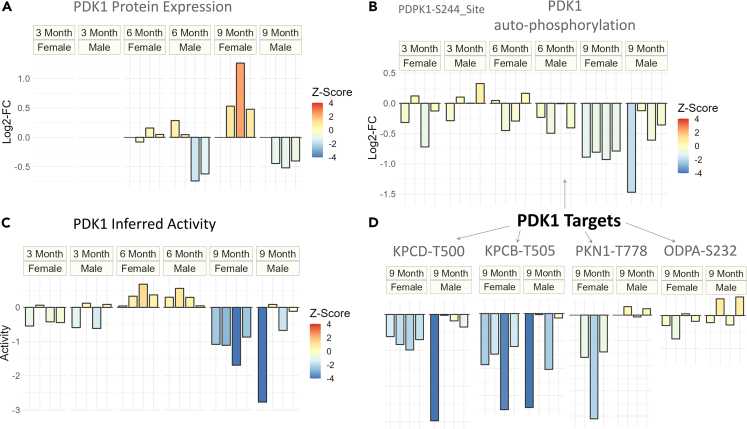
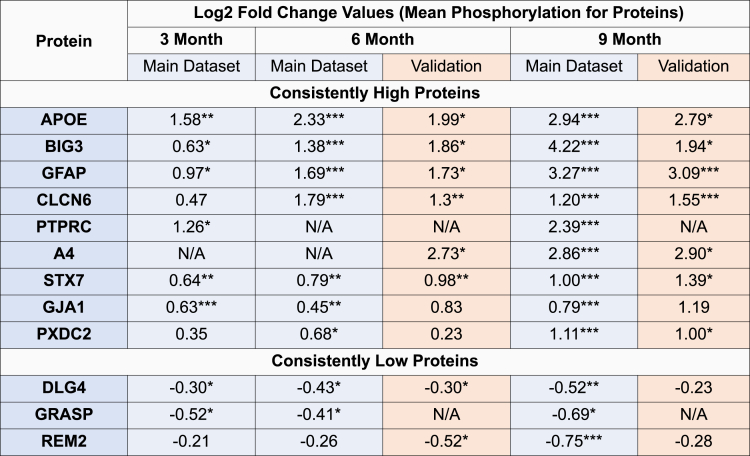
This study aims to characterize dysregulation of phosphorylation for the 5XFAD mouse model of Alzheimer disease (AD). Employing global phosphoproteome measurements, we analyze temporal (3, 6, and 9 months) and sex-dependent effects on mouse hippocampus tissue to unveil molecular signatures associated with AD initiation and progression. Our findings reveal consistent phosphorylation of known AD biomarkers APOE and GFAP in 5XFAD mice, alongside candidates BIG3, CLCN6, and STX7, suggesting their potential as biomarkers for AD pathology. In addition, we identify PDK1 as a significantly dysregulated kinase at 9 months in females, and the regulation of gap junction activity as a key pathway associated with Alzheimer disease across all time points. AD-Xplorer, the interactive browser of our dataset, enables exploration of AD-related changes in phosphorylation, protein expression, kinase activities, and pathways. AD-Xplorer aids in biomarker discovery and therapeutic target identification, emphasizing temporal and sex-specific nature of significant phosphoproteomic signatures. Available at: https://yilmazs.shinyapps.io/ADXplorer.
Keywords: Neuroscience; cell biology; molecular biology.
© 2024 The Author(s).
Conflict of interest statement
The authors declare no competing interests.
Figures
Update of
-
Exploring Temporal and Sex-Linked Dysregulation in Alzheimer's Disease Phospho-Proteome.bioRxiv [Preprint]. 2023 Aug 17:2023.08.15.553056. doi: 10.1101/2023.08.15.553056. bioRxiv. 2023. Update in: iScience. 2024 Sep 13;27(10):110941. doi: 10.1016/j.isci.2024.110941. PMID: 37645993 Free PMC article. Updated. Preprint.
References
Grants and funding
LinkOut - more resources
Full Text Sources
Molecular Biology Databases
Miscellaneous
