


Intraindividual Discordance Between Remnant Cholesterol and Low-Density Lipoprotein Cholesterol Associated With Incident Stroke: Results From 2 National Cohorts
- PMID: 39392152
- PMCID: PMC11935567
- DOI: 10.1161/JAHA.124.035764
Intraindividual Discordance Between Remnant Cholesterol and Low-Density Lipoprotein Cholesterol Associated With Incident Stroke: Results From 2 National Cohorts
Abstract
Background: The atherogenic effect of remnant cholesterol is being increasingly acknowledged. This study aimed to explore the association of discordance between remnant cholesterol and low-density lipoprotein cholesterol with stroke onset using 2 Chinese national cohorts.
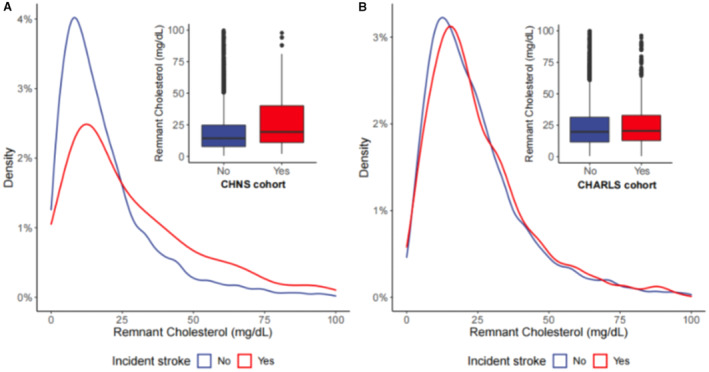
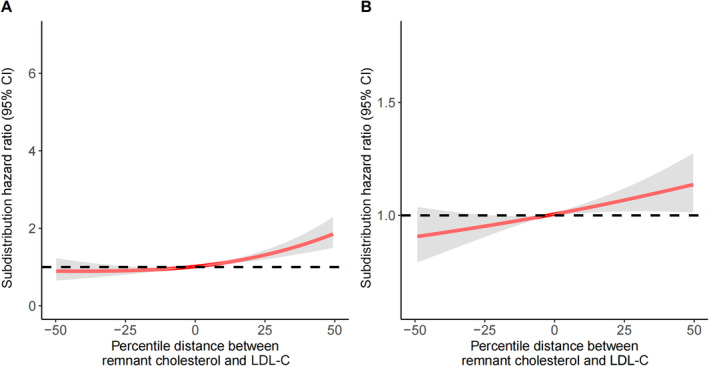
Methods and results: We studied 11 139 participants from CHARLS (China Health and Retirement Longitudinal Study) and 5993 participants from CHNS (China Health and Nutrition Survey) aged 45 years or older. The discordance between remnant cholesterol and low-density lipoprotein cholesterol was defined using the difference in percentile units (>15 units). There were 988 (8.9%) and 128 (2.1%) stroke events reported during follow-up in the 2 cohorts. Elevated remnant cholesterol was significantly associated with a higher risk of total stroke in 2 cohorts. After adjusting for remnant cholesterol level, the discordantly high remnant cholesterol group was significantly associated with an increased stroke risk (CHARLS: subdistribution hazard ratio [sHR], 1.31 [95 CI, 1.10-1.55]; CHNS: sHR, 1.84 [95 CI, 1.15-3.08]) compared with the discordantly low group. Consistent results were shown even among those with optimal low-density lipoprotein cholesterol level.
Conclusions: The discordance between remnant cholesterol and low-density lipoprotein cholesterol, representing the intraindividual discrepancy, is significantly associated with stroke onset among Chinese adults.
Keywords: LDL‐C; discordance analysis; remnant cholesterol; stroke.
Figures
References
-
- Yusuf S, Joseph P, Rangarajan S, Islam S, Mente A, Hystad P, Brauer M, Kutty VR, Gupta R, Wielgosz A, et al. Modifiable risk factors, cardiovascular disease, and mortality in 155 722 individuals from 21 high‐income, middle‐income, and low‐income countries (PURE): a prospective cohort study. Lancet. 2020;395:795–808. doi: 10.1016/S0140-6736(19)32008-2 - DOI - PMC - PubMed
-
- Goldstein LB, Adams R, Alberts MJ, Appel LJ, Brass LM, Bushnell CD, Culebras A, DeGraba TJ, Gorelick PB, Guyton JR, et al. Primary prevention of ischemic stroke: a guideline from the American Heart Association/American Stroke Association stroke council: cosponsored by the atherosclerotic peripheral vascular disease interdisciplinary working group; cardiovascular nursing council; clinical cardiology council; nutrition, physical activity, and metabolism council; and the quality of care and outcomes research interdisciplinary working group. Circulation. 2006;113:e873–e923. - PubMed
-
- Shahar E, Chambless LE, Rosamond WD, Boland LL, Ballantyne CM, McGovern PG, Sharrett AR. Plasma lipid profile and incident ischemic stroke: the atherosclerosis risk in communities (ARIC) study. Stroke. 2003;34:623–631. - PubMed
MeSH terms
Substances
LinkOut - more resources
Full Text Sources
Medical
