Self-Etching Ceramic Primer Affects Surface Topography and Roughness of Two Zirconia-Reinforced Lithium Silicate Ceramics
- PMID: 39393802
- PMCID: PMC11750331
- DOI: 10.1055/s-0044-1787283
Self-Etching Ceramic Primer Affects Surface Topography and Roughness of Two Zirconia-Reinforced Lithium Silicate Ceramics
Abstract
Objective: This article evaluates the etching efficacy of a self-etching ceramic primer (SECP) on zirconia-reinforced lithium silicate (ZLS) ceramics.
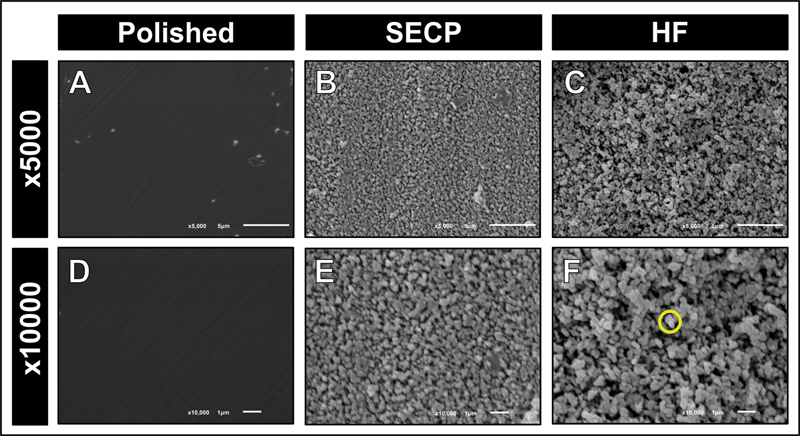
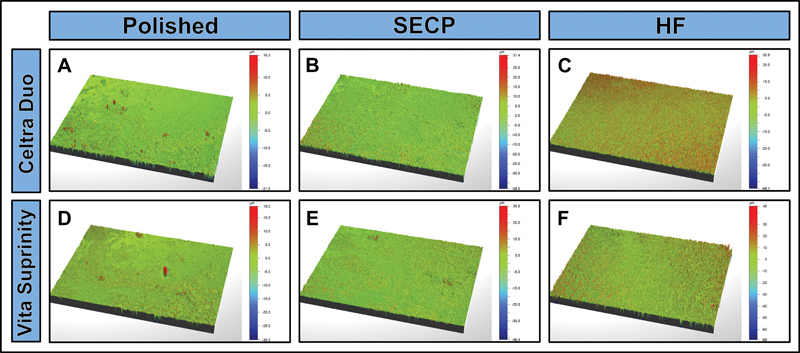
Materials and methods: Celtra Duo (DeguDent GmbH, Hanau-Wolfgang, Germany) and Vita Suprinity (Vita Zahnfabrik, Bad Säckingen, Germany) were used in this study. A total of 36 ceramic slices were prepared from each ceramic material and randomly distributed into three groups according to the surface treatment applied (n = 12 per group). Group 1 (polished) was polished with silicon carbide paper discs and did not undergo any surface treatment; group 2 (SECP) was surface treated with SECP (Monobond Etch and Prime, Ivoclar Vivadent, Schaan, Liechtenstein); group 3 (hydrofluoric acid [HF]) was surface treated with 4.7% HF etching. Half of the specimens (n = 6) from each group were gold-sputtered, and the surface topographic alterations were evaluated by scanning electron microscopy at magnifications of 5,000× and 10,000 × . The surface roughness of the other half (n = 6) from each group was tested using a three-dimensional optical profiler. Data were statistically analyzed using two-way analysis of variance and Tukey's multiple comparisons test.
Results: Both SECP and HF etching surface treatments resulted in a statistically significant increase (p < 0.05) in the surface roughness of both ceramic materials, compared to that of their respective control group specimens (polished). HF etching resulted in a significant dissolution of the glassy phase of each ceramic.
Conclusion: SECP can effectively etch ZLS ceramics. The etching patterns created after the application of SECP were mild compared to those produced by HF etching. The topographic surface features of ceramics are affected by both, surface treatment and material composition.
The Author(s). This is an open access article published by Thieme under the terms of the Creative Commons Attribution License, permitting unrestricted use, distribution, and reproduction so long as the original work is properly cited. (https://creativecommons.org/licenses/by/4.0/).
Conflict of interest statement
None declared.
Figures

References
-
- Spitznagel F A, Boldt J, Gierthmuehlen P C. CAD/CAM ceramic restorative materials for natural teeth. J Dent Res. 2018;97(10):1082–1091. - PubMed
-
- Tian T, Tsoi J K-H, Matinlinna J P, Burrow M F. Aspects of bonding between resin luting cements and glass ceramic materials. Dent Mater. 2014;30(07):e147–e162. - PubMed
-
- Politano G, Van Meerbeek B, Peumans M. Nonretentive bonded ceramic partial crowns: concept and simplified protocol for long-lasting dental restorations. J Adhes Dent. 2018;20(06):495–510. - PubMed
-
- Awad M M, Alqahtani H, Al-Mudahi A, Murayshed M S, Alrahlah A, Bhandi S H. Adhesive bonding to computer-aided design/ computer-aided manufacturing esthetic dental materials: an overview. J Contemp Dent Pract. 2017;18(07):622–626. - PubMed
Grants and funding
LinkOut - more resources
Full Text Sources
Research Materials
Miscellaneous