Review
. 2024 Oct 11;12(1):57.
doi: 10.1038/s41413-024-00374-0.

Metabolic reprogramming in skeletal cell differentiation

Affiliations
Review

Metabolic reprogramming in skeletal cell differentiation

Joshua C Bertels et al. Bone Res. .

Abstract

The human skeleton is a multifunctional organ made up of multiple cell types working in concert to maintain bone and mineral homeostasis and to perform critical mechanical and endocrine functions. From the beginning steps of chondrogenesis that prefigures most of the skeleton, to the rapid bone accrual during skeletal growth, followed by bone remodeling of the mature skeleton, cell differentiation is integral to skeletal health. While growth factors and nuclear proteins that influence skeletal cell differentiation have been extensively studied, the role of cellular metabolism is just beginning to be uncovered. Besides energy production, metabolic pathways have been shown to exert epigenetic regulation via key metabolites to influence cell fate in both cancerous and normal tissues. In this review, we will assess the role of growth factors and transcription factors in reprogramming cellular metabolism to meet the energetic and biosynthetic needs of chondrocytes, osteoblasts, or osteoclasts. We will also summarize the emerging evidence linking metabolic changes to epigenetic modifications during skeletal cell differentiation.


Conflict of interest statement

The authors declare no competing interests.

Figures

Fig. 1
Fig. 1
A diagram for glucose metabolism in mammalian cells. Core glycolysis pathway along with several side branches are depicted. The end-product of glycolysis pyruvate can enter the mitochondria to fuel cellular respiration or converted to lactate in the cytosol
Fig. 2
Fig. 2
Examples of amino acid catabolism in mammalian cells. Multiple amino acids can enter the TCA cycle via various intermediates (e.g., oxaloacetate, fumarate) but are not depicted here for simplicity
Fig. 3
Fig. 3
A diagram for long-chain fatty acid oxidation in the mitochondria. CPT1/2: carnitine palmitoyltransferase 1/2. CACT: carnitine acylcarnitine translocase
Fig. 4
Fig. 4
Depiction of metabo-epigenetic regulation. SAM: S-adenosyl methionine. SAH: S-adenosyl homocysteine. α-KG: alpha-ketoglutarate. HMT: histone methyltransferase. KDM: lysine demethylase. TET: ten-eleven translocation. SIRT: sirtuin. HDAC: histone deacetylase. HAT: histone acetyltransferase
Fig. 5
Fig. 5
A summary of major transcription factors and growth factors regulating chondrocyte differentiation and function. Information is derived from studies of chondrocytes during endochondral skeletal development. For simplicity, non-hypertrophic chondrocyte encompasses various stages before the onset of hypertrophy. Blocked arrow denotes inhibition. See text for details and references
Fig. 6
Fig. 6
Metabolic regulation of chondrocyte differentiation by transcription factors and growth factors. Blocked arrow denotes inhibition whereas pointed arrow indicates stimulation. PDK1: pyruvate dehydrogenase kinase 1. GSH: reduced glutathione. α-KG: alpha-ketoglutarate
Fig. 7
Fig. 7
Key transcription factors and growth factors regulating osteoblast differentiation and function. For simplicity, interactions between BMP and WNT or ACTIVIN signaling is not depicted (see text). Blocked arrow denotes inhibition whereas pointed arrow indicates stimulation. See text for details and references
Fig. 8
Fig. 8
Metabolic reprogramming during osteoblast differentiation by growth factors. GSH: reduced glutathione. α-KG: alpha-ketoglutarate. Dashed line denotes unknown mechanism
Fig. 9
Fig. 9
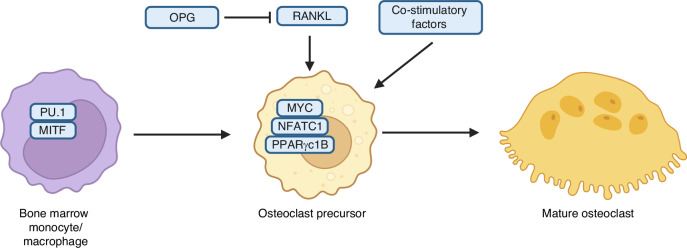
Major transcription factors and cytokines regulating osteoclast differentiation. See text for details and references
Fig. 10
Fig. 10
Metabolic reprogramming by RANKL during osteoclast differentiation. Dashed line denotes unknown mechanism

References

    1. Weber, D. R., Haynes, K., Leonard, M. B., Willi, S. M. & Denburg, M. R. Type 1 Diabetes is associated with an increased risk of fracture across the life span: a population-based cohort study using the health improvement network (THIN). Diabetes Care38, 1913–1920 (2015). - DOI - PMC - PubMed
    1. Sellmeyer, D. E. et al. Skeletal metabolism, fracture risk, and fracture outcomes in Type 1 and Type 2 Diabetes. Diabetes65, 1757–1766 (2016). - DOI - PMC - PubMed
    1. Ferrari, S. L. et al. Diagnosis and management of bone fragility in diabetes: an emerging challenge. Osteoporos. Int.29, 2585–2596 (2018). - DOI - PMC - PubMed
    1. Janghorbani, M., Feskanich, D., Willett, W. C. & Hu, F. Prospective study of diabetes and risk of hip fracture: the nurses’ health study. Diabetes Care29, 1573–1578 (2006). - DOI - PubMed
    1. Weber, D. R., Long, F., Zemel, B. S. & Kindler, J. M. Glycemic control and bone in diabetes. Curr. Osteoporos. Rep.20, 379–388 (2022). - DOI - PMC - PubMed

LinkOut - more resources