


Comparison of heart failure risk assessment tools among cancer survivors
- PMID: 39394611
- PMCID: PMC11468191
- DOI: 10.1186/s40959-024-00267-5
Comparison of heart failure risk assessment tools among cancer survivors
Abstract
Background: Cancer survivors have an increased risk of incident heart failure (HF) attributable to shared risk factors and cancer treatment-induced cardiac dysfunction. Selection for HF screening depends on risk assessment, but the optimal means of assessing risk is undefined. We undertook a comparison of HF risk calculators among survivors.
Methods: In this study from the UK Biobank, cancer and HF diagnoses were determined based on the International Classification of Diseases (ICD)-10 code and non-cancer participants were included as controls. Participants' risk of incident HF was determined using the Heart Failure Association-International Cardio-oncology Society (HFA-ICOS), the Atherosclerosis Risk in Communities (ARIC-HF) and the Pooled Cohort Equations to Prevent Heart Failure (PCP-HF). The predictive performances of each were compared using the area under the curve (AUC).
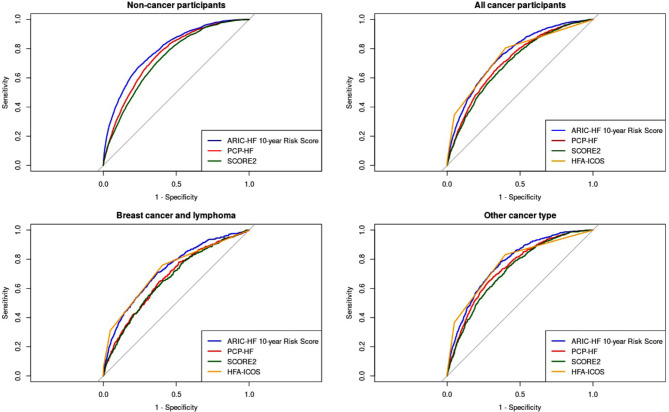
Results: After propensity matching with age and sex, 9,232 survivors from breast cancer or lymphoma (mean age 59.9 years, 87.8% female), and 23,800 survivors from other cancer types (mean age 59.1 years, 85.8% female) were included in the analysis. The discriminative value for HFA-ICOS (AUC 0.753 [95%CI: 0.739-0.766]) and ARIC-HF (0.757 [95%CI: 0.744-0.770]) were similar, and superior to PCP-HF (0.717 [95%CI: 0.702-0.732]). The overall performance for each risk score was better among participants in other cancer types than those with breast cancer and lymphoma.
Conclusions: HFA-ICOS and ARIC-HF outperformed the PCP-HF among cancer- and non-cancer cohort, although all showed modest discrimination for incident HF to be applied to clinical practice. A cancer-specific HF prediction tool could facilitate HF prevention among survivors.
Keywords: Cancer; Heart failure; Prognosis; Risk assessment.
© 2024. The Author(s).
Conflict of interest statement
The authors declare no competing interests.
Figures
References
-
- Lyon AR, Dent S, Stanway S, Earl H, Brezden-Masley C, Cohen-Solal A, Tocchetti CG, Moslehi JJ, Groarke JD, Bergler-Klein J, Khoo V, Tan LL, Anker MS, von Haehling S, Maack C, Pudil R, Barac A, Thavendiranathan P, Ky B, Neilan TG, Belenkov Y, Rosen SD, Iakobishvili Z, Sverdlov AL, Hajjar LA, Macedo AVS, Manisty C, Ciardiello F, Farmakis D, de Boer RA, Skouri H, Suter TM, Cardinale D, Witteles RM, Fradley MG, Herrmann J, Cornell RF, Wechelaker A, Mauro MJ, Milojkovic D, de Lavallade H, Ruschitzka F, Coats AJS, Seferovic PM, Chioncel O, Thum T, Bauersachs J, Andres MS, Wright DJ, López-Fernández T, Plummer C, Lenihan D. Baseline cardiovascular risk assessment in cancer patients scheduled to receive cardiotoxic cancer therapies: a position statement and new risk assessment tools from the Cardio-Oncology Study Group of the Heart Failure Association of the European Society of Cardiology in collaboration with the International Cardio-Oncology Society. Eur J Heart Fail. 2020;22:1945–60. - DOI - PMC - PubMed
Grants and funding
LinkOut - more resources
Full Text Sources
Research Materials
Miscellaneous