


Visceral to subcutaneous fat area ratio predicts early postoperative small bowel obstruction after total gastrectomy for cardia cancer
- PMID: 39394877
- PMCID: PMC11483825
- DOI: 10.1177/03000605241282077
Visceral to subcutaneous fat area ratio predicts early postoperative small bowel obstruction after total gastrectomy for cardia cancer
Abstract
Objective: We aimed to investigate the relationship between the visceral to subcutaneous fat area ratio (V/S ratio) and incidence of early postoperative small bowel obstruction (EPSBO) following total gastrectomy for cardia cancer.
Methods: We conducted a retrospective analysis among patients with cardia cancer who underwent elective total gastrectomy with esophagojejunostomy Roux-en-Y anastomosis at Nanjing Yimin Hospital between November 2019 and April 2024. Preoperative, intraoperative, and postoperative factors were meticulously monitored. The V/S ratio was calculated using computed tomography scans at the umbilical level with Slice-O-Matic software (Tomovision, Montreal, Canada). Statistical analyses included logistic regression and receiver operating characteristic (ROC) curve analysis.
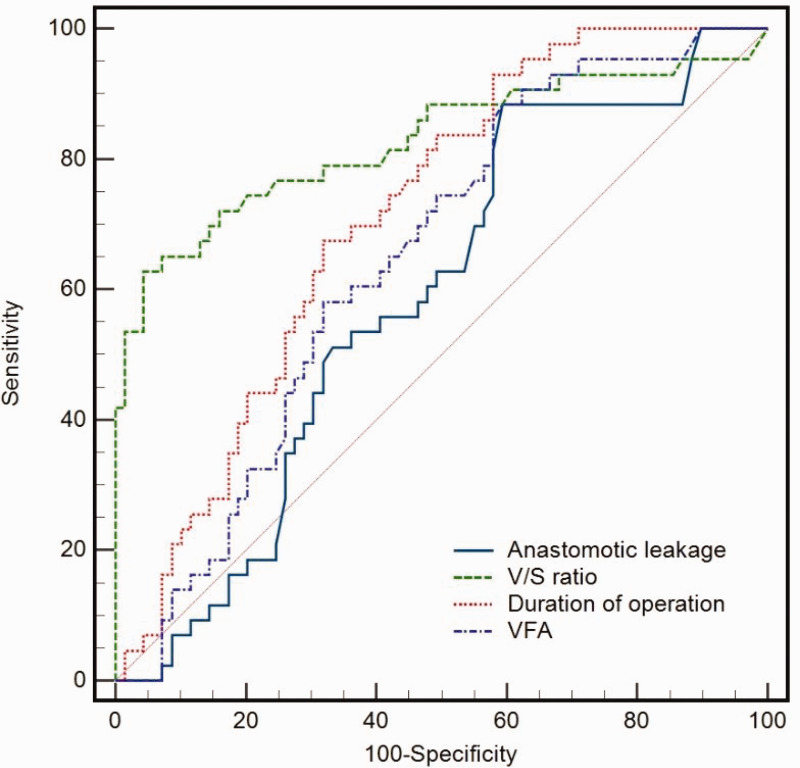
Results: Among 175 patients, 27 (15.4%) developed EPSBO. The V/S ratio was significantly higher in the EPSBO group (1.76 ± 1.05 vs. 1.01 ± 0.54). Logistic regression identified the V/S ratio as a significant predictor of EPSBO (odds ratio [OR] = 1.612, 95% [CI]: 1.102-1.605). ROC curve analysis demonstrated high sensitivity (92%) and specificity (100%) for the V/S ratio in predicting EPSBO, with a 0.83 AUC.
Conclusions: Our findings indicated a higher V/S ratio was a significant predictor of EPSBO following total gastrectomy for cardia cancer. Preoperative assessment of the V/S ratio can inform risk stratification and guide targeted interventions to improve postoperative outcomes.
Keywords: Visceral to subcutaneous fat ratio; cardia cancer; early postoperative small bowel obstruction; postoperative complication; total gastrectomy; visceral obesity.
Conflict of interest statement
Declaration of conflicting interestThe authors declare that there is no conflict of interest.
Figures
References
-
- Barmparas G, Branco BC, Schnüriger B, et al.. The incidence and risk factors of post-laparotomy adhesive small bowel obstruction. J Gastrointest Surg 2010; 14: 1619–1628. - PubMed
-
- Nishiguchi R, Katsube T, Shimakawa T, et al.. Predictive Postoperative Inflammatory Response Indicators of Infectious Complications Following Gastrectomy for Gastric Cancer. J Nippon Med Sch 2024; 91: 37–47. - PubMed
-
- Yang SY, Roh KH, Kim YN, et al.. Surgical Outcomes After Open, Laparoscopic, and Robotic Gastrectomy for Gastric Cancer. Ann Surg Oncol 2017; 24: 1770–1777. - PubMed
-
- Krielen P, Stommel MWJ, Pargmae P, et al.. Adhesion-related readmissions after open and laparoscopic surgery: a retrospective cohort study (SCAR update). Lancet 2020; 395: 33–41. - PubMed
MeSH terms
LinkOut - more resources
Full Text Sources
Medical
Research Materials
Miscellaneous
