. 2024 Oct 22;40(42):21976-21984.
doi: 10.1021/acs.langmuir.4c01684. Epub 2024 Oct 12.

Stability Assessment in Aqueous and Organic Solvents of Metal-Organic Framework PCN 333 Nanoparticles through a Combination of Physicochemical Characterization and Computational Simulations

Affiliations

Stability Assessment in Aqueous and Organic Solvents of Metal-Organic Framework PCN 333 Nanoparticles through a Combination of Physicochemical Characterization and Computational Simulations

Xiaoli Liu et al. Langmuir. .

Abstract

Mesoporous metal-organic frameworks (MOFs) have been recognized as powerful platforms for drug delivery, especially for biomolecules. Unfortunately, the application of MOFs is restricted due to their relatively poor stability in aqueous media, which is crucial for drug delivery applications. An exception is the porous coordination network (PCN)-series (e.g., PCN-333 and PCN-332), a series of MOFs with outstanding stability in aqueous media at the pH range from 3 to 9. In this study, we fabricate PCN-333 nanoparticles (nPCN) and investigate their stability in different solvents, including water, ethanol, and methanol. Surprisingly, the experimental characterizations in terms of X-ray diffraction, Brunauer-Emmett-Teller (BET), and scanning electron microscopy demonstrated that nPCN is not as stable in water as previously reported. Specifically, the crystalline structure of nPCN lost its typical octahedral shape and even decomposed into an irregular amorphous form when exposed to water for only 2 h, but not when ethanol and methanol were used. Meanwhile, the porosity of nPCN substantially diminished while being exposed to water, as demonstrated by the BET measurement. With the assistance of computational simulations, the mechanism behind the collapse of PCN-333 is illuminated. By molecular dynamics simulation and umbrella sampling, we elucidate that the degradation of PCN-333 occurs by hydrolysis, wherein polar solvent molecules initiate the attack and subsequent breakage of the metal-ligand reversible coordination bonds.


Conflict of interest statement

The authors declare no competing financial interest.

Figures
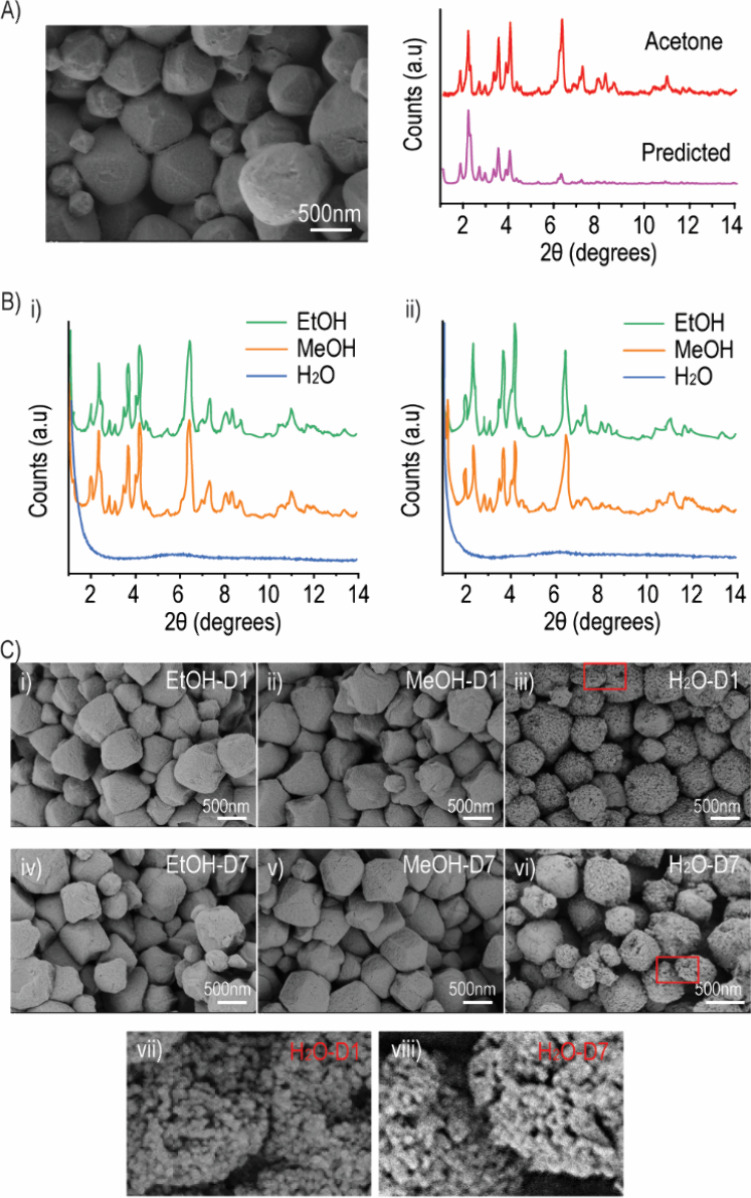
Figure 1
Figure 1
Characterization of nanosized-PCN-333(Al) (nPCN) in different solvents. (A) SEM images of nPCN and the XRD patterns as prepared and as predicted. (B) XRD patterns of nPCN after soaking in different solvents for 1 day (D1) (i) and 7 days (D7) (ii). (C) SEM images of nPCN after soaking in different solvents for D1 and D7, and the enlarged images of nPCN after soaking in water (H2O) for D1 (vii) and D7 (viii).
Figure 2
Figure 2
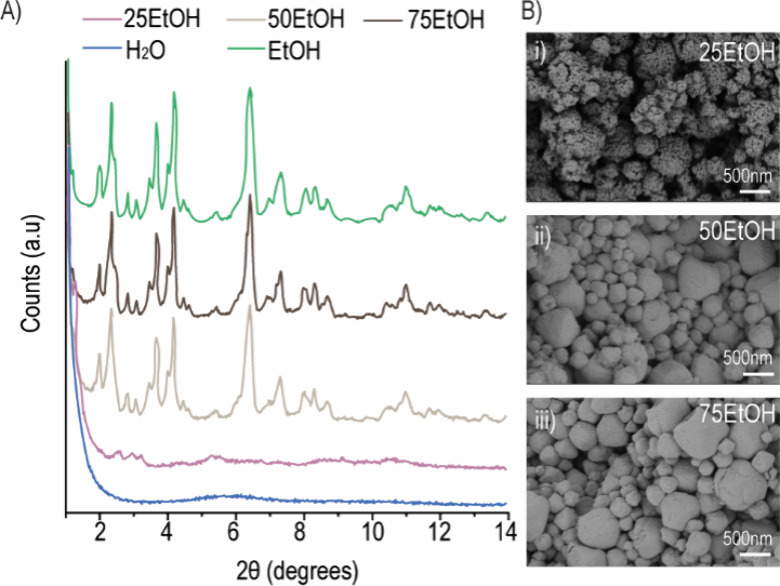
Characterization of nanosized-PCN-333(Al) (nPCN) in the mixture of EtOH and H2O for 1 day. (A) XRD patterns of nPCN after soaking in a solvent mixture of EtOH and H2O at different ratios of 25:75, 50:50, and 75:25, i.e., 25EtOH, 50EtOH, and 75EtOH, respectively. (B) SEM images of the corresponding nPCN in different solvents.
Figure 3
Figure 3
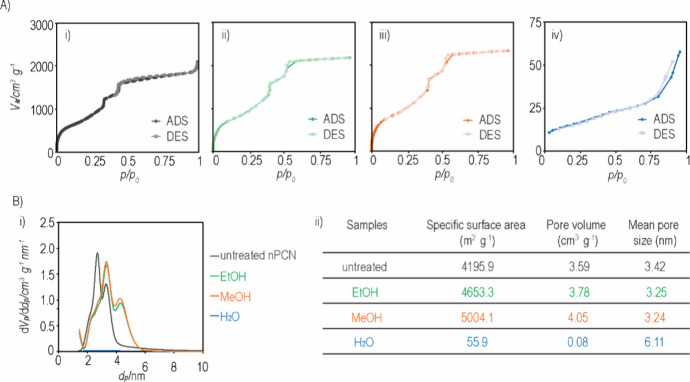
Porosity characterization of nanosized-PCN-333(Al) (nPCN) in different solvents. (A) N2 sorption isotherm of untreated nPCN (i) and after soaking in different solvents in EtOH (ii), MeOH (iii), and H2O (iv). (B) Pore size distribution (i) and porosity information (ii) of nPCN before and after soaking in different solvents.
Figure 4
Figure 4
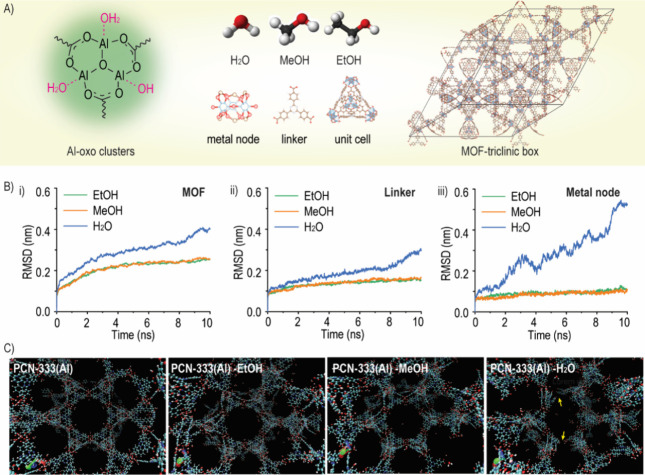
Molecular dynamics simulations of the MOF system filled with different solvents. (A) Scheme of the Al-oxo clusters, solvents, and MOF-triclinic box. (B) RMSD of the NVT simulation of the MOF structure in different solvents, including the whole simulated system of the MOF (i), linker (i.e., H3TATB) (ii), and metal node (iii). (C) Images of the original framework and those after 10 ns NVT simulation in different solvents, i.e., EtOH, MeOH, and H2O. The yellow arrows point to the broken part of the well-organized structure.
Figure 5
Figure 5
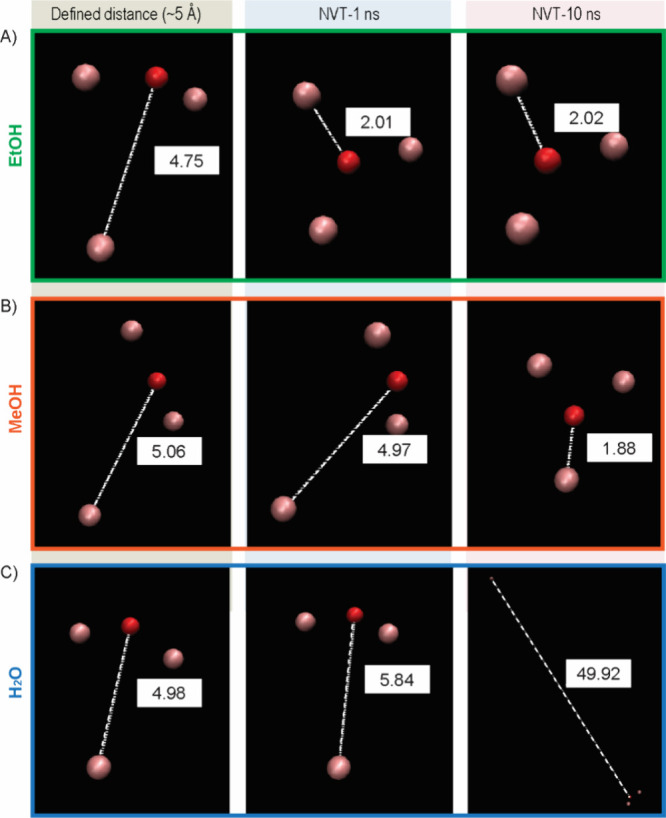
Movement of atoms that are composed of the metal node while enforcing a distance of oxo-oxygen (O) and aluminum (Al) of approximately 5 Å followed by NVT simulations after removing the distance restraint for 1 and 10 ns. The simulation box is filled with (A) EtOH, (B) MeOH, and (C) H2O. The pink spheres are Al atoms, and the red sphere is the O atom.
Figure 6
Figure 6
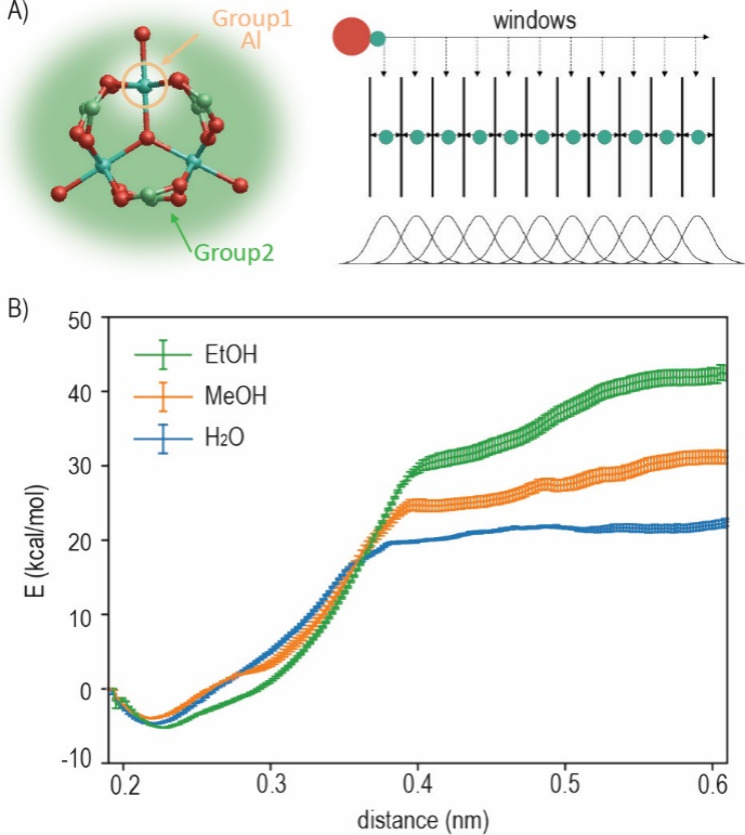
Umbrella sampling simulations of the MOF system filled with different solvents. (A) Scheme of the defined Group 1 and Group 2 for MD simulations and the mechanism of umbrella sampling simulations. (B) Potential of mean force (PMF) of PCN-333(Al) in terms of pulling one chelating metal atom (i.e., Al) away from the metal node in the presence of different solvents.

References

    1. Zhao Y.; Zeng H.; Zhu X. W.; Lu W.; Li D. Metal-Organic Frameworks as Photoluminescent Biosensing Platforms: Mechanisms and Applications. Chemical Society Reviews. 2021, 50, 4484–4513. 10.1039/D0CS00955E. - DOI - PubMed
    1. Velásquez-Hernández M. de J.; Linares-Moreau M.; Astria E.; Carraro F.; Alyami M. Z.; Khashab N. M.; Sumby C. J.; Doonan C. J.; Falcaro P. Towards Applications of Bioentities@MOFs in Biomedicine. Coord. Chem. Rev. 2021, 429, 213651 10.1016/j.ccr.2020.213651. - DOI
    1. Giliopoulos D.; Zamboulis A.; Giannakoudakis D.; Bikiaris D.; Triantafyllidis K. Polymer/Metal Organic Framework (MOF) Nanocomposites for Biomedical Applications. Molecules. 2020, 25, 185. 10.3390/molecules25010185. - DOI - PMC - PubMed
    1. Hong D. H.; Shim H. S.; Ha J.; Moon H. R. MOF-on-MOF Architectures: Applications in Separation, Catalysis, and Sensing. Bulletin of the Korean Chemical Society. 2021, 42, 956–969. 10.1002/bkcs.12335. - DOI
    1. Gao Y.-j.; Song W.; Liu J. L.; Bashir S.. Advances in Sustainable Energy: Policy, Materials and Devices; Springer International Publishing, 2021. 10.1007/978-3-030-74406-9. - DOI

LinkOut - more resources