. 2024 Oct 22;43(10):114866.
doi: 10.1016/j.celrep.2024.114866. Epub 2024 Oct 11.

LTP expression mediated by autonomous activity of GluN2B-bound CaMKII

Affiliations

LTP expression mediated by autonomous activity of GluN2B-bound CaMKII

Nicole L Rumian et al. Cell Rep. .

Abstract

Learning and memory are thought to require the induction and maintenance of long-term potentiation (LTP) of synaptic strength. LTP induction requires the Ca2+/calmodulin-dependent protein kinase II (CaMKII) but for structural rather than enzymatic functions. We show that the relevant structural function is regulated by CaMKII binding to the NMDA-type glutamate receptor subunit GluN2B. This binding directly generates Ca2+-independent autonomous CaMKII activity, and we show that this enzymatic activity is dispensable for LTP induction (within 5 min) but required for a subsequent LTP phase (within 15 min). This requirement for CaMKII activity provides an objective temporal definition for the intermediary phase of LTP expression. Later LTP maintenance may still require structural functions of GluN2B-bound CaMKII but not the resulting enzymatic CaMKII activity or their co-condensation. Thus, autonomous CaMKII activity mediates post-induction LTP but (1) via GluN2B binding, not T286 autophosphorylation, and (2) during the intermediary expression phase rather than for long-term maintenance.

Keywords: CP: Molecular biology; CP: Neuroscience; CaMKII; GluN2B; LTP expression; LTP induction; LTP maintenance; NMDAR; binding; condensation.


Conflict of interest statement

Declaration of interests The Regents of the University of Colorado have filed a patent application, with N.L.R., M.E.L., J.E.T., S.J.C., and K.U.B. in the list of inventors, that includes findings reported in this manuscript. K.U.B. is co-founder and board member of Neurexis Therapeutics, a company that seeks to develop a CaMKII inhibitor into a therapeutic drug for cerebral ischemia.

Figures

Figure 1.
Figure 1.. ATP-competitive CaMKII inhibitors enable LTP without pT286
Data show mean ± SEM. (A) LTP was assessed by the field excitatory postsynaptic potential (fEPSP) slope at the CA3 to CA1 synapse in hippocampal slices of CaMKII T286A mutant mice. LTP was stimulated by 2× HFS(2 × 1 s 100 Hz with 10 s interval) 20 min after recording of fEPSP baseline; 10 μM drug was added 15 min prior to the stimulation. The ATP-competitive inhibitors AS397 and ruxolitinib(Ruxo) rescued LTP in T286A mice when they were washed out at 5 min after HFS, as shown in a timeline of fEPSP recordings (n = 8, 8, and 6 slices for control, AS397, and Ruxo, respectively). (B) The rescue is demonstrated by the change in fEPSP slope during the last 5 min or recording (***p < 0.001 by Bonferroni’s multiple comparison test following one-way ANOVA). (C) Representative immunoblots of in vitro binding reaction of purified CaMKII to GST-GluN2Bc that was immobilized on microtiter plates, with quantification in arbitrary relative units. In this case, Ca2+/CaM in the absence of nucleotide or inhibitors (control) induced no significant binding, but significant binding was detected in the presence of 10 μM AS283, AS397, or Ruxo (one-sample t test; ***p < 0.001 and *p < 0.05). (D) Representative images and quantification of dendritic spine localization of the photoactivatable GFP-paCaMKII T286A mutant in cultured hippocampal neurons. The addition of 10 μM AS397 enabled synaptic enrichment in response to light stimulation (n = 12, 10 cells; one-sample t test; T286A p = 0.1773; T286A + AS397 p = 0.0081; **p < 0.01). Scale bar: 5 μm. (E) Photoactivation of paCaMKIIα T286A in hippocampal neuron caused a significant increase in spine area only in the presence of 10 μM AS397 application *(p < 0.05 in one sample t test; n = 10 and 12 for T286A alone and for T286A + AS397, respectively).
Figure 2.
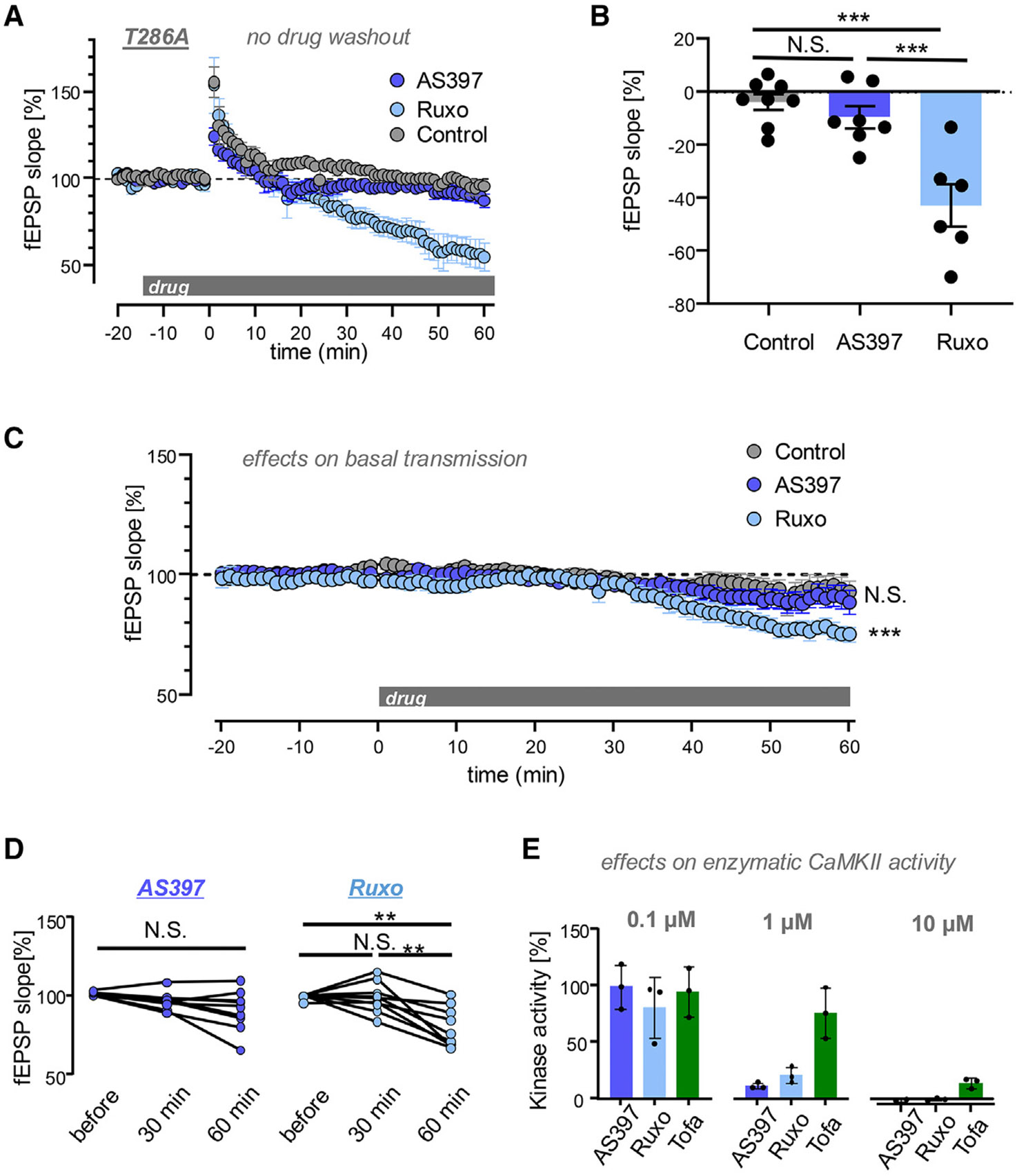
Figure 2.. The ATP-competitive CaMKII inhibitor AS397 affects LTP but not basal synaptic transmission
Strength of synaptic transmission was assessed by fEPSP slope at the CA3 to CA synapses in hippocampal slices in the presence of various drugs (10 μM). Data show mean ± SEM. (A) When the ATP-competitive inhibitors were not washed out after HFS, no rescue of LTP was seen in the T286A mice, as shown in a timeline of fEPSP recordings (n = 8, 8, and 6 slices for control, AS397, and ruxolitinib [Ruxo], respectively). (B) During the last 5 min of recording, AS397 reduced the fEPSP back to baseline, whereas Ruxo caused a further decrease below baseline (***p < 0.001 by Bonferroni’s multiple comparison test following one-way ANOVA). (C) An apparent mild decrease in basal synaptic transmission was observed in wild-type slices for Ruxo, AS397, and control without drug (n = 9 slices for each condition), but significance compared to control was reached only for Ruxo (***p < 0.001) (D) Compared to baseline before drug addition, only Ruxo, but not AS397, significantly reduced fEPSP slopes and only at 60 min, not at 30 min, after drug addition (**p < 0.01 repeated measured one-way ANOVA with Bonferroni’s post hoc analysis). (E) Biochemical assays in vitro showed that enzymatic CaMKII activity was dramatically reduced by 1 μM AS397 or Ruxo. At 10 μM, AS397 and Ruxo completely eliminated any measurable CaMKII activity, but tofacitinib (Tofa) also started to cause significant inhibition.
Figure 3.
Figure 3.. Differential effect of different classes of CaMKII inhibitors on LTP maintenance in wild-type mice
LTP was induced by 2× HFS and measured by the fEPSP slopes at the CA3 to CA synapses in hippocampal slices from wild-type (WT) mice. Drug (10 μM unless noted otherwise) was added as indicated. Data show mean ± SEM. (A) When added 1 min after LTP induction, the ATP-competitive inhibitors AS397 and ruxolitinib (Ruxo) both reduced fEPSP slopes back to baseline within 60 min (n = 7, 6, and 6 slices for control without drug, Ruxo, and AS397, respectively). (B) Significant reduction of LTP during the last 5 min of recording was observed for both AS397 and Ruxo (**p < 0.005 and ***p < 0.001 by Bonferroni multiple comparison test following one-way ANOVA). (C) When added 1 min after LTP induction, the peptide inhibitor tatCN21 (5 μM), but not the CaM-competitive inhibitor KN93, reduced fEPSP slopes back to baseline within 60 min (n = 6 for KN93 and tatCN21). (D) During the last 5 min of recordings, only tatCN21, but not KN93, caused a significant reduction of fEPSP slope compared to the no-drug control, as also shown in the other images, and tatCN21 also caused significant reduction compared to KN93 (***p < 0.001 and *p < 0.05 by one-way ANOVA followed by Bonferroni multiple comparison test). (E) The effect of different inhibitors (10 μM) on the autonomous activity of GluN2B-bound CaMKII was tested in vitro as illustrated in the schematic on the right. CaMKII binding was induced by Ca2+/CaM, which was then washed out before measuring the Ca2+/CaM-independent autonomous activity of the bound kinase. Negative control (−) contained no kinase and positive control (+) no inhibitor. All ATP-competitive inhibitors (AS105, AS283, and AS397) and tatCN21 completely blocked activity. KN93 had no effect on activity, and AIP reduced activity but did not block it completely. (F) When added 15 min after LTP induction, the ATP-competitive inhibitor AS397 had no apparent effect on LTP maintenance (n = 8 slices). (G) During the last 5 min of recording, addition of ATP at 15 min after LTP induction had no significant effect on fEPSP slope compared to the control without the drug, which is also shown in the other images.
Figure 4.
Figure 4.. Probing the role of CaMKII/GluN2B binding versus co-condensation in LTP
Data show mean ± SEM. (A) In slices from mice with the GluN2BΔCaMKII mutant that prevents CaMKII binding to GluN2B, neither 5 μM tatCN21 nor 10 μM KN93 (two CaMKII inhibitors that block LTP induction in wild-type mice) reduced LTP compared to control without drug (n = 9,8, and 7 slices for control, tatCN21, and KN93, respectively), showing that the LTP seen in the mutant mice was enabled by compensatory mechanisms and different from LTP in wild type. Drug was added 15 min before and washed out 5 min after LTP induction, as indicated. LTP was induced by 2× HFS and measured by the fEPSP slopes at the CA3 to CA synapses. (B) During the last 5 min of recording, no statistical difference was detected in the fEPSP slopes in the tatCN21, KN93, or control condition (one-way ANOVA). (C) Co-condensation of CaMKII wild type with the cytoplasmic C-tail of GluN2B in HEK cells is triggered by a Ca2+ stimulus with ionomycin and then maintained after chelating Ca2+ with EGTA (even if at a reduced level). For a CaMKII T286A mutant, Ca2+ triggers at least as much co-condensation, but these condensates are then fully reversed after chelating Ca2+ with EGTA. Scale bar: 10 μm.
Figure 5.
Figure 5.. Illustration of CaMKII structural and enzymatic functions in the phases of LTP
(1) Enzymatic CaMKII activity is not required for LTP induction within the first 5 min of stimulation. The structural CaMKII function that is required instead is regulated binding to GluN2B, which primes CaMKII for localized Ca2+-independent autonomous activity. The CaMKII autophosphorylation at T286 (indicted by arrows within the holoenzyme) aids in this binding step but is not required subsequently. (2) The autonomous enzymatic activity of GluN2B-bound CaMKII mediates LTP expression within the first 15 min. During LTP expression, CaMKII phosphorylates SynGAP to remove it from the synapse to allow accumulation of TARPs and, thereby, AMPARs. Additionally, direct phosphorylation of TARPs may further promote AMPAR trapping during LTP expression. (3) Beyond 15 min, the structural functions of GluN2B-bound CaMKII may continue to promote LTP maintenance, but the enzymatic activity is no longer required.

References

    1. Lisman J, Schulman H, and Cline H (2002). The molecular basis of CaMKII function in synaptic and behavioural memory.. Nat. Rev. Neurosci 3, 175–190. 10.1038/nrn753. - DOI - PubMed
    1. Lisman J, Yasuda R, and Raghavachari S (2012). Mechanisms of CaMKII action in long-term potentiation. Nat. Rev. Neurosci 13, 169–182. 10.1038/nrn3192. - DOI - PMC - PubMed
    1. Bayer KU, and Schulman H (2019). CaM Kinase: Still Inspiring at 40. Neuron 103, 380–394. 10.1016/j.neuron.2019.05.033. - DOI - PMC - PubMed
    1. Coultrap SJ, and Bayer KU (2012). CaMKII regulation in information processing and storage. Trends Neurosci. 35, 607–618. 10.1016/j.tins.2012.05.003. - DOI - PMC - PubMed
    1. Yasuda R, Hayashi Y, and Hell JW (2022). CaMKII: a central molecular organizer of synaptic plasticity, learning and memory. Nat. Rev. Neurosci 23, 666–682. 10.1038/s41583-022-00624-2. - DOI - PubMed

Publication types

Substances

LinkOut - more resources