


Comparing the effects of Swiss-ball training and virtual reality training on balance, mobility, and cortical activation in individuals with chronic stroke: study protocol for a multi-center randomized controlled trial
- PMID: 39396963
- PMCID: PMC11472495
- DOI: 10.1186/s13063-024-08532-9
Comparing the effects of Swiss-ball training and virtual reality training on balance, mobility, and cortical activation in individuals with chronic stroke: study protocol for a multi-center randomized controlled trial
Erratum in
-
Correction: Comparing the effects of Swiss-ball training and virtual reality training on balance, mobility, and cortical activation in individuals with chronic stroke: study protocol for a multi-center randomized controlled trial.Trials. 2024 Oct 28;25(1):724. doi: 10.1186/s13063-024-08575-y. Trials. 2024. PMID: 39468656 Free PMC article. No abstract available.
Abstract
Background: Balance and mobility deficits are major concerns in stroke rehabilitation. Virtual reality (VR) training and Swiss-ball training are commonly used approaches to improve balance and mobility. However, no study has compared the efficacy of VR training, Swiss-ball training, and their combination in improving balance and mobility function or investigated cortical activation and connectivity in individuals with stroke.
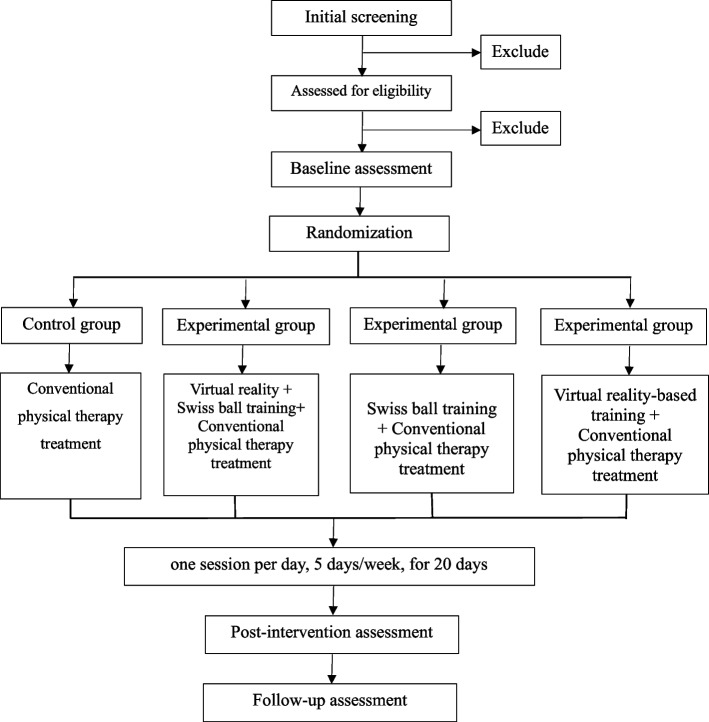
Methods: A prospective, single-blinded, parallel-armed, multi-center randomized controlled trial with factorial design will be conducted. Seventy-six participants aged 30-80 years with stroke will be recruited. Participants will be allocated to one of the four groups: (A) the VR training + Swiss-ball training + conventional physical therapy group; (B) the Swiss-ball training + conventional physical therapy group; (C) the VR training + conventional physical therapy group; or (D) the conventional physical therapy group. All participants will receive 50 min of training per day, 5 times per week, for a total of 4 weeks. The primary outcomes will be balance and mobility measures. Secondary outcomes will include the 10-min walk test, dynamic gait index, and cortical activation. Outcomes will be measured on three occasions: at baseline, after the training, and at the 4-week follow-up.
Discussion: This trial will provide evidence to determine whether there are differences in clinical outcomes and cortical activation following two different types of exercise programs and their combination, and to elucidate the recovery mechanisms of balance and mobility function in individuals with stroke.
Trial registration: Chinese Clinical Trial Registry reference: www.chictr.org.cn (No. ChiCTR2400082135). Registered on May 24, 2024.
Keywords: Balance; Clinical trial; Cortical activation; Mobility; RCT; Stroke; Study protocol.
© 2024. The Author(s).
Conflict of interest statement
All the authors have no competing interests.
Figures
References
-
- Suwaryo PAW, Ristanto R, Waladani B, Siwi AS. Swiss ball exercise post-stroke with hemiparesis to improve mobility: a randomised controlled trial. Med J Malaysia. 2023;78(4):508–10. - PubMed
Publication types
MeSH terms
Grants and funding
LinkOut - more resources
Full Text Sources
Medical
