Breeding zebra finches prioritize reproductive bout over self-maintenance under food restriction
- PMID: 39400300
- PMCID: PMC11556311
- DOI: 10.1242/bio.060417
Breeding zebra finches prioritize reproductive bout over self-maintenance under food restriction
Abstract
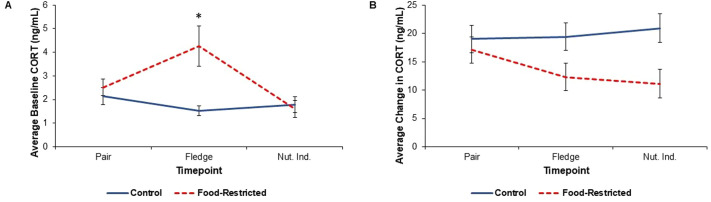
Reproduction requires high amounts of energy, and challenging environments during breeding can force parents to prioritize their current reproductive bout over self-maintenance or vice versa. However, little is known about how common stressors, such as food restriction, can influence these trade-offs during breeding, and the physiological mechanisms for these trade-off decisions. In this study, adult zebra finches (Taeniopygia castanotis) were subjected to a control diet (ad libitum) or a 40% food restriction while raising nestlings and fledglings, and we measured body mass, furculum fat, plasma corticosterone (CORT) and blood glucose levels of the parents at the time of pairing, when their offspring fledged, and when their offspring reached nutritional independence. We also measured body mass and growth rate in the offspring from hatching until the end of the treatment period. Food-restricted parents had lower body mass when their offspring fledged and reached nutritional independence and higher baseline CORT when their offspring fledged compared to controls. Offspring did not differ in body mass or growth rate between treatment groups. However, there was no effect of food restriction on parents' furculum fat, baseline glucose, the adrenocortical response, or the glucose response. Furthermore, path analysis results suggest that alterations in baseline glucose is the primary driver of changes in body mass in parents and offspring brood mass. Taken together, these results suggest that food restriction during chick rearing in a short-lived passerine drives parents to prioritize their current reproductive bout over self-maintenance, and glucose could potentially be a mechanism for diverting energy toward parental effort.
Keywords: Corticosterone; Glucose; Nutritional stress; Reproduction; Songbirds; Stress.
© 2024. Published by The Company of Biologists Ltd.
Conflict of interest statement
Competing interests The authors declare no competing or financial interests.
Figures



References
-
- Breuner, C. W. (1998). The avian stress response: Corticosterone and behaviour in a wild, seasonal vertebrate. PhD thesis, University of Washington, Seattle, WA.
-
- Christensen, R. (2023). Ordinal – Regression Models for Ordinal Data. R package version 2023. 12-4.1. https://CRAN.R-project.org/package=ordinal.
Publication types
MeSH terms
Substances
Grants and funding
LinkOut - more resources
Full Text Sources